
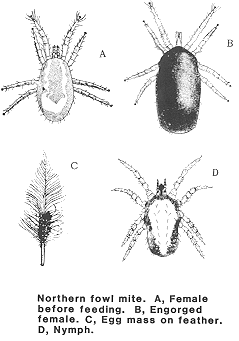
One of the most common problems encountered when raising and keeping poultry is mites. They can be introduced by wild birds or visiting rodents, or get picked up when your birds get into contact with other, infested, birds at places such as poultry shows, sales or auctions. There are several kinds of mites that will infest your birds. Infestations can cause a reduction in egg laying, pale combs and wattles, anemia and in extreme cases, or with very young birds, death. Infestations also cause feather loss, usually on the back, because the chicken will usually over preen and pull out her feathers in an effort to get relief. Sometimes the chicken's skin will be irritated and red.
Northern Fowl mites and Chicken mites (Red Roost mite) are the most common. Red mites tend to be nocturnal and will suck blood from the chicken while it sleeps, then hide in cracks and crevices in the coop during the day. They are very small, and initially yellow/grey in colour, but will darken as they feed. Removing the chicken mite is most effectively directed at the coop than the birds themselves. Northern fowl mites are the most aggressive. They live on the bird itself and will feed round the clock. If you examine the bird you will see very small red/brown insects and discolouration of the feathers due to the eggs and waste of the mite. Controlling this mite requires that the treatment be directed at the bird. Both of these forms of mites suck blood. If left untreated, this results in weakening, loss of appetite, emaciation, lowered egg production, lethargy and eventually death. The Scaly Leg Mite is a concern as well. This creature will manifest on the scales of the legs and feet. What you'll see is the lifting of the scales, and separation from the skin of the leg underneath. The legs and feet may become swollen, tender and have a discharge or exudate forming under the scales.
Lice
Like mites, poultry lice are ectoparasites that infest the skins and feathers of birds. Lice are tiny, wingless insects ranging from 1/25 of an inch to 1/4 inch long and are normally either straw coloured or yellow-brown. There are a number of different species of lice and one bird may host up to 15 different species at the same time. Each region will have variations in which strain is the most predominate and in general lice populations tend to peak on poultry farms during the autumn and winter months. Lice are generally host specific and and spend their entire life on one host. Bird or chicken lice won't infect humans or other animals, but are highly contagious between birds. If one of your birds have lice, chances are the rest of the flock will be infested as well.
Lice lay their eggs deep in the feather shafts of their hosts where they are inaccessible to their preening. They have chewing mouthparts, which differs from the sucking mouthparts of a mite. You can see a louse as it moves on the skin by parting the feathers, especially at the head, under the wings and around the vent. Lice do not suck blood. They feed on dry skin scales and feathers. They cause irritation by the act of movement on the skin of the bird and the action of the mouth. This, while not as direct a loss to the bird, will cause appetite loss and the resulting weakness, lowered egg production and susceptibility to illness.
Treatment
Treatment for all of the above pests must be undertaken to prevent loss. There are many different products and treatments on the market that have been effective for this. Products such as Sevin dust have been used effectively on both coops and directly on the birds. This is a Carbaryl based insecticide that will directly kill the existing mites. Re-treatment is usually necessary due to the eggs that will hatch and reinfest the birds and coop. Orange Guard is an effective organic non-toxic treatment for the coop itself, but cannot be used directly on the birds. All will respond to pour-on medications, such as Eprinex. Though there are some more natural treatments available, with a heavy infection chemicals have proved to be the most effective. In addition to the above scaly leg mites can be treated with a direct contact treatment. Petrolatum jelly, vegetable, mineral, linseed oil are effective when directly applied to the legs and repeated every two days till scales are smooth again. Adding 1 part kerosene to two parts oil has been noted to be effective as well.
Prevention
Preventing a mite and louse infestation is difficult. Early detection remains the best way to control these pests. Keep the coops and bedding clean and fresh, periodically scrub the coop and nesting boxes with soap and water, dust the coop, bedding and your flock as a preventative measure now and then and regularly inspect your flock to catch the problem before harm is done to the chickens.
Reference credit and thanks to :
University of Nebraska-Lincoln
Kansas State University
Graphic at top: North Carolina Pest Management Information
Learn how to protect your flock from Chicken Pests


