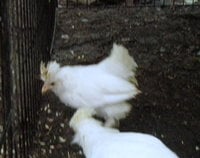
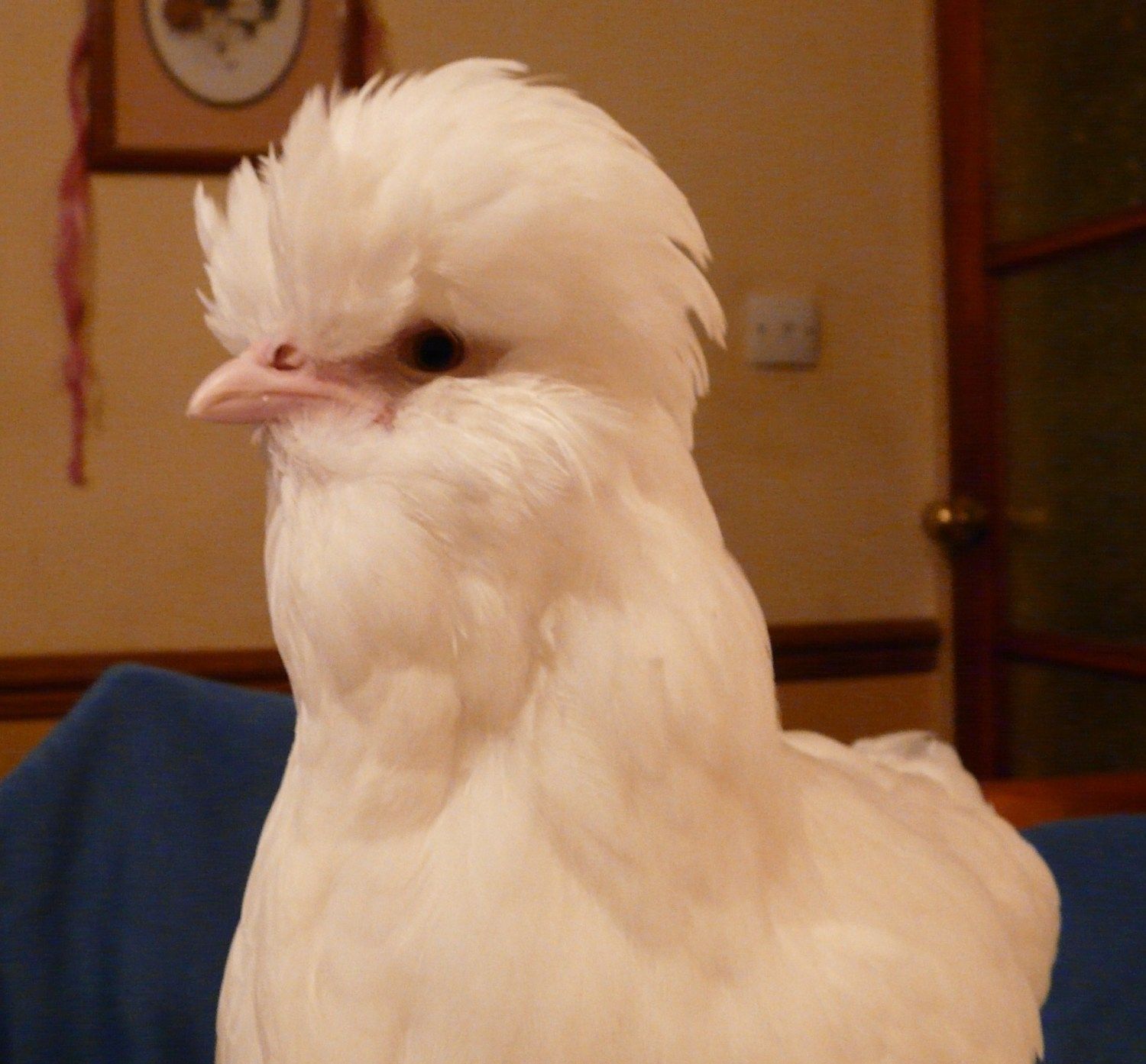
My first Sultans were a complete surprise to me.
Well, not a complete surprise. They looked like Sultans, white with crest, muffs, vulture hocks, five toes, and feathered legs and feet. I had heard that the boys were about 6 pounds, the girls were about 4 pounds, and that was true of my two pairs. I had also heard that they laid a medium-to-large size egg, and that was true of my two hens.
But then, all of the rest of what I heard was shattered.
"Non-setters"--oh, so not true! The very first time I left eggs in overnight, that was enough to set one of the hens to...setting. I removed one pair of Sultans from the cage and gave them alternate housing, and that second hen continued to lay in her new cage. I left one roo with the first hen. After 25 days, I candled the eggs under the first hen. All were fertile, but all had died part-way through the hatching period, probably due to a couple of our Missouri early-March rain-and-freeze cycles. I took five Crevecoeur chicks who had hatched a few days earlier in my incubator and tucked them under the Sultan hen that night, removing her other eggs. The Sultan hen started talking to the Crevecoeur chicks immediately, and they responded. In the morning, I stood anxiously by the cage as dawn broke, and discovered that the Sultan roo was already coaxing the Crevecoeur chicks to food and water. The Crevecoeur chicks were fully adopted and raised by both Sultan rooster and hen. This pair of Sultans raised these chicks, and went on to raise another brood of four of their own in the same year. When I left eggs for the other Sultan pair, they quickly brooded and raised their own family.
Not good foragers...? I submit a YouTube video of the first Sultan hen in question with four chicks plowing up the barnyard in search of stuff I probably don't even want to know about (though I did recognize some mealworms and earthworms:
In foraging ability, I would rate Sultans more in the "rototiller" than in the "non-garden-damaging" category.
Since then, I am on my fifth generation of Sultans. The roos are great fathers, the hens are wonderful brooders (given the right housing, which I didn't give them the first time around) and mothers. It has been disconcerting to see how the Sultans sometimes will start a family in the late fall, yet they are good parents, and have not lost a chick yet, despite the cold.
Their laying pattern is typical of setters, about 8-12 days of laying, two weeks or so of not laying, then repeat, if they are not setting. This continues all year long, if you collect the eggs. If you forget to collect the eggs, then it's off to the brooding/hatching phase!
My Sultans typically talk to one another almost constantly. I listen in to these musical conversations as I work in the yard. Sometimes, if I am close to or actually in their coop, my Sultans talk to me. The roosters and hens have never shown any indication of ill will toward me or any other human I have in tow. But we are careful not to get between them and their mates or chicks.
I have to say, Sultans are a rare breed, and the individuals I have may not be typical of the breed. However, you will want to note that, as a rare breed, individual Sultans that anyone has may not be typical of the breed. Also, chickens are flock animals, and if you only have one, and you (as far as they can tell) are the only other member of their flock, then they may not behave in a breed-typical way.
In my experience, Sultans are a great bird for anyone who wants to raise their own birds, and have eggs, too! We haven't eaten any of ours, although I understand that they are good eating. For us, it doesn't make sense to eat them because we can sell them at a much higher price than it costs for us to buy a chicken dinner. But we do eat some of the eggs.