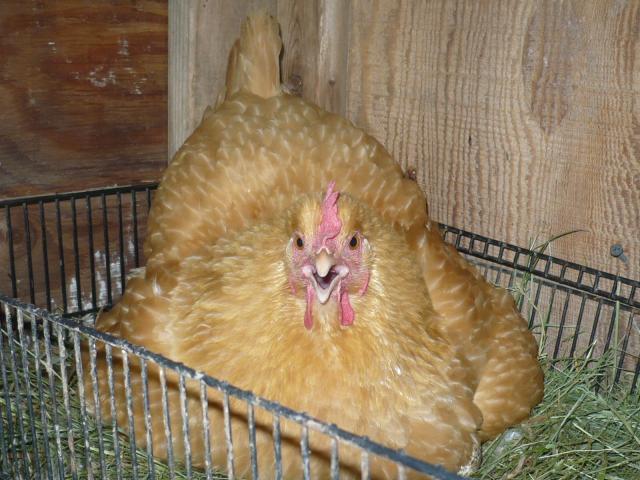
For our broody hens, I built a bunch of small cages: 2 foot square for the medium-sized birds, and a measly 18"X18"X36" for the banties. That's big enough for one of our nest boxes at one end, and food and water at the other (I just use a Mason jar chick feeder and waterer). For added privacy, I split a paper feed sack and tie it over the end with the box. Generally I will get a box all ready, then move the hen in there at night. That first night, I either give her eggs I don't care about, or fake eggs. I'll check on her during the day for the next couple of days. If she is consistently sitting tightly, then I give her the eggs I want her to hatch.
It makes a huge difference to move the hen at night. If you can move her in the nest box that she's chosen, that's ideal, but not always practical; if you place her in the new nest with fake eggs in it, chances are she will settle down on them. Having the new nest box resemble the old one can help too; I have a bunch of nest boxes that I made out of cat litter tubs, and I use those (nearly all of my broodies are banties anyway).
One thing that's important about moving a broody: if she doesn't feel safe in her new environment, she won't stay on the nest. I had to learn the hard way that even giving the hen a box facing a different direction than the one she had chosen could be enough to make her reject the nest. Also, the broody box needs to be in a place that doesn't get bright light (dim places feel "safe" to the hen). Generally I keep the broody boxes inside the main coop: I put them on the roof of the "nursery" (which is 4 feet tall) and that gives them some privacy from the rest of the flock, while also giving them a little better air flow than they would get on the floor.
Regarding temperature: hmm, tricky. You could try constructing a double-walled nest box out of cardboard boxes with straw stuffed in between the layers. I did that for pigeons, and it worked well. Make sure the nest box has a roof, so she doesn't lose body heat out the top. And it might be a little challenging to make sure she doesn't get too hot during the day, if the temperature rises above 70 degrees. Putting her in a dog crate will help cut down on drafts, so that's good. You'll want to put shavings or something absorbent and easily removed on the floor of the crate, because when she comes off the nest to poop, it will be super nasty stuff.
Good luck!


 I bought BO's and silkies hoping to get a broody so I can hatch some eggs, and I'm hoping she decided she didn't want to be left out on mother's day and now she wants to be a momma. How long should I wait to make sure she is broody before I get eggs to put under her? I don't have a rooster so she is sitting on a couple of golf balls and I think there are a few unfertilized eggs under her, she won't let me get close enough to check.