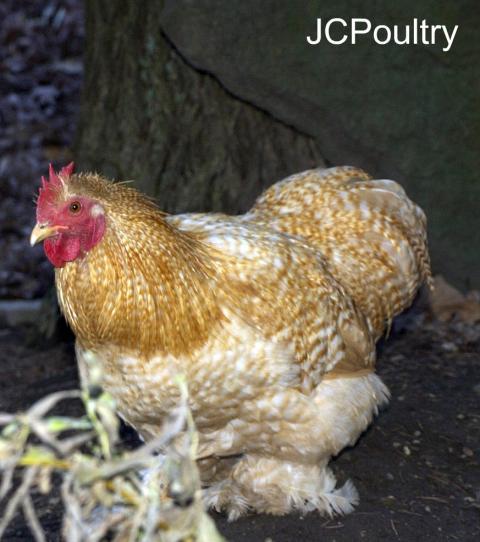
Buff Barred Project Bantam Cochin Trio

RhodeRunner

Songster
11 Years
Joined
Feb 22, 2009
Messages
1,548
Reaction score
183
Points
231
Location
Ashtabula, Ohio
Local Pick Up at 15046 PA (Around 30 min from Pittsburgh and Ohio) No shipping.

Cockerel is fully buff barred without black. He hatched this summer and is around 4 months of age.

Pullets are solid buff, and around 4 months of age. The father is barred (top photo), and mother was pure buff as well. We had approximately 50% pullets hatch barred (25% of this 50% looked more like buff mottled) and the other 50% were buff. All roosters hatched have been buff barred in this generation.

These are our last Buff Barreds, as we are selling all our Cochins. More information and pictures at our website jcpoultry.com

23433_keven.jpg

23433_buffpullets.jpg
 
Last edited:
Oh how I wish you could ship. You wouldn't consider advising me on steps I need to take to start this color project myself would you? I don't know much about color genetics but would love to try to get this color in large fowl Cochins. Beautiful birds!

Blessings to ya!
 
Quote:
Barred is a dominant gene so in buff barred if you cant see it it doesnt have it.
 
Quote:
Barred is a dominant gene so in buff barred if you cant see it it doesnt have it.

I'm new to genetics so please excuse/correct me. However, from my understanding Barring is Sex-Linkable. In the first generation of Barred Roo X Non Barred Hen all the male offspring would be barred. All female offspring wouldn't be barred, but they would carry it recessively.

In the F2 Sex-Linked Dominate/Recessive Generation then males would once again be barred, and so would half the females. The other half of the females would once again carry the trait recessively(single dose). Which is the result of what occurred with my females. 1/2 buff, 1/2 barring/white mottled.

If my rooster wasn't double dose barred, then it would be possible that a certain percentage of the hens wouldn't carry the gene. If I was to say that my females didn't carry it recessively(single-dose) then it wouldn't really make sense how some of the offspring that is female would be barred.
 
Last edited:
Very pretty! I have seen the barred LF buff orpington and the females don't look barred (even when they are) so I think it would be hard to tell either way on the girls. The barring gene is dominant (not recessive) and sex-linked, so the male can be either double or single-barred, and the females either have 1 barring gene or not (without having a 2nd gene for barring or not, if that makes sense. So even a single-barred male will still produce 1/2 barred offspring (25% barred female, 25% single-barred male, 25% unbarred male, 25% unbarred female). With a double-barred male, all of his offspring would be barred (males just single barred though unless he was bred to a barred female). So, basically, with the barring gene, you really only need 1 male that is barred (as it obviously is) and it could be paired with either barred or non-barred hens and still produce 50-100% barred female chicks (though it would be hard to tell which are barred since it's very subtle).

edited to add: I wasted a lot of money trying to get eggs that didn't make it in the mail of this particular breed, so I would definitely recommend people buy these birds instead of trying to get hatching eggs if you're close enough to drive to PA! (not saying it was anything to do with the breeders I bought eggs from, but the post office is horrible, it seems especially with expensive eggs!)
 
Last edited:
Quote:
Interesting, and thank you. I have been using the word recessive instead of single-dose, but single-dose hens would be much more appropriate. You can visually tell if a hen is buff barred, but it isn't nearly as crisp of a color as the rooster. All of my roosters produced by my breeding (around 40 chicks) have been barred. All the hens have been 50% barred (25% of the female barreds look mottled instead of barred) and 50% buff.
 
Last edited:
Quote:
Interesting, and thank you. I have been using the word recessive instead of single-dose, but single-dose hens would be much more appropriate. You can visually tell if a hen is buff barred, but it isn't nearly as crisp of a color as the rooster. All of my roosters produced by my breeding (around 40 chicks) have been barred. All the hens have been 50% barred (25% of the female barreds look mottled instead of barred) and 50% buff.

Hens only have one dose, its a sex linked gene, so all they can be is single dose.
 

New posts New threads Active threads

Back
Top Bottom