I hope it's okay to post this here, but for anyone who's getting their first chicks this (
http://jackshenhouse.com/VSChickHensBroodiesChicks.htm ) is one of the resources I used in raising mine this year. In fact, the lady who runs this website is one of the reasons I got them in the first place! She is a teacher and every spring she runs something called Chickam which is a live webcam feed of eggs in the incubator, then hatching, then the chicks growing up, and then finally transitioning to the outside. I got my chicks about a week after hers hatched so it was fun for me to watch them grow up "together" across the country.
This is what she has to say about raising chicks. I know it's a lot of reading but I bolded the parts I really used:
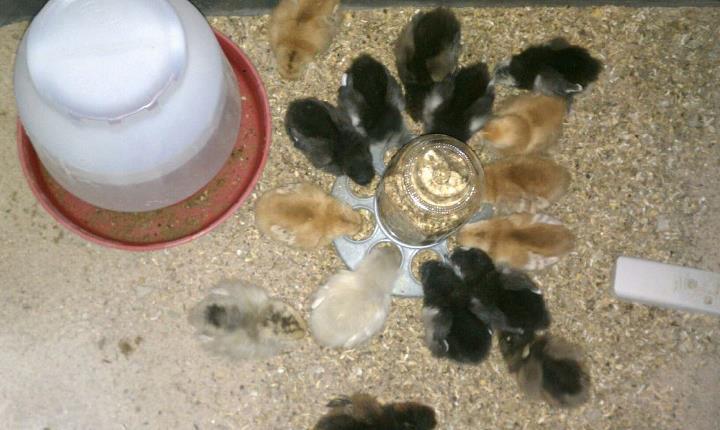
"Baby chicks need your help even if they have an adult hen for a mama. With no mama hen YOU are mom and need to protect and teach the little ones. Appropriate food such as chick starter or grow mash needs to be placed within easy reach, and waterers should have marbles placed in the trough so that accidental drownings do not occur--remember that Chicken Motto. Both food and water must be available to the chicks 24/7. Since I use shavings as litter in my brooder boxes,
I've found that placed the food & water dispensers up on a couple of bricks keeps them MUCH cleaner--otherwise the chicks kick shavings into them in their normal scratching around. Don't make yourself crazy cleaning feeders out constantly, elevate those feeders a bit. 
Of course the chicks should be kept warm (95 to 100 degrees at first with no drafts) and placed in a brooder box or run that keeps them safe from predators. I use an old gooseneck desk lamp with a 75 watt bulb to provide heat & light for the chicks, it stays on 24 hours a day if there is no mama hen in with them. Gooseneck lamps are great because there is a low chance of chicks burning themselves on the light or knocking it over and starting a fire. Use a lamp with a nice, heavy base that can't be tipped over by the babies--thrift stores and yard sales are a great source for old lamps. It's going to get pooped on and dirty, so use one you don't care about! Don't use the modern eco-friendly curly light bulbs, they do not produce enough heat--use an old fashioned bulb or a heat lamp of some kind.
You need to keep the area under the light at around 100 degrees. Too cold, and the peeps will cluster together underneath it and peep in distress, too warm and they will avoid it. What you want is a brooder box where the chicks roam around dispersed evenly throughout.
"If the chicks will be kept indoors, say in a large cardboard box, they will need some diversion. In the brooder box picture you'll notice that I've cut a window for the chicks to see out of and covered it with a piece of hardware cloth, which was placed on the OUTSIDE of the cut-out area and hot glued into place--on the outside so there are no sharp wire ends for the chicks to hurt themselves on.
Having a window to look out of is vital--would YOU want to live in a room with no windows? It also makes for tamer chicks, since they can easily see people moving around and get used to it. I place the window before the chicks are in the box, of course. I also make SURE I place it about 5 inches from the bottom of the box--place it too low and the chicks will constantly be kicking shavings out through it, making a huge mess for you to clean up. As the chicks grow and develop their wings, you'll also want to fashion a wire cover for the TOP of the brooder box--otherwise after a couple of weeks the chicks are going to start jumping/flying out of the box! Also, if you have small chidren it's a good idea to have a wire cover (I use chickenwire for the cover, it's perfect) from the outset so the kids don't accidentally drop toys on the chicks or climb in with them. You can also use an old fishtank for a brooder box or a large Rubbermaid tub--but realize that the chicks are going to outgrow them pretty darned fast! I prefer the huge cardboard box, that way the chicks can live in it for the first two months until they ae ready to go outside with the adult chickens, and when I'm done with the brooder box, I just remove the hardware cloth 'window' to save for next time and throw the box away--the cardboard box gets pretty nasty by the end of two months and isn't worth keeping.
Boredom, overheating and overcrowding can cause chicks to peck each other. I give my chicks a great big, nasty, grassy dirt clod--dirt, grass, roots, bugs and all. It provides several things: A toy to jump and climb on, green matter (grass) to eat, dirt to peck and scratch at and dustbathe in, grit in the form of dirt for their little crops so they can digest their food, protein from the bugs they find, etc. So far it's the best thing I've found for chicks to keep them busy and happy for days. They'll spend hours pecking and scratching away at it, discovering new goodies to eat--sprinkle some chick food on it, 'peck' at it with your finger and call excitedly when you first put it in. They love to climb on it and play "King of the Hill", jumping on each other. Just make sure your grass is pesticide-free and is not so long as to be a choking hazard--trim it with scissors if needed. The roosts you provide them are also great for play time."
I highly suggest the dirt clod method - my little chickies loved it and it prevented them from gorging on grass the first time we took them outside