Kevin D. - Congrats on joining the BYC!
You have chosen some great breeds to start with.
To answer your question,
Hi!
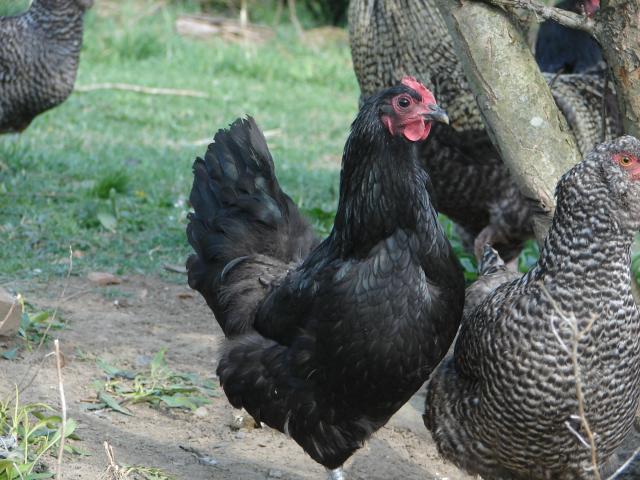
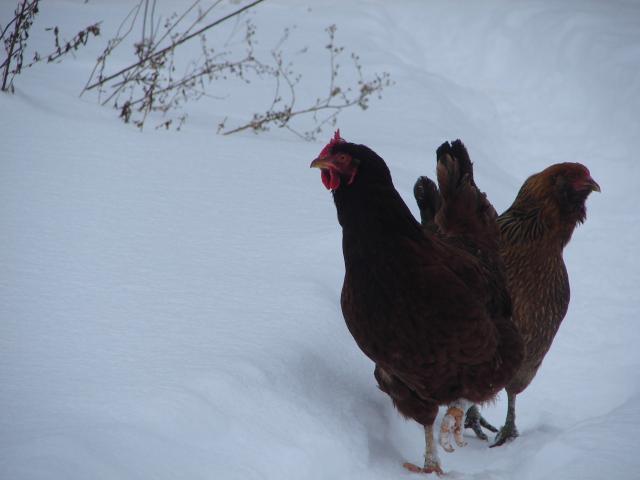
Thank you for all the quick replies! The only thing is, when i typed in cuckoo muran on google, it gave me a barred rock looking chicken, not a brown one like in the pic. are there diffrent colors?
Thanks!
The terms that fanciers use in poultry are often not sharply defined or standardized. Two people can use the same term and mean different things.
The term 'cuckoo' almost always means 'sex-linked barring', the dominant barring gene on the Z chromosome having the symbol, B.
But, the expression of the sex-linked barring, B, can be clean or smudgy, wide bars or narrow. So there are a number of other genes that influence the appearance of barring. W.C. Carefoot likes heterozygotes of sex-linked barring with the (also sex-linked) slow feathering gene. There are some comments on the genetics pages in the gene tables about cuckoo (sex-linked) barring if you're interested.
Some people, usually people who have been showing chickens for many decades use the term 'cuckoo' to mean a certain type of sex-linked barring. It is the same barring gene but it expresses differently in the presence of (unknown) modifyers. I once read something about this that Glenda Heywood wrote. It has to do with the angle of the barring to the center rib and the width of the bars.
I believe the barring in Cuckoo Marans is sex-linked barring, B. We have a line of black barred birds that look very much like Marans and the barring they have is B. The expression of the barring is just smudgy due to other modifying factors.
Sex-linked barring is not the only kind of barring. There is an autosomal barring that is very common. Autosomal barring is a polygenic trait and is an interaction with the pattern gene, Pg, and other secondary pattern genes like Db, Co, Ml. (A secondary pattern is one that is expressed on single feathers like lace, barring and others.) There is a table in the genetics pages (part II, I believe) that is devoted to this.
Crele is a color scheme. Since I don't have any Crele, I'll defer to others here.
A We don't know all the differences between cuckoo barring and the barring of Barred Rocks, but we do know some things. They are due to the same mutation, but this mutation is expressed differently on different genetic backgrounds. Barred Rocks have columbian (Co) and sex-linked late-feathering (K). Both of these alleles are known to improve the quality of the barring. Cuckoo birds do not have columbian and are early-feathering. The greatest difference in pattern is seen on the rapidly growing feathers. Crele is just sex-linked barring on a wild-type background instead of extended black. You can't have columbian to improve the barring because you would loose the black breast. Red is not as affected by sex-linked barring as black is and it is very difficult to breed a bird with good red barring. Crele birds are also almost always early-feathering and so have problems with cuckoo barring.
It is more complex than just these two genes. The old standard used to require the sexes to have the same barring pattern in Barred Rocks, but males can have one copy or two copies of sex-linked barring, while females can only have one. To make the sexes have the same pattern the old breeders used to have to keep black non barred birds in their flocks and breed for Bb+ heterozygous males to match the BW females. These were amazing birds. I've seen the feathers taken from a champion in the 1940s or 50s and the barring was crisp and straight and even. This bird could have been a freak, but you couldn't have painted the pattern any cleaner.
I hope this helps you!
Miss Floppy


 and I was wondering if anyone kept these chickens, what they are like, and really anything and everything about them!