Even after cleaning my glasses I can't see that well enough to guess fertile or not. Hopefully someone with better eyes and monitor can see it well enough. But let me address a few other things.
How many other hens do you have that you might want to hatch their eggs? If a hen goes broody she will try to hatch her eggs, any other chicken eggs, turkey or duck eggs, door knobs, golf balls, or about anything else. If she does not physically have anything to try to hatch she will create something from her imagination. The way I handle getting eggs for broody hens is to collect eggs from other hens after she goes broody until I get a clutch. I don't know if this would work for you or not.
If you want to hatch only her eggs or certain eggs, you can store them for a while. If you store them in certain conditions they can remain viable for two weeks or even a little longer, but the further you get from those ideal conditions the shorter that viable window is. Ideal storage conditions are about 13 C (55 F) and high humidity. Try to avoid cycles where the eggs warm up and cool back off. The eggs should be turned three times a day or more. Keep them out of direct sunlight and out of breezes.
Do not try to hatch dirty eggs and do not wash eggs that you are going to put under a broody hen. The last coating a hen puts on an egg just before she lays it is something we call "bloom". Bloom helps stop bacteria from going through the egg shell and ruining the egg. Bloom is not perfect but it is highly effective. A hen can hide a nest and lay eggs for two weeks, them incubate then for three weeks. The majority will still hatch. By dirty I do not mean something with a light dry smudge of dirt. Rather a clump of poop or dirty will circumvent the bloom and allow bacteria inside. I don't know if you have ever smelled a rotten egg but trust me, you do not want an egg to go rotten anytime, especially under a broody hem.
Very few of us have ideal conditions, I certainly do not. I keep mine in a drawer in the guest bedroom in my house. The temperature is climate controlled and may be either 22C or 26C depending on the time of year. Humidity inside is often pretty low. I have gotten good hatches after storing them a week this way but have not tried keeping any longer.
There are different ways to turn the eggs. I lay them on their sides and put a mark on one side of the egg and a different mark on the opposite side so I can tell when the egg has been properly turned. Another method is to store them in an egg carton pointy side down so the air cell is at the top. Use a block of wood or maybe a stack of books to raise one end, then regularly swap ends. The idea is to get it to a 45 degree angle so each time you turn them they go through a 90 degree change. Just do the best you reasonably can on the storage conditions and you will probably do OK. You do not want the eggs to get too cold, freezing is bad, and you don't want them to get much warmer than 28C.
It is pretty unlikely a pullet just starting to lay will go broody, but anything is possible. Not every hen will go broody anytime in her life, but Silkies are known to be a broody breed. Your odds of getting a broody hen will improve as the weather warms up and the days get longer. It helps for those pullets to get a little older too.
There are some issues with trying to hatch the first eggs a pullet lays. They are typically quite small compared to what she will be laying in a month or two. That mean any chicks that hatch from them will be fairly small. You can hatch pullet eggs, I have several times, but I find the mortality rate of the chicks that do hatch is higher compared to chicks from eggs from more mature pullets/hens. I don't mean all the chicks will die or even close to half. Maybe none. But on average if I have a chick die it probably hatched from a pullet egg.
There is a more important issue. An egg has to be pretty close to perfectly formed to hatch when incubated. When pullets first start to lay it is pretty common for them to not lay perfect eggs. It is fairly common for these pullets to lay no-shelled eggs, soft-shelled eggs, eggs with no yolk or no white, double yolked eggs, just all kinds of things you can see. Some of the things you cannot see have to be right also. It often takes a while for them to get all the bugs out of their internal egg making factory. I find that if I wait at least a month after a pullet starts to lay I do much better.
If you look at that egg photo you see a couple of spots. Those are probably blood spots or meat spots. It is still safe toe eat but that might be enough to keep a chick from hatching, I don't know for sure. It is highly likely she will correct that glitch in her internal egg making factory fairly soon.
If you decide to save eggs in the hopes of a hen going broody, you first decide how many eggs you want her to hatch. Then work out a system where you can turn the eggs but keep them in a specific order. Perhaps use an egg carton and start storing them on one end and lets say 8 eggs just to have a number to work with. Start on one end so you always know which is the older egg. When you get to 10 eggs (so you have a spare if for some reason you don't want to hatch a certain egg, maybe you drop it and crack it). Then when you put the 11th egg in remove the oldest egg. You can still eat it if you want, they store quite well. If you can maintain this system you will always be ready with your best eggs.
Good luck!



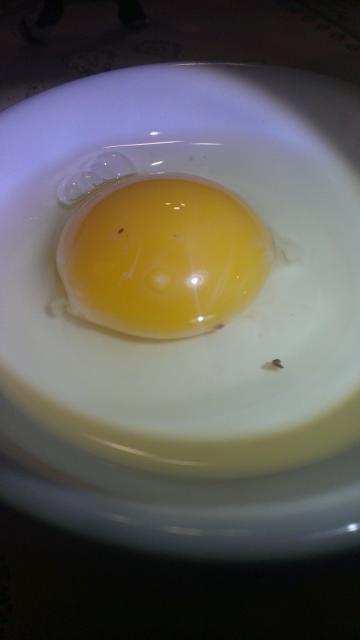


 . This was the first egg she laid on Tuesday that I opened and I'm pretty sure (got hubby with his shortsightedness to look too and he said there is definitely a dot) it looks fertile.
  ) and they are now upside down in an egg carton on a stack of books on one end. They are in our unheated, very thick stone walled guest-bedroom - this stays a very constant temp which I wouldn't think would be much above 13 degrees so I'm happy that those conditions are right! If I'm lucky and get an egg today and tomorrow that would bring it up to 4 eggs to potentially put under one of them. I'll give them 2 weeks from today and if they haven't gone broody I'll have scrambled eggs and wait until they do and buy some eggs of varieties I want in for them to sit on (or if they leave it to the last minute I could potentially grab some eggs off my neighbours who have lovely chickens and roosters to up the numbers!). How many is the ideal number - is it possible to not have enough for heat / breakage reasons?


 totally get what you are saying - bummer LOL! But does that mean that if the girls lay eggs early next week I don't need to rush them in to the fry pan just beacuse they are past the 2 week mark? Would 3 weeks be a good compromise?

 - all good I can wait for them to go broody and get them some good eggs to hatch


