I raise Mallards and go by this hope it helps:
Incubating:
Here are a few tips for hatching your mallard duck eggs. It takes 26 days to incubate a mallard duck egg. This is what works for us here at our farm. It doesn't mean it will work for you as every situation is different, but we'll tell you anyway. During the incubation period we keep our incubators (GQF cabinet models) temperature set at 101 degrees at the top of the incubator, not the top of the egg, the humidity is kept between 60% and 70% and they are automatically turned 3 times a day. The eggs are misted with warm water once a day. Day 23 ends the incubation period and the eggs are moved to hatchers. This is when you stop turning the eggs so they can get in position to hatch. During this hatching period the hatchers (GQF cabinet models) temperature is lowered to 100 degrees at the top of the Hatcher, not the top of the egg, the humidity is raised to 70% to 80%. On day 26 your duckling will start to pipe out. Don't help them out the shell. If they can't get out of the shell on their own, they either have something wrong with them or they are just too weak. Either way they won't survive. Both of these problems are due to incubator settings, so monitor your temperature and humidity several times a day!!
If you are using another type of incubator, such as the Styrofoam kind, you need to set the temperature at 99.5 and keep the humidity settings the same.
Brooding:
Brooding is simple and has only two goals - to keep the ducklings warm and dry. You can use a large plastic storage container to brood small clutches. Just suspend a light bulb (plugged in of course!!) about a foot from the bottom with at least a 60 watt light bulb. Be sure the ducklings have room to move away from the heat if they get too hot. Use some common sense, like don't put the water bowl directly under the light. DO NOT USE NEWSPAPER as bedding, this will cause the duckling to lose their footing and they will become straddle legged. Keep drafts off the ducklings. Be sure predators can't get to them. For larger number of birds you will need 1 square foot per bird until they are 6 weeks old. Only feed NON MEDICATED chick starter crumbles or game bird crumbles with 24 hour access DUCKLINGS DO NOT NEED WATER TO SWIM. A duckling will become water logged and drown or freeze to death. When the duckling has the mother she gives them oil from her feathers to repel the water. With out the mother the ducklings do not have this oil and won't have the glands to produce it until they are 6 - 8 weeks old. So put rocks in the water bowl to prevent them from swimming. They don't know what you know!! They will want to swim, it's natural to them. They should have access to water AT ALL TIMES. A duckling will dehydrate in 8 hours and die.
Raising Ducks:
If you've gotten these far, congratulations. You are on the home stretch. Your ducklings have grown fast and are big. At 6 - 8 weeks you will need to provide the ducks more room. We provide a minimum of 6 square foot per bird. Anything less will be uncomfortable for the ducks and they will pick each others feathers. You can start to feed those non-medicated laying pellets, cracked corn, or game bird pellets. You will have to find out what is available in your area. They can be given free access to water and be allowed to swim. Your ducks can fly by the time they are 8 weeks old so if you are going to keep them penned up make sure they have enough room to be able to fly around. If you are going to let the ducks loose in your pond, please don't clip the wings. Their only defense against predators is to fly away. So think twice before you do that, unless you will enjoy having had dedicated all that time and care to these guys and then find pieces and parts around the pond after a coyote or dog has eaten them.
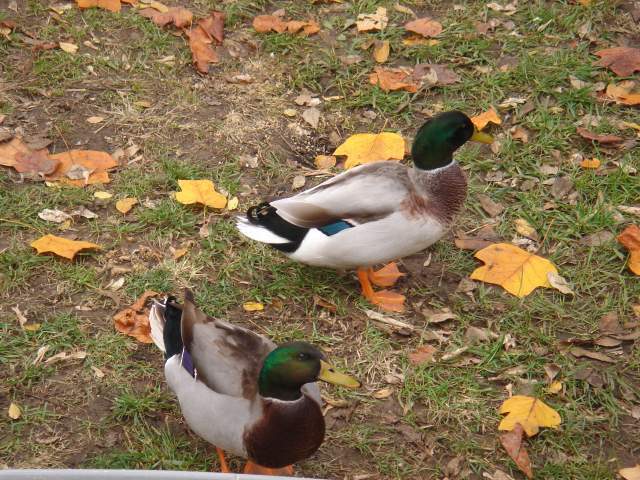
Here is a pic of my 2 beautiful boys