- May 8, 2010
- 473
- 0
- 119
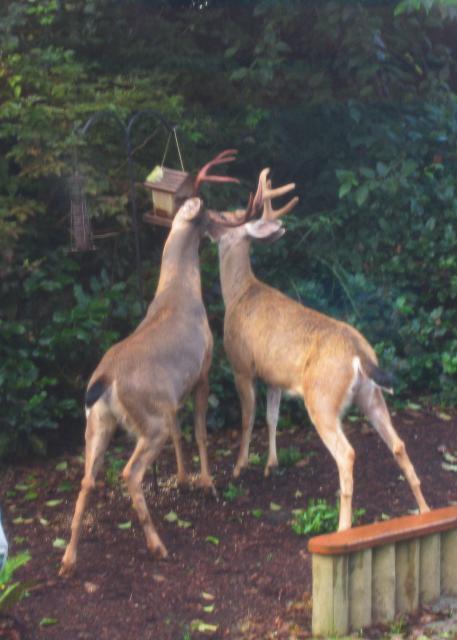
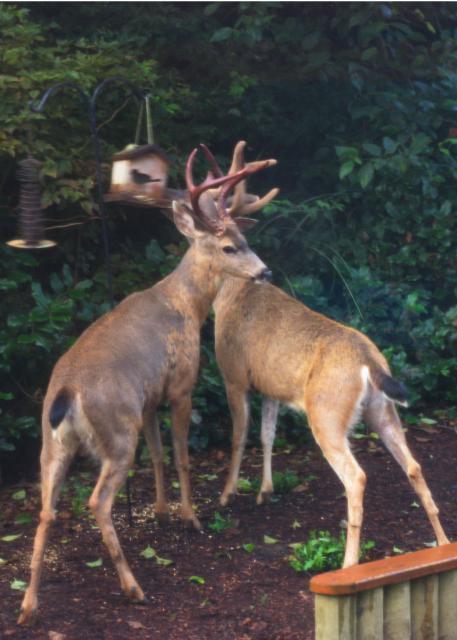
BLACK TAIL DEER:
The black-tailed deer was once believed to be a subspecies of the North American mule deer (Odocoileus hemionus), however, recent DNA testing has proven this not to be the case. In Valerius Geist's book Mule Deer Country he explains that by testing the mitochondrial DNA of the three species (blacktail, whitetail and mule deer), researchers have now determined that it was the mating of whitetail does and blacktail bucks that gave rise to the mule deer, and not the opposite as was once suspected, therefore not falling under a subspecies of O. hemionus and rather as its own species O. columbianus.[2]
It is now believed that millions of years ago the whitetail deer (Odocoileus virginianus) expanded its range down the east coast of the United States, across Mexico, and then back up the west coast, where it eventually evolved into the blacktail deer. Thousands of years later as the recently evolved blacktail's range spread eastward and the whitetail's range again expanded westward, the two deer species again met. At this point, the blacktail bucks displaced the whitetail bucks, and bred the whitetail does. Researchers now believe that it is this hybridization that produced what is now commonly known as the mule deer.
WHITE TAIL DEER:
The white-tailed deer (Odocoileus virginianus), also known as the Virginia deer or simply as the whitetail, is a medium-sized deer native to the United States (all but five of the states), Canada, Mexico, Central America, and in South America as far south as Peru. It has also been introduced to New Zealand and some countries in Europe, such as Finland and the Czech Republic.
The species is most common east of the Rocky Mountains, and is absent from much of the western United States, including Nevada, Utah, California, Hawaii, and Alaska (though its close relatives, the mule deer and black-tailed deer Odocoileus hemionus, can be found there). It does, however, survive in aspen parklands and deciduous river bottomlands within the central and northern Great Plains, and in mixed deciduous riparian corridors, river valley bottomlands, and lower foothills of the northern Rocky Mountain regions from South Dakota and Wyoming to southeastern British Columbia, including the Montana Valley and Foothill grasslands.
The conversion of land adjacent to the northern Rockies into agriculture use and partial clear-cutting of coniferous trees (resulting in widespread deciduous vegetation) has been favorable to the white-tailed deer and has pushed its distribution to as far north as Prince George, British Columbia. Populations of deer around the Great Lakes have also expanded their range northwards, due to conversion of land to agricultural uses favoring more deciduous vegetation, and local caribou and moose populations. The westernmost population of the species, known as the Columbian white-tailed deer, once was widespread in the mixed forests along the Willamette and Cowlitz River valleys of western Oregon and southwestern Washington, but today its numbers have been considerably reduced, and it is classified as near-threatened. The white-tailed deer is well-suited for its environment. Fossil records indicate that its basic structure has not changed in four million years.[citation needed]
The black-tailed deer was once believed to be a subspecies of the North American mule deer (Odocoileus hemionus), however, recent DNA testing has proven this not to be the case. In Valerius Geist's book Mule Deer Country he explains that by testing the mitochondrial DNA of the three species (blacktail, whitetail and mule deer), researchers have now determined that it was the mating of whitetail does and blacktail bucks that gave rise to the mule deer, and not the opposite as was once suspected, therefore not falling under a subspecies of O. hemionus and rather as its own species O. columbianus.[2]
It is now believed that millions of years ago the whitetail deer (Odocoileus virginianus) expanded its range down the east coast of the United States, across Mexico, and then back up the west coast, where it eventually evolved into the blacktail deer. Thousands of years later as the recently evolved blacktail's range spread eastward and the whitetail's range again expanded westward, the two deer species again met. At this point, the blacktail bucks displaced the whitetail bucks, and bred the whitetail does. Researchers now believe that it is this hybridization that produced what is now commonly known as the mule deer.
WHITE TAIL DEER:
The white-tailed deer (Odocoileus virginianus), also known as the Virginia deer or simply as the whitetail, is a medium-sized deer native to the United States (all but five of the states), Canada, Mexico, Central America, and in South America as far south as Peru. It has also been introduced to New Zealand and some countries in Europe, such as Finland and the Czech Republic.
The species is most common east of the Rocky Mountains, and is absent from much of the western United States, including Nevada, Utah, California, Hawaii, and Alaska (though its close relatives, the mule deer and black-tailed deer Odocoileus hemionus, can be found there). It does, however, survive in aspen parklands and deciduous river bottomlands within the central and northern Great Plains, and in mixed deciduous riparian corridors, river valley bottomlands, and lower foothills of the northern Rocky Mountain regions from South Dakota and Wyoming to southeastern British Columbia, including the Montana Valley and Foothill grasslands.
The conversion of land adjacent to the northern Rockies into agriculture use and partial clear-cutting of coniferous trees (resulting in widespread deciduous vegetation) has been favorable to the white-tailed deer and has pushed its distribution to as far north as Prince George, British Columbia. Populations of deer around the Great Lakes have also expanded their range northwards, due to conversion of land to agricultural uses favoring more deciduous vegetation, and local caribou and moose populations. The westernmost population of the species, known as the Columbian white-tailed deer, once was widespread in the mixed forests along the Willamette and Cowlitz River valleys of western Oregon and southwestern Washington, but today its numbers have been considerably reduced, and it is classified as near-threatened. The white-tailed deer is well-suited for its environment. Fossil records indicate that its basic structure has not changed in four million years.[citation needed]