What did you do in the garden today?

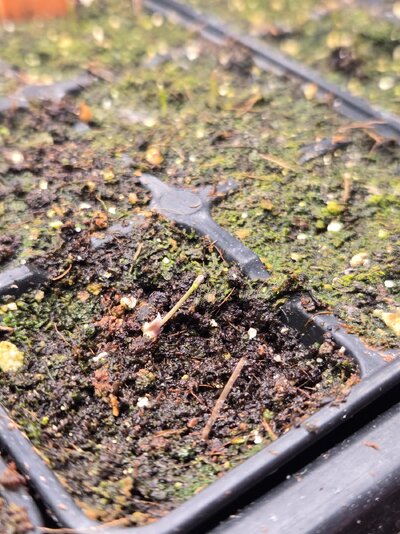
My black Simpson lettuce sprouted in the hole of the seed cube.
I didn't have to cover the seeds; I just drop the seeds in the hole.
1771971827289.jpeg
 
What's in it?
Short version: TPS Base A and B don’t publish a full ingredient list, but horticulturally they follow the standard two‑part formula logic: Part A = calcium + micronutrients, Part B = nitrogen–phosphorus–potassium (NPK) + magnesium + sulfur. This separation prevents precipitation (mainly calcium + sulfates/phosphates). Below is the clearest breakdown based on manufacturer statements and horticultural chemistry.


🌱 What’s Actually in TPS Base A & B (Horticulture Terms)​

The manufacturer does not disclose exact percentages or salts, but their own product pages confirm the functional categories of nutrients in each part.

✔ What TPS publicly states​

TPS Base A+B provides:
  • NPK (macro‑nutrients)
  • Calcium
  • Magnesium
  • Micronutrients
  • Low‑molecular‑weight organic acids to improve uptake
    TPS Nutrients
This matches the standard horticultural design of two‑part hydroponic bases.


🧪 Horticultural Interpretation: What’s in Each Part?​

Below is the industry‑standard composition for A/B fertilizers and how TPS’s description maps to it.

BASE A (Calcium + Micros Part)

Typically contains:
  • Calcium (usually calcium nitrate or calcium chelate)
  • Iron (often chelated)
  • Manganese
  • Zinc
  • Copper
  • Boron
  • Molybdenum
  • Organic acids (TPS emphasizes these instead of synthetic chelators like EDTA)
Why these go in Part A:
Calcium reacts with sulfates and phosphates, forming insoluble precipitates. Keeping Ca separate prevents “nutrient snow.”


BASE B (NPK + Magnesium Part)

Typically contains:
  • Nitrogen (nitrate and/or ammonium sources)
  • Phosphorus (usually as mono‑potassium phosphate or similar)
  • Potassium (potassium nitrate, potassium sulfate, etc.)
  • Magnesium (usually magnesium sulfate)
  • Sulfur (from MgSO₄ or K₂SO₄)
Why these go in Part B:
Magnesium sulfate and phosphate salts must be kept away from calcium until diluted in water.


🧬 Why TPS Splits Them This Way​

TPS markets Base A+B as:
  • “Energy dense” (high concentration)
  • “Bioavailable” (organic acids instead of EDTA)
  • “Complete macro + micro”
    TPS Nutrients
This is consistent with a modern hydroponic two‑part formula designed for coco, DWC, Kratky, NFT, and soil.


📦 Summary Table​

PartWhat It Contains (Horticulture Terms)Why It’s Separated
Base ACalcium, iron, manganese, zinc, copper, boron, molybdenum, organic acidsPrevents Ca from reacting with sulfates/phosphates
Base BNPK macros, magnesium, sulfurKeeps MgSO₄ and phosphates away from Ca until diluted


If you want, I can also:​

  • Compare TPS A+B to General Hydroponics Flora, Jacks 3‑2‑1, or Athena Pro
  • Break down how to dose A/B in Kratky, DWC, or coco
  • Estimate the likely NPK ratios based on plant behavior and TPS feeding charts
Just tell me what direction you want to go.
 
Short version: TPS Base A and B don’t publish a full ingredient list, but horticulturally they follow the standard two‑part formula logic: Part A = calcium + micronutrients, Part B = nitrogen–phosphorus–potassium (NPK) + magnesium + sulfur. This separation prevents precipitation (mainly calcium + sulfates/phosphates). Below is the clearest breakdown based on manufacturer statements and horticultural chemistry.


🌱 What’s Actually in TPS Base A & B (Horticulture Terms)​

The manufacturer does not disclose exact percentages or salts, but their own product pages confirm the functional categories of nutrients in each part.

✔ What TPS publicly states​

TPS Base A+B provides:
  • NPK (macro‑nutrients)
  • Calcium
  • Magnesium
  • Micronutrients
  • Low‑molecular‑weight organic acids to improve uptake
    TPS Nutrients
This matches the standard horticultural design of two‑part hydroponic bases.


🧪 Horticultural Interpretation: What’s in Each Part?​

Below is the industry‑standard composition for A/B fertilizers and how TPS’s description maps to it.

BASE A (Calcium + Micros Part)

Typically contains:
  • Calcium (usually calcium nitrate or calcium chelate)
  • Iron (often chelated)
  • Manganese
  • Zinc
  • Copper
  • Boron
  • Molybdenum
  • Organic acids (TPS emphasizes these instead of synthetic chelators like EDTA)
Why these go in Part A:
Calcium reacts with sulfates and phosphates, forming insoluble precipitates. Keeping Ca separate prevents “nutrient snow.”


BASE B (NPK + Magnesium Part)

Typically contains:
  • Nitrogen (nitrate and/or ammonium sources)
  • Phosphorus (usually as mono‑potassium phosphate or similar)
  • Potassium (potassium nitrate, potassium sulfate, etc.)
  • Magnesium (usually magnesium sulfate)
  • Sulfur (from MgSO₄ or K₂SO₄)
Why these go in Part B:
Magnesium sulfate and phosphate salts must be kept away from calcium until diluted in water.


🧬 Why TPS Splits Them This Way​

TPS markets Base A+B as:
  • “Energy dense” (high concentration)
  • “Bioavailable” (organic acids instead of EDTA)
  • “Complete macro + micro”
    TPS Nutrients
This is consistent with a modern hydroponic two‑part formula designed for coco, DWC, Kratky, NFT, and soil.


📦 Summary Table​

PartWhat It Contains (Horticulture Terms)Why It’s Separated
Base ACalcium, iron, manganese, zinc, copper, boron, molybdenum, organic acidsPrevents Ca from reacting with sulfates/phosphates
Base BNPK macros, magnesium, sulfurKeeps MgSO₄ and phosphates away from Ca until diluted


If you want, I can also:​

  • Compare TPS A+B to General Hydroponics Flora, Jacks 3‑2‑1, or Athena Pro
  • Break down how to dose A/B in Kratky, DWC, or coco
  • Estimate the likely NPK ratios based on plant behavior and TPS feeding charts
Just tell me what direction you want to go.
That's good. I was just curious as to why it's in two parts and is it was natural or synthetically sourced.
 
I love rose rocks. I have a few I found as a kid growing up back in Oklahoma. So far only one opal that I'm sure of, not very good quality. There's opal here, it's been recorded in geological reports at our property and on the BLM land that borders our property. I have yet to go prospecting to find any, but it's on my to-do list.
There's a state park in Arkansas called Crater of Diamonds. It has natural deposits of diamonds. Visitors can search for diamonds and keep anything you find. I took the kids there once when they were young. They thought it was fun for about 15 minutes and then got bored. I've always wondered if the surrounding properties have ever found any diamonds. I'd be digging up everything around there... 😂 I've always wanted to go back but never had the time. It's a good 2.5 hours away so not just a jaunt down the road.
 
I put up another fence to try to keep the chickens from flying up onto the pool to get around the fence and into my garden. Hopefully it works.

You know those jalapeno seeds? The ones that didn't sprout? I looked yesterday, no sprouts. I looked today, one is coming up. 🤣 I'm going to laugh if more come up.

The asparagus seeds are sprouting. It's the most adorable thing. Tiny asparagus! Tiny!!!

20260224_172859.jpg
20260224_172842.jpg
 

Attachments

  • 20260224_172847.jpg
    20260224_172847.jpg
    629.8 KB · Views: 1
  • 20260224_172907.jpg
    20260224_172907.jpg
    666.4 KB · Views: 1
  • 20260224_172834.jpg
    20260224_172834.jpg
    581 KB · Views: 1
I was in Mainerds today. They now carry sunshine potting mix. Use to carry pro mix. I browsed the seed racks and bought some. Bought a new to me seed starting tray. The silicone type cells. Itching to grow something.
I found promix at home Depot last year when Menards stopped selling it. Promix is my go to, but I'm getting tired of finding HUGE sticks in them. So they better shape up. Let me know how well the Sunshine is screened.
I tried the silicone bottom pop out trays three or 4 years ago and ended up with a lot of root and stem rot compared to the controls in the standard trays next to them. Hope they work for you.
=====
Let the birds out for the first time since Thursday, they about bowled me over. Eagle flew over and everyone raced for the barn. They came back out.
Harrier flew over, back in they went.
They came screeching out clutching their skirt hems, followed by the resident cottontail, who must have had a holy hand grendade.
Rabbit ran into the garden.
Flock of snow geese went over, very low, headed for the lake, back in ran the chickens.
I'm sensing a theme out there today.
 
Last edited:

New posts New threads Active threads

Back
Top Bottom