
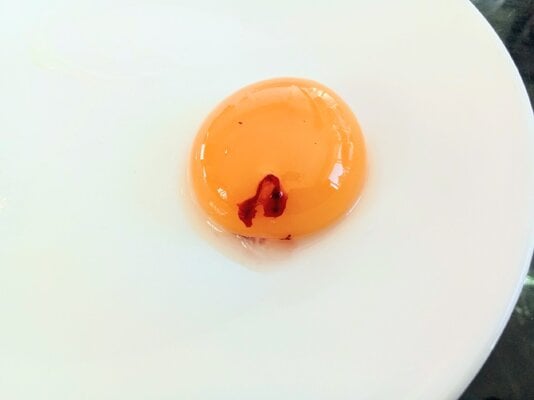
What is this blood in my cracked egg?

wannabefarm girl

In the Brooder
Joined
Aug 21, 2025
Messages
31
Reaction score
23
Points
34
About a week or so ago I cracked this egg open and saw this blood in it.

There was also a regular blood or meat spot on the underside of the yolk.

What do you think this is?
 

Attachments

  • IMG_20260207_100558~2.jpg
    IMG_20260207_100558~2.jpg
    128.4 KB · Views: 20
  • IMG_20260207_100845~2.jpg
    IMG_20260207_100845~2.jpg
    96 KB · Views: 2
  • IMG_20260207_100558~2.jpg
    IMG_20260207_100558~2.jpg
    128.4 KB · Views: 2
I don't know if it's visible, but it seems to be coming from the bullseye on the yolk.

We have been having some of our eggs have distinct bullseye's on them, but we aren't supposed to have any roosters...

P.S. in case it's not obvious, I'm a newbie at this. Chickens are about 8 months old...
 
The blood can occur in various areas. You can also see blood in the white that is very similar to this. Go ahead and look up "follicle in egg" or "blood in white" or "blood in egg" and similar search terms on the Emergency Forum and elsewhere and see if you can look at a bunch of pictures. You will eventually find some very good examples of this phenomenon - they all look different. The blood color is the same as what you see, a very vivid red, and can contain some type of structure sometimes.

Eggs can appear to have a bullseye and not be fertile - it's not always super accurate. Only way to truly tell what egg is fertile is to incubate them - after 3 days it will be very obvious which are fertile and which aren't. Since you don't have a rooster, you won't be having fertile eggs, so I wouldn't worry about it.

8 months is still a pretty new layer. New layers are prone to random one-off stuff as they figure out their systems. Unless this becomes a constant thing, I wouldn't worry about it.
 
A piece of follicle. It happens sometimes. It's usually a one-off. Always crack eggs in a separate container before use is good advice. It pays off in occasions like these.
Oh! Interesting. I never would have thought of that.

Yes, I've learned the hard way to crack into a separate bowl😆
 
The blood can occur in various areas. You can also see blood in the white that is very similar to this. Go ahead and look up "follicle in egg" or "blood in white" or "blood in egg" and similar search terms on the Emergency Forum and elsewhere and see if you can look at a bunch of pictures. You will eventually find some very good examples of this phenomenon - they all look different. The blood color is the same as what you see, a very vivid red, and can contain some type of structure sometimes.

Eggs can appear to have a bullseye and not be fertile - it's not always super accurate. Only way to truly tell what egg is fertile is to incubate them - after 3 days it will be very obvious which are fertile and which aren't. Since you don't have a rooster, you won't be having fertile eggs, so I wouldn't worry about it.

8 months is still a pretty new layer. New layers are prone to random one-off stuff as they figure out their systems. Unless this becomes a constant thing, I wouldn't worry about it.
Thanks for the info.

Good to know it can just be a normal nothing-to-worry-about occurrence.

Do you have a link to some good info about the "bullseye" not being accurate for indicating fertilization? I would love to read about it to fully understand.😊

We're actually trying to figure out if one of the “Hens" is actually a rooster, but we've gotten mixed info. It's a blue cochen and developed the comb and wattles a lot earlier than anyone else and had been displaying some rooster behaviors. It still has a considerably redder and larger comb and wattles than it's sister blue Cochin (that looks like she might actually have splash coloring) and we've never caught "her" laying yet.

So, that's why I questioned the bullseye.
 
Thanks for the info.

Good to know it can just be a normal nothing-to-worry-about occurrence.

Do you have a link to some good info about the "bullseye" not being accurate for indicating fertilization? I would love to read about it to fully understand.😊

We're actually trying to figure out if one of the “Hens" is actually a rooster, but we've gotten mixed info. It's a blue cochen and developed the comb and wattles a lot earlier than anyone else and had been displaying some rooster behaviors. It still has a considerably redder and larger comb and wattles than it's sister blue Cochin (that looks like she might actually have splash coloring) and we've never caught "her" laying yet.

So, that's why I questioned the bullseye.
If you post pictures of your suspect rooster and her sister, either here or in the What Breed/Gender is This? forum, we can help you out on whether you have a roo. Need front view standing, side view standing, closeup of head/wattles/comb and saddle feathers if you can post them. In good lighting.

There's lots of posts in this forum about the bullseye and whether it indicates an egg is fertile - lots of experiences and opinions and science about it. I don't have specific links, but you can search them up pretty easily.

There's an interesting phenomenon (parthenogenesis) where a small percentage of unfertilized chicken eggs can actually start to develop a bit if they get the right temperature/humidity conditions, but it's not super noticeable unless you're looking for it, and stops in the first few days.
 
Last edited:

New posts New threads Active threads

Back
Top Bottom