
faa34c79_IMG_18.jpeg

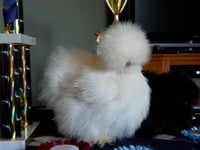
Silkie

The silkie chicken was developed in the southeast asian countries or china.It was valued as a medicinal food item because of its black skin and bones

General Information

Breed Purpose
Ornamental
Comb
Walnut
Broodiness
Frequent
Climate Tolerance
All Climates
Egg Productivity
Medium
Egg Size
Medium
Egg Color
Light Brown/ white
Breed Temperament
Friendly, Easily handled, Calm, Bears confinement well, Quiet, Docile
Breed Colors/Varieties
Grey, Blue, Splash, Partridge, Buff, Black, White are the standard colors with many off standard & derivative colors in existance today.
Breed Size
Bantam
APA/ABA Class
Feather Legged
Color
Grey, Blue, Splash, Partridge, Buff, Black, White are the standard colors with many off standard & derivative colors in existance today
d3dc30a9_Tulip_Buttercup_Cam_3.jpeg

The Silkie breed was developed in the southeast Asian countries or China. It's named for its atypically fluffy plumage, which is said to feel like silk. The breed has several other unusual qualities, such as black skin and bones, blue earlobes, and five toes on each foot, whereas most other chickens only have four. They are often exhibited in poultry shows and come in various colors. It was valued as a medicinal food item in Asia, because of its black skin and bones, and was thought to be particularly good to reinforce body immunity and protect from emaciation and feebleness. It also is reported to treat diabetes, anemia, female reproductive functioning and postpartum disorders. Marco Polo gave the first accounts of Silkie chickens in the late 13th century. As trade route between East and West were established, the Silkie was brought to Europe. Records have shown that in the Netherlands, they were sold as the product of crossing a rabbit and a chicken!

Nowadays the breed is very popular for the purpose of pet chickens as well as exhibition. They are not good layers, averaging 3 eggs per week, but are known and valued for their exceptional broodiness and are often used for hatching eggs from other breeds. They are also considered very good pet chickens, especially for children and are known for their friendliness and docile temperaments.

The breed was officially recognized in North America by acceptance into the Standard of Perfection in the first year of publication which was 1874.

6dc02698_coco1.jpeg
Silkie juvenile

cfaa7b1b_IMG_6253.jpeg
Silkie chick

29dd774f_DSC_0125.jpeg
Silkie rooster

81ea9419_Tulip_5monthsold.jpeg
Silkie hen

For more information on Silkies and their owners' and breeders' experiences with them, see our breed discussion here:

https://www.backyardchickens.com/threads/chicken-breed-focus-silkie.1048544/

Latest reviews

Fluffy babies
Pros: They're hilarious.
They're small and don't take up much space as they will pile together to sleep.
They like cuddles.
Cons: Picky eaters.
Their batteries die when it's dark and will come sit next to the kitchen door to be picked up and put away (but is this really a con?).
I have loved silkies for YEARS just because they're adorable. when we decided we wanted to have our own chickens for eggs (we eat a lot of eggs..), I initially wanted to go with a breed that lays every day but since I had my oldest daughter with me and she got to choose, of course we came home with 5 silkies haha.
They've only just recently started laying after freeloading for 6 months, and they all lay different colours of eggs so I can tell which egg is whose (helpful for when we want babies!).
Purchase Price
5€ each
Purchase Date
1/04/2025

Attachments

  • 1.jpg
    1.jpg
    1,006.1 KB · Views: 99
so cute and fluffy
Pros: Roosters are friendly!!
Fluffy and cute
very laid back
Love the crest and beard!
Cons: I don't like that they're usually sold as straight run, with sexed females being very expensive
My hen with a big crest and beard can't see, at all. Sometimes gets picked on. When i have treats she wobbles over and circles around, not being able to get to the treats because she can't see properly.
I love this breed, I just wish they were more often sold as sexed females.
Purchase Price
6$ but straight run
Purchase Date
april 2
Nicest, cutest, and fluffiest babies ever.
Pros: Amazing pets, great hatchers, sweet, can be kept in a smaller space.
Cons: Low egg production and eggs are small. Also take up to a year of age to start laying.
I have a few and I love them to death. Got to say that they're my fav breed. They take a long, long time to lay though.

Comments

Are you sure you have cockrels? My boys were crowing at 6 months and were very different from pullets. Very developed with huge combs and wattles. Tail feathers were prominent and hackle feathers stood out.
 
Yes I had boys, mine crowed every day. They would find morsels on the ground and call my 8 hens to come. Mine didn't have a comb nor a wattle. But they are gone now so I can't check. I picked them up a lot and cuddled them though. Mine won a ribbon at the 4H fair...I was so proud of him. :-)
 
Give them more time before you give up on them. Mine were slow to develop, too: no eggs for at least 9 months. Today, 2 years later, they are among my best layers. Yes, the eggs are small, but they taste great, and the eggs Do get bigger, maybe up to medium size. My girls brood and hatch as a group, all together or not at all. I have one rooster (of several) who raised a chick from hatch to maturity all by himself. Be ready for some surprises.
 
I have an indoor silkie rooster (not sure if this counts) and he is very friendly and likes to be held. He tolerates bath time and loves the blow dryer. He was nearly dead when I found him and he didn't crow for months. For awhile we thought he was a hen, until I play him youtube videos of roosters crowing. The next morning he let out the most awful crow- he was a little rusty. Now he crows every time he wants something because he's spoiled. I agree with coop410silkies, don't give up on them yet!
 
I have a Sid, too. He just hates some people and attacks with intent to kill. He's a lot better now that he's older and free ranging - and has more company. I lost a little white hen to a hawk two days ago. Haven't seen one in ages, but I've had to keep my dog penned up lately, and everything seems to have picked up on it. My Silkies just never stop laying, and while their eggs never get much bigger than a medium, they make up for it in number.
 
I recently just posted a question about silkies and saw that you had some. I really want to get some to add to my flock but I really only want females. I know that everything that I have read has said that you cant sex them. What should I do? I have 7 other hens. Ri reds, barred rocks, and wyandottes. I just want to add 3 or 4 more.
 
I would buy adult hens to start with and then if you want a roo then you can breed more silkies.
I have started out with 3 adult hens 1 lavender, 1 buff, 1 black. I love them so much. I got a black silkie roo(only $5) And I will have baby silkies on MARCH 8TH.
I have heard that you can't really sex them because of all their fluff. But you would have to get some to try it out.
If you get silkies I would definitely get some polish too they are both so sweet and funny looking.

BCP
 
Thank you so much for your advice and knowledge. I think i will get them as hens or pullets. I just think they are adorable! I also looked at polish and think those are very cute. My local feed store will only let you buy a minimum of 6. So i originally planned to spit it with someone and get 3 silkies, but now that I know they can't sex them I will probably get a few as adults and look into other breeds for the baby chics.
 
Hey acomeau13, you can buy sexed silkie chicks at mypetchicken.com. They have many different colors of silkies. But they are expensive.
 
Thank you RodNTN I will look into it. If not I'm just going to get a chic or 2 with my other chics that I am getting and hoping for a pullets.
 
I agree my rooster trys to attack anything that moves and my hen freaks up if I touch her but ive been handle them every day and now there really tame.
 
I have a Silkie flock of about 18, equal #'s hens and roo's. I never cease raving about them and recommending them highly. BUT, just for the record, I have to say the following, not to make others wrong, but more to say that they can vary a LOT from what one might expect of them. Mine, for example, are prodigious layers when they are not brooding - and that is not all that often. They do go broody, but, left unassisted or to their own devices, they are not that persistent or successful. My Silkies are great foragers!; they are the first to rise and get about - and the very last to go to bed. They know which side their bread is buttered on it (and who butters it!) and are easy to spoil. They are easy to confine but happiest when given freedom to range, dust bathe, and graze. Mine are NOT cuddly and are quite adept at avoiding capture. They do fine with LF breeds, and develop a tolerance for those who can live by their rules - but they keep pretty much to themselves. My Silkie Roos can be absolute terrors if they take an exception to you. They are paranoid and fast with their spurs. One minute they're crowding for food, and the next they're looking like they want to make my leg bloody. The point is, I would not ever trust them around a small child. It's something to think about if you are considering buying chicks, because they are usually sold straight run and you'll probably get some cockerels that will be hard to unload. In the end, mine have worked out and we coexist easily - with a little bit of patience thrown in. They ARE a delight and easy to care for.
 
Ive had Silkies for about 4-5 years. They are in pen but I let them free range every once and while. My now 7 year old loves them. They do not bother her even if she picks them up. They mostly don't like to be picked up. I have a few that will let me no problem and a young roo that follows me like a lost puppy. I agree, they have there own personality. So know them before you let a child around them.
 
I don't have any silkies....yet! Just getting started, and getting our coop and run built first, then...we will be off! Anyway, we decided on silkies and showgirls due to their gentle nature with children, and OFCOURSE, their looks. Theses will be pets for our disabled son ( Autistic-severely so..) but will be showing them too we hope . Working with local 4 H leaders to start a Poultry Club for disabled children.
1f600.png
Wish us luck, and pray!
 
The Poultry Club for Disabled Children sounds wonderful to me; I find my poults very therapeutic. Were it me, I'd go with a larger, more placid breed for therapy purposes. Whatever you choose, though, you have my prayers and wishes for good luck!
 
My buff bantam silkie is as adorable as they come. Really, really cute, but she's unfriendly and skittish, and loud, even though I've raised her from one day old. She nine months now and although she was the first to lay, she now hasn't laid in almost a month. She's also had a tiny yolkless egg, and two shelless eggs. They are cute to have around but I'm disappointed that she isn't friendlier. My other full size girls are sweethearts compared to her.
 
Well I think then the breed isn't the best for you needs then if u can't hatch baby's that often unlike me I can hatch when ever I want or need. But I live in e country so I have plenty of space for them though to. I can't wait until mine grow bigger so I can start breeding them.
 
Loads of chicken folk have a silkie or two just to get the best broodies possible. They by far exceed any mechanical incubator. If you don't want broody silkies, I suggest you get hatchery stock. I've heard the hatcheries bred it out of them - they want eggs from them NOT chicks.

You could use your silkie(broody) to hatch fertile eggs of any breed, or even ducks etc.
 

Item information

Category
Chicken Breeds
Added by
Super Admin
Views
187,861
Watchers
74
Comments
417
Reviews
295
Last update
Rating
4.37 star(s) 301 ratings

More in Chicken Breeds

  • Cochin Bantam (Pekin)
    The cochin bantam is a bantam breed originating from China. It is known for its fluffy butt...
  • Easter Egger
    Easter Eggers are mixed crossbred X chickens created in barnyards by hobby farmers all around...
  • Barred Rock
    Adventurous, sociable birds!
  • Starlight Green Egger
    A lightweight breed that is a great egg producer!
  • White plymouth rock
    With a super kind temperament and 4-6 eggs per week, you really can't go wrong with this breed!

More from Super Admin

Back
Top Bottom