electric fences and ground rods

Quote:
I got fried working on a fence so I know how your puppy felt.

To ground your fence you can just run a wire from it to your existing ground rod. Now technically this means it's common with the fence controller ground but it should work fine.

Your fence is most likely grounded anyways, especially if it's chain link with metal posts.

As an electrician I use something called a megger to test if something is truly grounded. Some guys get really picky with grounds.
 
I once read about a dairy that had cows that were dropping production and nobody could figure out why. Then after a few weeks cows were getting dehydrated to the point they needed medical treatment so they tested the water at the well, nothing. Tested the tanks in the barn and found the reason when the health dept. guy got knocked on his butt as soon as he touched the tank. The barn's electrical system was not properly grounded making the used electricity hunt for a place to go to ground.

Proper grounding is very important. Remember the old metal cased drills and saws? I knew people that would not use them while standing on concrete
 
Elextricity!
Okay cows getting shocked at the water trough. That is entirely possible. Years ago when a home was wired it was common practice to ground the homes entire electrical system to the cold water pipe. Theory being that the cold water line travels through earth, before entering the house. System works fine until you start combining old with new.
Then a two wire wall socket was normal. Black wire hot, white wire nuetral. It was also a common practice when wiring a wall switch for an overhead light to put the switch on the nuetral leg. Doesn't take a rocket scientist to see that changing a light bulb was a risk unto itself.
Now take these old systems that can still be found in house 50 years old and combine it with a clothes dryer that uses a 4 wire plug. On these dryers the nuetral leg can sometimes be charged due to the way the dryers timer is run.

Electric fence charger--- Every one I ever seen came with a set of simple instructions. Explaining several different ways to "ground" the fence. Nearest I can remember grounding through a rod or fencing was acceptable.
Just my opinion thrown in. Grounding with a piece of rebar is not good. Rebar will rust, corrosion is not a good conductor-- resistance will increase as the rod gets older. And in dry conditions may not provide a ground at all.
 
Aha....thanks everyone. I learned a few more things on this thread.
smile.png
 
Thanks for all the pointers everyone! There are a lot of things I didn't take into consideration. I am wondering if maybe I should just open the gate so my dog can patrol that side of the property when the chickens are locked up for the night- keep things simple.
 
Bizzybird.......
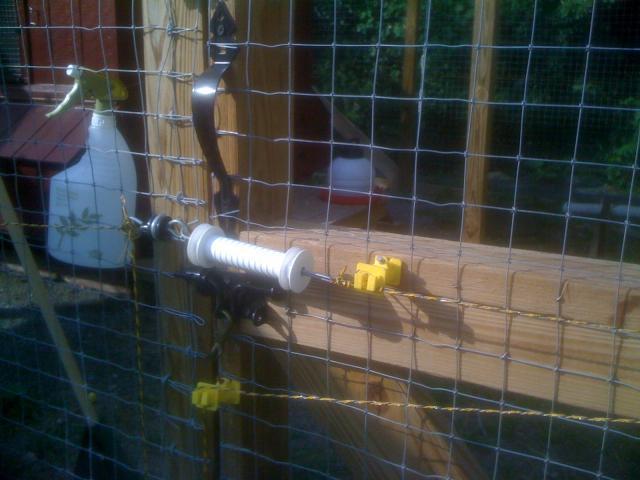
I touch the run fencing all the time............you will not get shocked. I actually have to pull on the fencing (the fencing, NOT the hotwire!) on the gate to open it.....as the grounded 2" x 2" fencing is touching the black gate handle (see pic below).....
I have the gate rigged with an "electric fence gate handle"...........so that when I unfasten 'this' handle.......the hotwires on the gate are no longer charged.......but the rest of the perimeter hotwire "is" charged.................
Here's a picture of the electric fence gate handle (white handle in the pic below)......when I unhook it, everything on the gate......ground and positive....is disabled. I can open the gate and the rest of the perimeter fencing is still 'hot'. When I reconnect it, it hooks the gate back into the system.
16990_img_0203.jpg

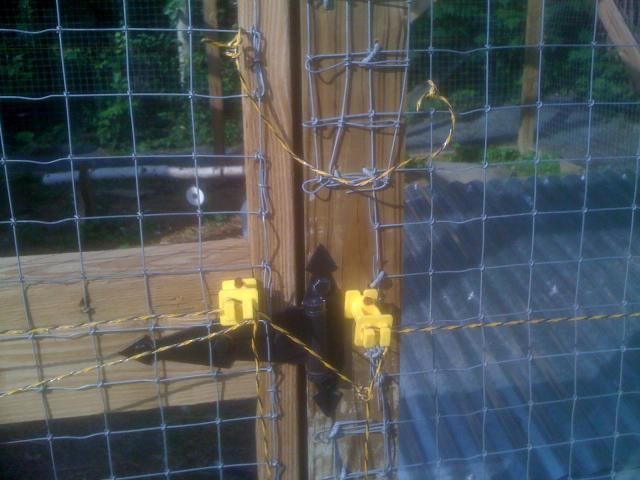
and here's how I have the gate both grounded (hanging down loop is grounding the 2" x 2" fencing on the gate to the 2" x 2" fencing on the rest of the run).......and diagonally running
polywire is the 'hot'......
16990_img_0202.jpg

You have to be touching BOTH the earth 'and' the hotwire, or the run fencing 'and' the hotwire, at the same time, to get zapped with my system.
Did I mention that I always, always disable the charger when I let the chickens free-range outside the run? I do not want 'them' getting zapped if they
were to peck at the hotwire!!!!!
Also, I unplug it when I am working around the outside of the run!!!! Bending over to pick something up.........and your butt touching the hotwire......
is NOT my idea of a good time!!!!!
 
Last edited:
I have a question to the experts, how will snow effect the electric fencing when buried in snow???
 
Quote:
I'd assume the snow would ground, or at least weaken the system. I plan to add an additional mid height wire on my system before the winter. Once the snow is up to the first line I'll disconnect it from the system. Hopefully it won't get high enough that I need to disconnect the second wire, but then again I am in Vermont, where anything is possible.
 
The snow question is a good one. fhdogs the second separate wire sounds like a good idea. how high above the ground will you place it. I live in NY and we get plenty of snow here. I am in the process of installing a hot wire my self and may use the second separate wire also. Actually I will have a third wire at the top to prevent climbers. ( I am going to ground my metal dog run )
 
Quote:
My lower wire now is 4-6 inches from the ground. I also have a wire that runs along the top of my run fence. I'm thinking somewhere around 18" should be good. Since I expect to walk around the run quite a bit I should be able to keep the snow down enough. I also have enough material that if we have a real bad winter I can add additional line as needed. (Not that I want to do that work in the winter.)

I guess the other important factor is how cold it is. This will be my first winter with the chickens, but I would almost prefer that they don't want to go out. I'd rather clean the coop than fuss with them in the cold. I guess I better get moving on the automatic pop door.
wink.png
 

New posts New threads Active threads

Back
Top Bottom