Quote:
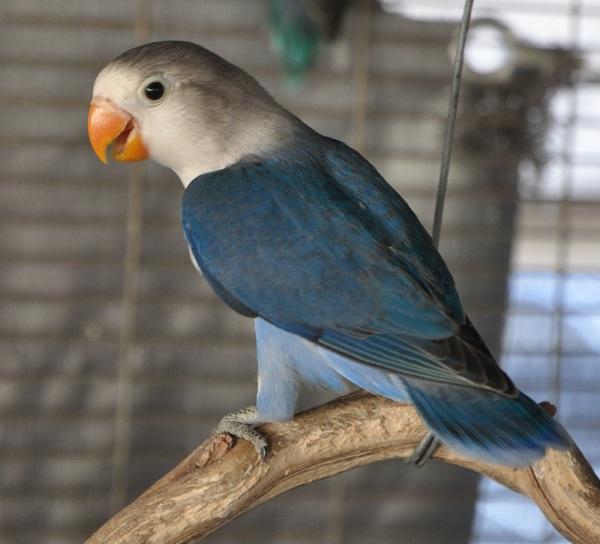
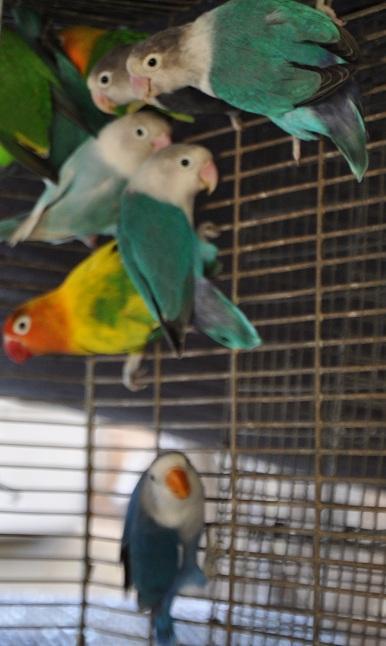
The violet factor is a separate gene, and can be had regardless of whether the bird is blue or green. It's just that the way it modifies the feathers shows the best "violet" coloring in the blue birds (especially with the addition of one dark factor). Green birds can certainly be SF or DF violet, it's just that they'd be hard to tell apart from SF or DF dark greens.
The secret is in looking for areas that are blue in normal fischer's lovebirds -- the lower rump. I don't have experience with the species myself, so I wouldn't be the one to ask about the differences in hue between "normal" blue on a green fischer's rump, SF violet blue on a green fischer's rump, and DF violet blue on a green fischer's rump. I'm sure if you googled around, you'll find some breeder who has posted pictures for identification SOMEWHERE on the net.
I'd first start looking at the males, since it's more likely that the female cheated if she was the only one laying eggs. Look for boys that are a darker shade of green than normal, then check their rumps too see if they're also "darker blue" or more "violet blue." That's how I'd guess to proceed.
If you have multiple nest boxes up, it's also possible that she took over a nest and incubated the egg(s) of another female, or another female snuck one or more in, but I don't know how many of your birds actually bred this time, and how common that behavior is among fischer's.
ETA -- the more I look at your pic, the more I wonder if it's really only a SF violet, as opposed to a DF violet. If that's the case, it'd need only one parent with a violet gene (parent could be SF, could be DF). I'm not as familiar with the subtle shades of blue in Fischer's, and internet pictures are notorious for affecting color representation....and it's a baby, so maybe it's not fully colored yet...
ANYWAY, I first posted on here because I wanted you to know that Violet is an incomplete dominant mutation, not a recessive. So if you get a violet chick, SOMEONE else in there has at least one copy of the violet gene. If the chick is a DF violet, then you've got 2 SOMEONES.
Here is some information I found regarding violet fischer's lovebirds. If something is vague on there (in genetics-speak), I can possibly help. For example, the D and DD refer to SF Dark (Cobalt in a blue-bird) and DF dark (Slate in a blue bird), respectively. But don't ask me about how to name a shade of blue in a live bird.
 Hens go broody when you don’t want them to… and won’t go broody when you do.