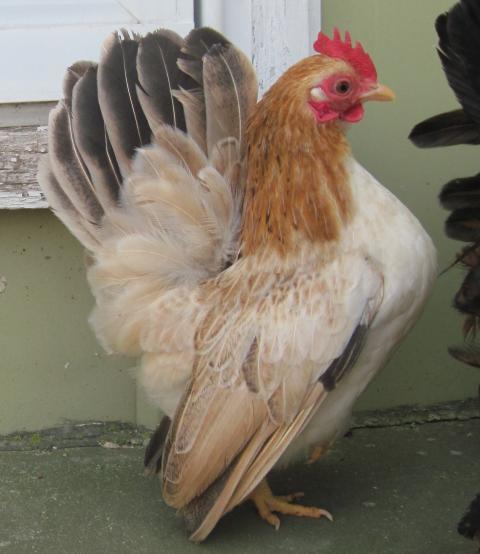
~MALAYSIAN SERAMA THREAD~ (PICS!!!)

Status
Not open for further replies.
Quote:
I think you actually have a great little start with these guys! The two from the first set of pictures were no good, but I can't see anything that raises a red flag with any of these cuties. The black tailed buff cockerel looks pretty good when he stands up! I can't complain about any of these birds - you'll have to let them grow up and see how they turn out.
smile.png
You only need to worry about the green legs if you are color breeding - some people actually have a personal preference for green because of the junglefowl heritage. I don't personally care to see the green legs in my flock and will not keep a green legged bird. Right now white is the only color accepted into the standard, if I'm current on my information. They are asking for yellow legs on the white birds. Also asking for yellow legs on the black birds.
smile.png
Good yellow pads on the feet of the black will be a decent start for breeding. Blah, blah, blah! Good looking babies. You didn't do half bad afterall!

This is great news! Obviously yall can see why I was worried in the first place. but this is very incouraging thanks again!
 
Quote:
He is very pretty - I love frizzles! He looks pretty close to the second generation offsprings I got when I made my red pyle old english games. His color is very interesting and pretty but is not a correct pyle. Has the potential to make some, however. He would be a splash pyle type. Take him to a BBR or blue red to get the red in the correct places, then cross the offspring with whites to get red pyle. Take the offspring with the correct red markings back to a solid blue for blue pyle. Remember that the blue gene potentially dilutes the red.
smile.png
Head, neck, hackles, saddle hackles, and parts of the secondaries and primaries should be red/ orange. Wing bar should be blue. The difference between the "blue pyle" and "blue red" should rely on the hens genetics as a blue pyle will be blue with rosy color in the breast and lemony color in the neck whereas blue red hens will have the duckwing hen pattern on the blue tinted feathers. He'd make an interesting project for sure.

* I forgot to add that splash and black throw blues - would be better off breeding to a duckwing bird with a black base, but not improbable to get the blue color from splash and blue red if blue is strongly present in the background. Would just be better off with the splash x black. Sorry for any confusion.
smile.png
 
Last edited:
Quote:
Yes, I can see why you were worried! For sure! But yeah, let the rest of them grow up and post lots of pictures for us to see.
smile.png
I still highly recommend silkieds!! Again, cute babies!
 
I am pretty sure I'd like to breed and raise Seramas. Where's the best place to get either hatching eggs or day old chicks of EXCELLENT show quality?? Feel free to message me if it's not allowed to post people's names or sites. Thanks!!!
 
Quote:
I know of several breeders but I would have to know what you're looking for to get you on the right track. Most breeders that breed for specific colors and/or type do not sell day old chicks or hatching eggs because they have serama classes set at a fixed rate. Good quality birds can be very, very expensive! You can always check out the auctions on this forum and browse through the archives to see if anyone breeds anything that strikes your fancy.
smile.png
Let me know what exactly you're looking for and I'd be more than happy to make some recommendations to get you started on the right foot. Will you be breeding for type and color or just type? Frizzled, smooth, silkied, booted?
 
Quote:
You won't be able to tell the quality of a Serama by looking at an egg or chick. Pretty birds can produce mediocre chicks just as easily as they can produce the next national champion. You may get lucky, but your chances of being happy with your purchase is better if you buy older birds. For example, these two pullets have the same father, and when they were chicks, I couldn't tell them apart. Since then, one has won BB or RB several times and the other is a givaway pet.
31816_img_1847.jpg
31816_img_2050_1.jpg
 
Quote:
He is very pretty - I love frizzles! He looks pretty close to the second generation offsprings I got when I made my red pyle old english games. His color is very interesting and pretty but is not a correct pyle. Has the potential to make some, however. He would be a splash pyle type. Take him to a BBR or blue red to get the red in the correct places, then cross the offspring with whites to get red pyle. Take the offspring with the correct red markings back to a solid blue for blue pyle. Remember that the blue gene potentially dilutes the red.
smile.png
Head, neck, hackles, saddle hackles, and parts of the secondaries and primaries should be red/ orange. Wing bar should be blue. The difference between the "blue pyle" and "blue red" should rely on the hens genetics as a blue pyle will be blue with rosy color in the breast and lemony color in the neck whereas blue red hens will have the duckwing hen pattern on the blue tinted feathers. He'd make an interesting project for sure.

* I forgot to add that splash and black throw blues - would be better off breeding to a duckwing bird with a black base, but not improbable to get the blue color from splash and blue red if blue is strongly present in the background. Would just be better off with the splash x black. Sorry for any confusion.
smile.png


I'd like to thank everyone for all their input, it was greatly appreciated!

Thank you, Tailfluff, for the genetics involved with this project! I wasn't really ready to embark on another color project right now, but if Mother Nature has been kind enough to drop Precious in my lap, who am I to say no??? LOL Now all I have to do is find the right girl for him, and smooth-feathered, which is a rarity around here!

Also, I'm blushing over the compliments from everyone, even though I had little to do with his arrival, he just sort of "appeared"...Aren't seramas GREAT???
 
Status
Not open for further replies.

New posts New threads Active threads

Back
Top Bottom