Metal roof construction (ventilation?)

Nikidust

Chirping
Joined
Sep 28, 2021
Messages
48
Reaction score
81
Points
99
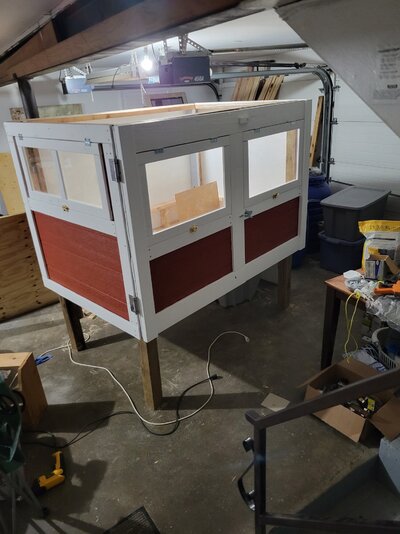
Hi, I'm almost done constructing my coop and getting ready to put the roof on. I'm using recycled metal panels and I'm not sure how I want to attach them. The question is do I notch the supports so the roof is flush with the walls or do I let the roof supports sit on top of the walls creating an air gap all the way around for ventilation? The roof peak will be left open with a ridge cap over it, and the eaves will be open either way. I live in the Midwest where it gets hot in the summer and cold in the winter so I want to make sure I have enough ventilation. As it is now, there are windows that will open for summer but I think they are too low to open in winter so the roof will be all the ventilation for winter. Pictures of the coop in progress below. It's currently partly disassembled as in the first pic because I'm in the process of moving it out to the yard and it was too tall to put the roof on it in the garage with the legs on. All openings will be covered with hardware cloth and there will be an attached run that the roof will extend over. So should I notch out for the roof supports or attach them on top like they are in the first pic?
 

Attachments

  • 20211227_155057.jpg
    20211227_155057.jpg
    478.4 KB · Views: 70
  • 20211221_234752.jpg
    20211221_234752.jpg
    341.3 KB · Views: 25
  • 20211221_170134.jpg
    20211221_170134.jpg
    340.3 KB · Views: 22
  • 20211212_222004.jpg
    20211212_222004.jpg
    363.5 KB · Views: 22
  • 20211211_002934.jpg
    20211211_002934.jpg
    407.2 KB · Views: 26
I personally wouldnt notch the top, that way youd at least have some ventilation. Im sure some fellow posters will say you need far more ventilation in the winter than just the openings in the rafters. An easy fix is having a piece of wood that can fit over the bottom 50-75% of the window openings. This way you can still have the windows open during the winter with good ventilation without too large of openings. Id also keep the roosts relatively low so if you do keep the windows open with the seasonal wood blockage I mentioned, then at least you'd know the air draft wont be a concern blowing directly on them, Just my 2 cents 🤟, hope it all works out for ya !
 
Welcome to BYC.

do I let the roof supports sit on top of the walls creating an air gap all the way around for ventilation?

This, coupled with ridge or gable venting, is an excellent way of providing draft-free ventilation year round.

In the midwest you'll get snow so gable-peak vents will be better than just a ridge vent (having both is good in the summer), since snow will block the ridge vent.

This diagram is from an article on cattle barns, but the principle holds for chicken coops:

natural-ventilation.png


The usual guideline is to have 1 square foot of permanent, 24/7/365 ventilation for every adult, standard-sized hen.
 
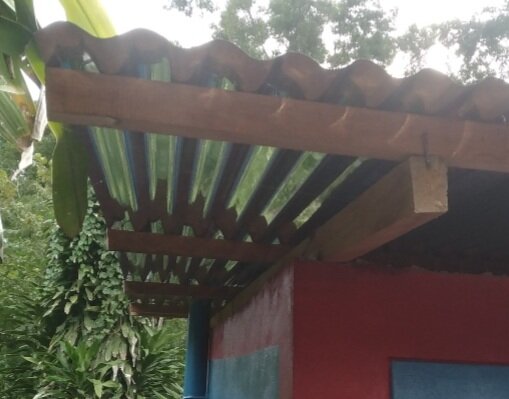
If you want better than the metal, add plywood layer below it like in these photos. It helps with heat in the summer and insulation in winter. But ventilation needs a lot of air movement and outside vents but could put in fans or something to vent the moist air outside.
 

Attachments

  • Screenshot_20211229-173529_Gallery.jpg
    Screenshot_20211229-173529_Gallery.jpg
    196.6 KB · Views: 24
  • Screenshot_20211229-173556_Gallery.jpg
    Screenshot_20211229-173556_Gallery.jpg
    121.8 KB · Views: 26
  • Screenshot_20211229-174136_Gallery.jpg
    Screenshot_20211229-174136_Gallery.jpg
    90.8 KB · Views: 29
Set your rafters vertically, not horizontally as they are laid in the first picture. I'd recommend running them from ridge to low side, so they can overhang in the direction water will shed, placing it further from the coop when it hits the ground, which will add longevity. Hardware clothe the bottom of the overhanging rafters for weather sheltered, predator protected ventilation and you get 3.5 sq inches of venting per linear inch (roughly), or about 1/2 sq ft per 2 foot in length.
 
I would also leave the gap but protect that gap with hardware cloth to keep rodents and other potential entrants out of the coop. Having a ridge vent at the peak of the roof is extremely useful in all weathering conditions. I realize you've probably already got set pieces of metal roofing you're working with, but the bigger you can make the overhangs on all 4 sides of the structure, the better you will protect your building by keeping rain off the side walls and shading the walls in the summer.
 
Here are some more photos of the spaces, good ventilation but i dont get winter where i live.
 

Attachments

  • Screenshot_20211229-175508_Gallery.jpg
    Screenshot_20211229-175508_Gallery.jpg
    56.7 KB · Views: 34
  • Screenshot_20211229-175448_Gallery.jpg
    Screenshot_20211229-175448_Gallery.jpg
    108.5 KB · Views: 31
Setting your roof purlins on edge instead of flat. Will give more ventilation and increase your roof load capacity. I also put 1/2 inch plywood covered by tar paper under the metal roofing. The plywood keeps some of the radiant heat out and body warmth in. Depends on the season. The tar paper keeps condensation off of the plywood.
 
Setting your roof purlins on edge instead of flat. Will give more ventilation and increase your roof load capacity. I also put 1/2 inch plywood covered by tar paper under the metal roofing. The plywood keeps some of the radiant heat out and body warmth in. Depends on the season. The tar paper keeps condensation off of the plywood.

IMO, if you have adequate airflow directly under the metal radiant heat is not a problem. My coop is in the direct sun in a hot climate but inside is the coolest place in the yard because the roof slopes and vents were placed to capture the summer breeze and to take advantage of the chimney effect -- directing hot air up and out the clerestory while pulling cool air in.
 
^^^ my metal roof experience is similar. Not only is the galvanized metal highly reflective, greatly slowing passive heat gain, but its quite thin, meaning low thermal mass, which allows warming air to pass under it and remove much of the heat before it can radiate significantly. What warmth is imparted simply helps air exchange, causing the structure to draw more cool air from under the eaves to vent at the ridge.
 

New posts New threads Active threads

Back
Top Bottom