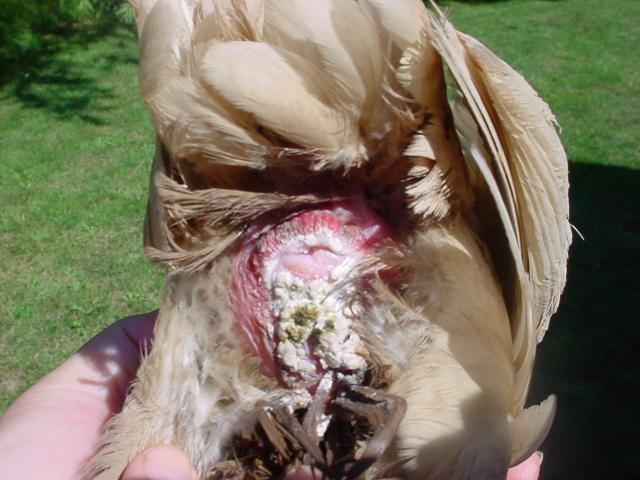
Miss Lydia's suggestion sounds like it is worth exploring.
I'm don't know as it is a prolapse, but here is some info I found on another thread:
Prolapse Information and Treatment
When a hen lays an egg the lower part of the oviduct is momentarily everted through the cloaca. Normally the hen can retract the oviduct after laying.
A prolapse occurs when the hen cannot retract it and a part of the oviduct remains outside the body
Causes can be:
1. Being too fat
2. Older hens
3. And in early laying pullets with low bodyweight
4. Eating feed that has too high an energy level
5. Or a fright can cause the hens oviduct to prolapse
6. When the hen ruptures the muscle in her vent while laying and egg.
7. Obesity (excess fat)
8. Early sexual maturity contribute to this condition
9. Common causes of early sexual maturity are increasing day lengths during the growing period, obesity and switching to the laying ration too early
A mass of tissue, often bloody and dirty, can be seen protruding through the vent
This is a real blow when it occurs, because it is often the best layers that are affected
Fortunately, it is not very common
Prolapse is difficult to cure because the hen continues to lay, and forces the organs out again after they have been replaced
A prolapse attracts the other birds to cannibalism, pen mates seeing the blood usually pick the bird to death.
Debeaking or pick guards will reduce picking, but will not remove the underlying cause.
To prevent obesity in pullets, monitor their body weight and condition.
Restrict their energy intake if they are putting on too much fat.
First line of defence Treatment:
Chickens that show signs of prolapse can be helped by preventing them laying. However, if there is any small prolapse gently push it back into the chicken with your fingers.
The chicken should then be put on a maintenance diet of wheat and water and put in a dark cage. Leave the hen there for a week.
In severe prolapse a purse suture and maintenance diet with the chicken kept in the dark, as above, works well. However, it is important to restrict the chickens diet to maintenance only for possibly a couple of months.
This does work!!
Alternative to maintenance diet is feeding the chicken enough to keep it alive, moving and keeping warm plus enough extra feed for it to produce eggs.
You may find that by reducing the feed it brings on a forced molt
By reducing feed intake so that the bird has just enough feed to keep it alive, moving and keeping warm you are feeding for maintenance only. The chicken will not lay eggs and so give it the best chance of recovery.
Treatment:
You can try to push the prolapse organs back in, very carefully
First, remove the hen immediately from the flock to prevent cannibalism
Clean the prolapse organ
Which will have become dirty
Use warm water and a very mild soap
Smear with a lubricating jelly like Vaseline and very gently push the prolapsed organs back into the body cavity
Isolating the bird and reduce the feed to try and stop her laying
She more than likely she has another egg already moving down the oviduct
The next egg laid could cause another prolapse
Helping to prevent further damage when a hen is prolapsed
1. Reducing swelling and allowing the muscles to contract
2. Preventing a yeast infection
3. Preventing them laying
4. If there is any small prolapse gently push it back into the chicken with your fingers
5. Put the hen on a maintenance diet of wheat and water
6. Put in a dark cage to stop the laying cycle (5 days to 2 months (severe case))
7. In severe prolapse a purse suture may be need to the cloaca
Wash area with sterile water and using preparation-H (this is an ointment used for humans who have piles or hemaroids)
Coat the extended portion in and around the vent area.
Preparation -H reduces the swelling tissue and thus allows the tissue to recede.
If the bird is left in this condition, the other birds will peck at her, and she will become infected and fly blown, die from loss of blood or blood poisoning
You should cull the bird immediately if this happens
A prolapse is not a disease and the bird can still be eaten
Even using some oral teething gel and put a dab of that on the vent and prolapse to numb it a little before you push it in. Some of the tissue doesn't have much in the way of nerves, but the vent will and it can be sore.
Check to see if any of the birds intestines are hanging out through the prolapse.. if there is .. you best option is to put the bird down, or seek vetinary help to have it put back in quickly or the bird will die from septic poisoning or obstruction (which is very painful)
If she is still able to pass droppings, then continue to push the prolapse in.
It will probably come out again, especially if it has been injured and has a scab forming on it. The scab will stimulate the hen to push the prolapse back out again.
Removed any scab that is "ready" to be removed (dont want to cause further bleeding or injury by removing the scab if it isnt ready to come off
so I only started to try removing it after about 5 days , it may take up to 10 to get it off completely).
Bath it twice a day, pushed it very gently back in after putting a bit of numbing gel on it and a bit of KY jelly.
Hold the prolapse in for a minute or two before sliding your finger out.
The prolapse would usually come out again after a bit, but if you do this twice a day, it seemed to "rebuild" the muscles where the tissue was supposed to be!
Keep the bird in a very clean pen with no shavings or anything to stick to the prolapse.
After this time the scabs should all be off and the tissue should be staying in place