The Dragon Bird { Green Peafowls

It seems discussion has been quite dead for the past week.

I've probably seen every Green Peafowl image on the internet already (or maybe Dani has beaten me
tongue.png
)

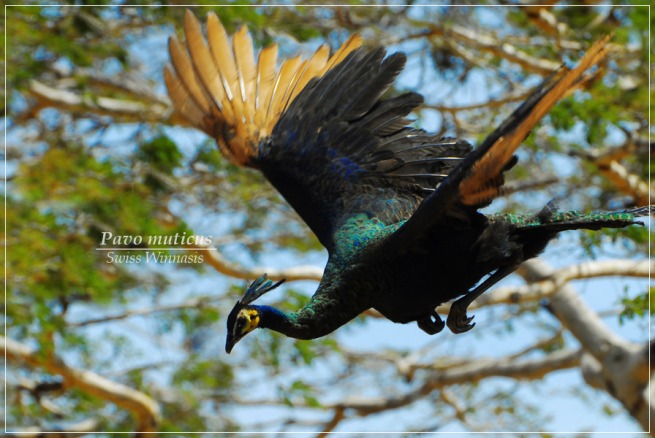
Here's an interesting malesin Thailand taken by a Japanese blogger, they appear to be spicifer:
img_496586_10874259_6

img_496586_10874259_5


It's unfortunate that Thai website all about Green Peafowl with the many great photographs you had uploaded before is gone, the one with families of spicifer and annamensis pictures. Right now, it seems to be all about siamensis in Thailand.

And another similarly peculiar bird:
http://art43.photozou.jp/bin/photo/62111867/org.bin?size=800

I also wonder about the breeding system of Green Peafowl now. I thought they were monogamous as you mentioned before but it is strange that Fritz's observations suggest they are polygamous, while Dani found some studies that show there are more females than males....

I also wonder if true mutations of Green Peafowl are possible and have been recorded; with leucism and melanism it may be possible? I know about the white Tonkin imperator, sad to know there's none left; the artworks by the Japanese and Chinese is all that's left for us to imagine what these mythical birds looked like. Were their ocelli coloured not white?

I'm almost finished my illustration of the peacocks.
 
Last edited:
Hi Frank,
Resolution is very busy with his animals in his farm, while I did not feel like drawing last week.

I had been frustusted as I had asked AndyPeafowlSanctuary on 22/10/11 to send me the photoes of opened wings of his/her peafowls, he/she said he/she will do when he/she is not busy, then he/she forgetten about me,
barnie.gif
so I remindered AndyPeafowlSanctuary on 22/11/11, and I told him about I making illustrations of peafowls, but no reply from AndyPeafowlSanctuary.
he.gif


I were asked him/her to send me the photoes of open (spread) wings of
adult spalding peafowls, (both IB and BS) both sexes
1-year-old BS peacock
2-year-old BS peacock
Adult BS (Black-shouldered) peacock
Adult Midnight peacock

For making future illustrations of peafowls.

I looked for a photo of a flying javanese green peahen with right upper wingcoverts, flying downward from branch, but the photo was missed
rant.gif
I need for illustration of Javanese green peahen.

Can you please help me.
frow.gif


Clinton.
 
Last edited:
Dani,
Thankyou very much for your help, I appreciated your help.
smile.png


Question: Was Javanese peafowls from Baluran (East Java), the pavo javanensis baluranensis ???

Clinton
 
I'm giving peafowl a break for a while and let some of the peafowl hobbyists room to participate. I'll be back in a few days. Franky your links won't work for me.
To answer your question regarding behavioral ecology of Green Peafowl, it is very difficult to distinguish genders of immature and juvenile birds in the field.
There may be more females at any given time seen with adult males. This does not mean that all the females are mated. Indeed, what people are generally seeing are family units looked over by a local territory holding male- often the sire of some of the group and uncle or socially related to other juveniles in the group. In nature, Green Peafowl do not go to nesting until they are four or five years of age. Indian Peafowl mature earlier. Males "showing off" their trains are signaling something communicative to their group- not trying to attract a mate. The same pair will remain together indefinitely.

I hope that those of you truly interested in Green Peafowl will study behavioral ecology in college and learn to be objective field biologists. There are many passionate bird watchers that have become self-styled experts on pheasants as we can appreciate with some of the pheasant societies. These bird watchers become field biologists by experience but their foundations in understanding will always be biased by their lack of objectivity.
There is a much smaller pool of individuals interested in Peafowl, and they too are not trained field biologists but at least they live with their birds. Anyone and everyone has much to learn from Fritz even if he is not a trained scientist.

In order to contribute to the conservation of these birds you must be able to publish in peer-review journals or collaborate with those that do.

I know of two mutations in wild Green Peafowl populations. There is the "trainless male", which never grows ocelli in the train or even suggestions of them. They can probably be observed in any population of wild Green Peafowl regardless of species of race.
Some of these birds will eventually grow some version of a slightly elongated train but not until their seventh or eighth year- and subsequently may lose their vestigial train plumes during moult one year and replace it with the unmarked short train of previous seasons. These birds will also not lose their entire train of coverts like an adult male but rather hold on to them like a female.
Another mutation is the white form once present around the Gulf of Tonkin. I think that they were white but being green peafowl, the structural morphology of the plumes themselves is different from that of an Indian peafowl. Consequently, when a pure Green Peafowl is white, it is iridescent and rather yellowish pink, greyish or dunn in appearance- at least on certain regions of the body and in the umbra of the train. When white peafowl of any species are fed specific diets -especially the breeding pair- their chicks will hatch with additional genes turned on that expressed - give the birds much more visually arresting traits. Iridescence for example.
The "Harlequin Jade" peafowl of Japan are descended of Tonkin whites and normally hued Sri Lanka peafowl. There were probably very few if any Sri Lanka females carried to this region of Japan but many pairs of Green Peafowl of the Tonkin form but logically Burmese and Javanese birds as well. Again, founder population genetics- are at work with females of the Tonkin race- generally of the white sport being the most frequent gift to the Chrysanthemum Throne - males of other forms of Green Peafowl of varying number and those of the Sri Lanka race of the Indian were introduced intermittently over many centuries of Japanese isolation. The Harlequin with normal coloured umbra are very rare. It is more common to see piebald birds with normal hued ocelli and white birds with normally coloured heads and crests- with visible umbra in the train but with no colour per se- only the morphological structure of the Green Peafowl train and iridescence. There were once flocks of the original Peony Harlequin which was all white with coloured centres of the neck and breast, the back plumes, the train- and the umbra naturally coloured. The hard quill in their plumes were dark but the ratchis white.
There are skins of this bird to be seen but not photographed in Nara preserved on the walls of the Summer Palace.
 
Last edited:

New posts New threads Active threads

Back
Top Bottom