Wheaten genetics

chikenkid617

In the Brooder
Joined
Feb 17, 2026
Messages
37
Reaction score
41
Points
37
Hi, I'm just curious how wheaten genetics work when crossing to duckwing. I'm hoping to make blue (gold) wheaten and silver wheaten/salmon in the main breed I work with, and I am using blue breasted red to wheaten to make the blue wheaten and silver duckwing to wheaten to make silver wheaten. I'm just curious how many generations this will take, chicken genetics calculator says wheaten to duckwing makes duckwing and you have to cross those to wheaten to get more wheaten, but ai, Google, and other threads here say wheaten is dominant over duckwing, so I'm just curious which is true. I know how BBS and gold/silver genetics work, just asking about the wheaten to duckwing :). Thank you!
 
Hi, I'm just curious how wheaten genetics work when crossing to duckwing. I'm hoping to make blue (gold) wheaten and silver wheaten/salmon in the main breed I work with, and I am using blue breasted red to wheaten to make the blue wheaten and silver duckwing to wheaten to make silver wheaten. I'm just curious how many generations this will take, chicken genetics calculator says wheaten to duckwing makes duckwing and you have to cross those to wheaten to get more wheaten, but ai, Google, and other threads here say wheaten is dominant over duckwing, so I'm just curious which is true. I know how BBS and gold/silver genetics work, just asking about the wheaten to duckwing :). Thank you!
If what you really want is chicks that are pure for the Wheaten gene (E^Wh), then you should be able to get some in the second generation. For that, it does not really matter whether Duckwing is dominant over Wheaten or vice versa.

Cross the Wheaten and the Duckwing, and you've got chicks that are E^Wh/e+ (one Wheaten gene, one Duckwing gene.)

Breed those chicks back to Wheaten, or breed them to each other, and you should get some chicks that are E^Wh/E^Wh (pure for Wheaten). That would be about 50% if you crossed back to Wheaten, or 25% if you breed the crossed chicks to each other.

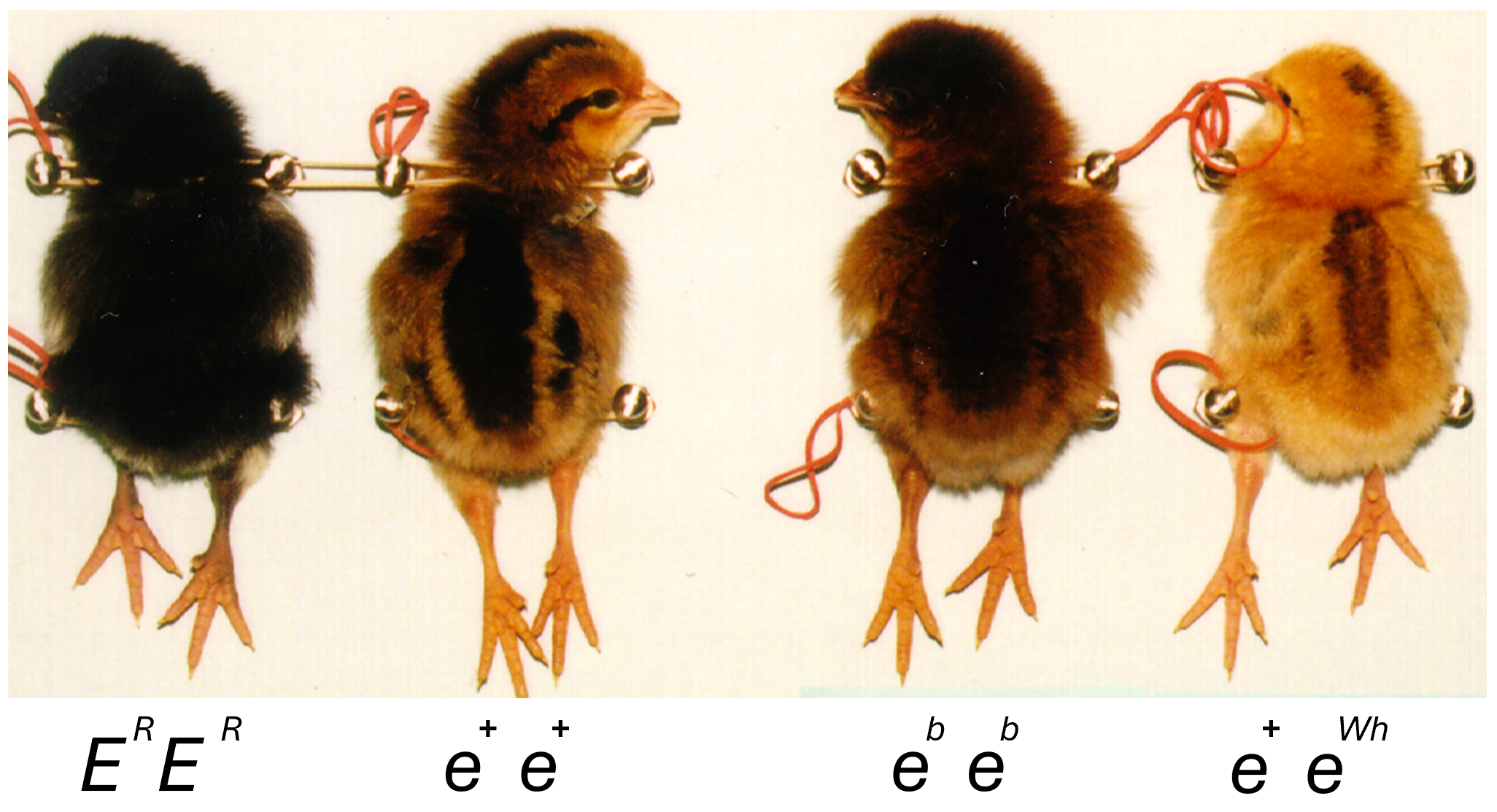
I would take a good look at your Wheaten chicks and your Duckwing chicks, then at the crossed chicks you produce. Taking photos might be a good idea. Duckwing chicks usually have clear stripes in the down. Wheaten chicks mostly do not. Mixed chicks tend to have some amount of striping.

When you get some pure Wheaten chicks in your second or later generations of breeding, you can probably pick them out by sight, just based on the down color. Mark them, or put them in a separate pen, and choose your next generation of breeders from them. After that, the Duckwing gene should be gone, so you will not have to think about it any more.

I know how BBS and gold/silver genetics work, just asking about the wheaten to duckwing :).
There may also be some other genes involved in making good wheaten vs. good duckwing chickens, but breeding back to Wheaten for a few generations will probably fix most of them.

 
Hi, I'm just curious how wheaten genetics work when crossing to duckwing. I'm hoping to make blue (gold) wheaten and silver wheaten/salmon in the main breed I work with, and I am using blue breasted red to wheaten to make the blue wheaten and silver duckwing to wheaten to make silver wheaten. I'm just curious how many generations this will take, chicken genetics calculator says wheaten to duckwing makes duckwing and you have to cross those to wheaten to get more wheaten, but ai, Google, and other threads here say wheaten is dominant over duckwing, so I'm just curious which is true. I know how BBS and gold/silver genetics work, just asking about the wheaten to duckwing :). Thank you!
I would like to know what you get from your crosses. What breed are you working with?

Silver and gold are sex-linked so you should make your first cross Silver Duckwing males to Wheaten females. This will give you silver F1 progeny of both sexes (the males will be heterozygous S/s+). You can use a blue splash (Bl/Bl) male or female to cross to a gold Wheaten to produce all blue hybrid progeny.

I would like to know how dominant the wheaten allele is in this cross. I have only dealt with wheaten crosses where Columbian (Co) was involved and wheaten showed some dominance, but I would have characterized it as incompletely dominant.

Your Wheaten should have wheaten chick down. There should be reduced black and mostly straw colored down. The adults should have a cream undercolor. The undercolor is just the fluff at the base of the feathers, so if you spread the feathers on the back of a wheaten bird the undercolor should be cream colored. If you do this for your Silver Duckwing birds the undercolor will be gray. I am near sighted so I could take off my glasses and blow on the back of a bird to see the undercolor.

The hybrid chicks may be intermediate in down type and have reduced black in the striped down. The adult hybrid males will likely look like Silver Duckwing because wheaten reduces the black in the hackle and saddle, and Silver Duckwing have other modifiers reducing the black in the hackle and saddle. The hybrid male undercolor is supposed to be cream colored (for dominant wheaten), but it may only be a lighter shade of gray (that is what it was for me, but Co was present in my crosses). The hybrid females may show some wild-type stippling, but they will not be a clean silver body color. Dominant wheaten should distribute the salmon pigment over the body of the bird, so they should be a light wheaten color. Their undercolor should be cream, but it may be light gray.

So, I'd like to know how this cross turns out. Thanks.

Ron Okimoto
 
I would like to know what you get from your crosses. What breed are you working with?

Silver and gold are sex-linked so you should make your first cross Silver Duckwing males to Wheaten females. This will give you silver F1 progeny of both sexes (the males will be heterozygous S/s+). You can use a blue splash (Bl/Bl) male or female to cross to a gold Wheaten to produce all blue hybrid progeny.


Ron Okimoto
Are you really Dr. Ronald Okimoto from "The Classroom at the Coop forums"? Poultry Geneticist Supreme. I was just a hatchling when I was reading your amazing posts and responses on that Amazing forum (now defunct) filled with Amazing Poultry enthusiasts. In 2005 transitioned to industry, joining a broiler breeder company and stopped posting at The Coop forums and we missed you dearly. You retired on 2024. Does that mean you will be posting here more frequently?


it's been my experience that basic wheaten (Think Salmon Faverolle) behaves as Codominant (like OEGB). The chick down will show faded/incomplete chipmunk stripes as chicks and the females will have a salmon breast but show much salmon pheomelanin on the body

2025-01-13_13-43-43.png
 
Last edited:
Are you really Dr. Ronald Okimoto from "The Classroom at the Coop forums"? Poultry Geneticist Supreme. I was just a hatchling when I was reading your amazing posts and responses on that Amazing forum (now defunct) filled with Amazing Poultry enthusiasts. In 2005 transitioned to industry, joining a broiler breeder company and stopped posting at The Coop forums and we missed you dearly. You retired on 2024. Does that mean you will be posting here more frequently?


it's been my experience that basic wheaten (Think Salmon Faverolle) behaves as Codominant (like OEGB). The chick down will show faded/incomplete chipmunk stripes as chicks and the females will have a salmon breast but show much salmon pheomelanin on the body

2025-01-13_13-43-43.png
Yes, I am the Ron Okimoto that used to post on The Coop decades ago. This is a repost since I seem to have gotten into trouble for telling you that I have a blog and posting a link. As you note I have retired.

I signed up for this forum because I wanted to find out attributions for photos that show up on Google searches, but clicking on them only takes you to this forum, and there is no other evidence that they came from here or who posted them.

Thanks for your description about Wheaten. It is what I expect, but Kimball in the 1950's claimed that the cream wheaten undercolor was dominant among his crosses. He was using wheaten birds that did not have Columbian restriction. My experience is with New Hampshire Reds and that cross is complicated by Columbian and gold diluters. As you say it was codominant or incompletely dominant for undercolor and down in terms of black dilution in the down of Columbian chicks. The e+/eWh chick from one of my powerpoint presentations that you posted above is a New Hamp X Light Brown Leghorn hybrid.

Ron Okimoto
 
Yes, I am the Ron Okimoto that used to post on The Coop decades ago. This is a repost since I seem to have gotten into trouble for telling you that I have a blog and posting a link. As you note I have retired.

I signed up for this forum because I wanted to find out attributions for photos that show up on Google searches, but clicking on them only takes you to this forum, and there is no other evidence that they came from here or who posted them.

Thanks for your description about Wheaten. It is what I expect, but Kimball in the 1950's claimed that the cream wheaten undercolor was dominant among his crosses. He was using wheaten birds that did not have Columbian restriction. My experience is with New Hampshire Reds and that cross is complicated by Columbian and gold diluters. As you say it was codominant or incompletely dominant for undercolor and down in terms of black dilution in the down of Columbian chicks. The e+/eWh chick from one of my powerpoint presentations that you posted above is a New Hamp X Light Brown Leghorn hybrid.

Ron Okimoto
Wow. Dr. Ron Okimoto, the Legend himself. I believe That there are multiple wheaten e alles or multiple genes That affect it's expression as chick down can vary even in the same clutch
 
There are multiple possible wheaten alleles. Before I left the university we had identified two possible wheaten alleles. One in New Hampshire Reds, Buff Minorcas and commercial Rhode Island Reds. There was another possible wheaten allele in Speckled Sussex that are suppposed to be recessive wheaten. It had an e+ coding sequence, so the variant likely had something to do with regulation of the gene. Davila et al., 2014 found the same coding sequence in their Spanish recessive wheaten line. You likely recall that I developed PCR tests for the alleles that my lab had identified, and I found another likely wheaten allele in Murray McMurray Buff Rocks. I do not have the full coding sequence, but it had the polymorphism that likely reduced the production of eumelanin by the receptor in the eb allele. There have been others that have since published similar sequence and other possible wheaten alleles. There may be 4 or 5 of them.

I could post the E locus articles on my Blog here, but I do not know how to do that. I see that there is a section for posting new articles. I don't copyright the blog articles and they would have to remain open access, and I do not care about use of the articles as long as the users state where they got the article from. Signing onto this web site seems to be required to access the articles, but that is OK with me since sign up is free. The articles on my blog are not peer reviewed, so I am the only one responsible for the content. There likely is some review process for getting articles posted on this forum. You seem to have moderators that have the thankless job of keeping objectionable material off this site.

Ron Okimoto
 

New posts New threads Active threads

Back
Top Bottom