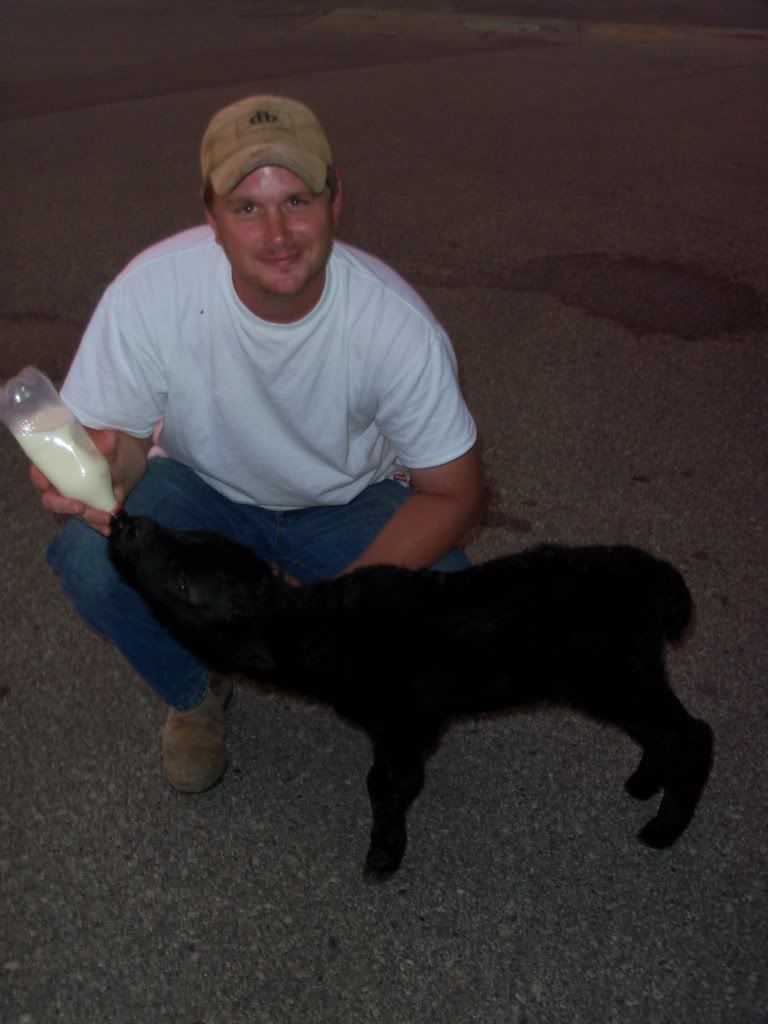
Hi, there! Good to see some familiar names on here. Thanks, guys, for calling me 'nice people'. I haven't been on here in quite some time because I've been working as the Chairperson for the Yak Meat Nutrition Committee for IYAK. It's been a big project, and has consumed the majority of my 'free time'. One of my BYC friends who also keeps in touch with me on FB, alerted me to this thread.
9gerianMile, welcome to the world of yakking! It's a really awesome world to be in.
These animals are amazing, and you will never tire of them. They simply won't let you.
You mentioned that one of the founders of IYAK lives there in MT. I'm assuming that you are referring to Larry Richards. He's a wonderful guy, and he owns my personal favorite yaks out there. I have not yet been able to purchase any of his animals, but would love to add some to my future breeding program. I just got back from the NWSS in CO, where IYAK holds its annual member meeting. I took some pics of Mr. Richards and some of his animals. If you're ever on FB, look me up (Michigan Yakkers). The pics are posted there. If you ever have the opportunity to pick up a couple of his animals, I would highly recommend it.
Green Bay Yakkers are also good people. We purchased our first herd of 8 from them. Our bull, Raven, came from there and I have high hopes in regard to his genetics.
IYAK is fairly new, and is still working out all the kinks. You should definitely become an active member, but be careful about what you read on other members' webpages. For example, be careful about any comparisons to fish or chicken. As I mentioned, I chaired a meat committee this past year. My job was to procure the first yak meat labels for IYAK. We received samples from 10 farms, from various geographical regions. Those samples were sent to a lab in Chicago, where they were combined and analyzed. We now have our first 3 yak meat labels and Certificates of Analysis, which are posted on the IYAK page. We're currently in the process of having our info added to the USDA database. The results were very favorable. The data confirmed that yak meat is incredibly nutritious, and is very comparable to grassfed beef and bison.
As Turkeyrangler mentioned, our niche market is for health conscious gourmands. What takes our meat above bison and grassfed beef is the flavor. In my opinion, it really is the best tasting beef out there. The biological makeup of these animals results in a very lean meat that remains juicy and flavorful when cooked. It cannot be aged, because it is so very lean. It doesn't need to be, though. It's amazing just the way it is. Some of the original IYAK board members used an old report that was privately owned, and took that data to use in their marketing plans. The reason that I worked on this project for IYAK this past year is because:
a) The old study was owned by a private individual. Lab reports can only be used by the individual or group that pays for the study.
b) The old study was performed using samples of meat from only that one farm, years ago. We wanted to see if yak meat samples from various regions would result int he same data.
Some of the people who were involved in the yak business back then took the privately owned data and ran with it, sometimes making their own interpretations and claims in the process. Through the years, some of the claims and statements were accepted as 'common knowledge'. IYAK is working hard to sort through all the data to make sure that what is published is truly accurate. As I said, we definitely know that our meat is very nutritious. So is salmon and chicken in certain circumstances. People who buy yak meat are not going to be buying chicken off the shelf of a grocery store. Pasture raised chicken without hormones and antibiotics is probably every bit as nutritious as yak meat, as would be wild salmon. These meats are just so different, though, that it's ludicrous to make statements of comparison.
Another thing to be careful about... there is not yet any kind of 'breed standard' set in place for yaks. IYAK is working on that. Anyone who is making claims that their animals are better, or worth more money, etc, needs to be able to give some very detailed reasons as to why. Be careful who you buy from, and why. The value of a yak depends largely on what you want to raise them for. There are yaks that are bred for wool production, yaks that are bred for temperament, yaks that are bred for meat, and even yaks that are bred for a specific color pattern. Think about why you want yaks, and what kind of yaks would be important for you to have. Then find people who have those kinds of yaks. Since there aren't many yaks in the USA right now, it's important to think about bloodlines. You already mentioned that, so you're aware.
Feel free to contact me if you have any questions. Larry Richards is a fount of yak knowledge, as is Mike Swartz, Eddy Sanders and Jim Watson (all may be found on IYAK). Different yak owners have different breeding programs and farm philosophies, so they may give you a bit different information. Decide what your farm philosophy is and choose someone who is operating as closely to your approach as possible. You may change things as you go along, too.
By the way, yaks are fence testers and they eat more than what used to be posted as 'common knowledge', unless you just want to have some really skinny yaks. Be sure your fencing is adequate before the yaks arrived. If you are going to have the yak bull by himself for awhile before his gals arrive he will be a bit depressed. They are herd animals and they don't like to be alone. He will test your fencing to try to find his buddies. We were told that yaks are not fence testers, and boy were we surprised to find out differently. We ended up having to line our split rail fencing with cattle fencing, and then added hot wire when that didn't work. The hot wire did the trick, but we've even had some who will jump right through hot wire if we try to separate them.
Best of luck to you, and do stay in touch if you need anything.
-Cayce Kelly