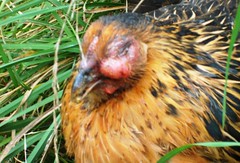
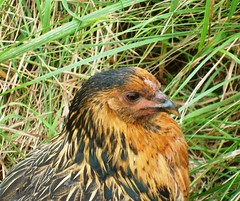
Always rinse the eye and then, after a few minutes of it draining, use Terramycin ointment in the eye.
Honestly if you want to treat for respiratory, I'd recommend trying Tylan injectable. Without knowing exactly what bacteria is causing it, it's one of your best choices.
If you smell something very nasty in that eye/nose drainage of any birds with respiratory (not injury) = usually coryza (susceptible to Tylan)
If you see mucus and slobber from their beaks = usually pasteurella (especially with neck twisting - suspectible to Sulmet)
Otherwise, it could be a number of other things. Bubbling in the eyes usually indicates one of the mycoplasma diseases but not necessarily as a rule. But there are more than ONE kind of mycoplasma. There's MG, and then there's at least there other kinds - more commonly Mycoplasma synoviae. MG and MS are supposed to be susceptible to Tylan.
Tylan is best given by injection as Tylan50 in the breast muscle - a different spot each injection, 3 days. It may cause a little muscle burn but it's much less deadly than a respitory illness. Please let us know, if you yourself choose to use a medicine like Tylan, if you need a dosage.
Again - in ALL of these cases it's best that a vet (any vet) do a simple swab and send it off for a culture and sensitivity. In a C&S, they grow the bacteria on a plate that has antibiotic discs. They identify the bacteria - exactly ... no guessing - by name. The discs around which the bacteria don't grow are the antibiotics to which the bacteria are susceptible - the antibiotic of choice.
Also, always give full nutrition to these birds. Use probiotics daily during any illness. Yogurt if you aren't using a -mycin or -cycline med (read the active ingredients in the label). Otherwise please use either Probios dispersible powder from the feedstore, or acidophilius capsules from the vitamin section of the drug store. All probiotics are best given in a quickly eaten damp mash - a tiny amount so you make sure they all get it.
Also consider using VetRx to swab all the nares (nostrils) of the birds, swab the roof of each beak, etc. This helps open airways, facilitate breathing, and possibly reduce inflammation.
A bird that can't breathe won't eat; a bird that won't eat won't live. So faciliate their breathing.