Light, Buff, Dark, Gold, Black, White, Blue, and Blue Columbian.
Breed Size
Large Fowl
APA/ABA Class
Asiatic
There has been considerable controversy over the true origins of the Brahma breed, but appears to have developed in the US originally, from birds imported from China. They were send off from the port of Shanghai and were thus known as "Shanghai birds". Brahmas as we know them were first exported to England in December 1852, when George Burnham sent nine "Gray Shanghaes" to Queen Victoria as a gift. The Dark Brahma variety was developed by English breeders from this stock and later exported to the United States, where the Brahma was the principal meat bird from the 1850's to around 1930. Some of these birds were very big, with males weighing in at up to 18 lb and females at 13 lb.
The Light and Dark Brahma were developed and included in the first edition of the American Poultry Association's Standard of Perfection in 1874 and the Buff variety was added in 1924. The Australian Poultry Association has accepted black, blue, partridge, crele and barred varieties of Brahma in addition to the standard light, dark, and buff.
Brahma eggs
Brahma chick
Brahma juveniles
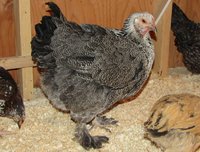
Brahma hen
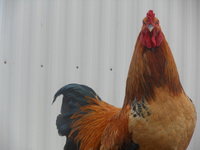
Brahma rooster
For more about Brahmas and their owners' and breeders' experiences with this breed, see our breed discussion here:
Pros: So fluffy!
Cuddly
I love the feather pattern!
Cons: not heat hardy
My brahma is so cuddly and fluffy. I love her so much even though i'm pretty sure she hates me. I'm in New England, and we have cold winters (why I got a brahma) and very hot summers (which i forgot to consider). Also very unpredictable weather. My Light brahma is very big and covered with dense fluff, not great when we got a heat wave this year. However I'm definitely getting more brahmas, I love their massiveness, maybe a buff.
I do love the Brahmas. Like others I am looking for the Giant Brahma that you commonly see on the internet. Please help. I can not seem to find them any where. If any of you have them let me know I just want some eggs to incubate. Thank you have a great day all.
There is no "giant Brahma." The ones you have seen are simply Brahmas. They get very large, and people videoing them will choose an angle where it makes them look even larger than they actually are.
So there has been a video going around about the GINORMOUS brahma chicken that looks like its 4ft tall. My sweet neighbor is dying to have one so I am wondering does this really happen? I want to gift her one if I can but I don't want to get her hopes up if they truly don't get that big... Can anyone help me with this?
There is no "ginormous Brahma." The ones you have seen are simply Brahmas. They get very large, and people videoing them will choose an angle where it makes them look even larger than they actually are.
So there has been a video going around about the GINORMOUS brahma chicken that looks like its 4ft tall. My sweet neighbor is dying to have one so I am wondering does this really happen? I want to gift her one if I can but I don't want to get her hopes up if they truly don't get that big... Can anyone help me with this?
I have Blue Partridge Brahmaand they are very rare in the USA! I will be selling hatching eggs this spring!
Takes a second to wrap your head around this....The overall color variety is called Blue Partridge Brahma. The Andalusian Blue gene that is responsible for their blue color in one mating hatches chicks in 3 different colors. Below, is how the gene works. The lighter ones are called splash and or red pyle or can be a very light blue. You will also have chicks that are black and gold/red called Gold and lastly, Blue and Gold/red are blues. It is very hard with real accuracy to tell the difference between a blue or gold blue partridge Brahma chick until they are about 3-5 weeks of age....
How the Andalusian Blue Gene works For Black, Blue, and Splash (BBS)
When breeding with the andalusian blue gene, one mating can give you 3 colors of chicks.
The gene for Andalusian Blue is a WYSIWYG gene. The visible plumage color is the color of the genetics. There is no need to do test matings to find out if it is present. The gene is a dominate blue, effecting black and little effect on red. The blue gene not present is a black bird (Feathers are Black and Gold), one blue gene will change a black bird to blue ( Blue and red) where 2 blue genes will change black to a whitish bird with splashes of gray/blue/red.
Below is the different combinations of matings between the 3 colors of BBS. The percentages are based on 100 chicks hatched.
I have Blue Partridge Brahmaand they are very rare in the USA! I will be selling hatching eggs this spring!
Takes a second to wrap your head around this....The overall color variety is called Blue Partridge Brahma. The Andalusian Blue gene that is responsible for their blue color in one mating hatches chicks in 3 different colors. Below, is how the gene works. The lighter ones are called splash and or red pyle or can be a very light blue. You will also have chicks that are black and gold/red called Gold and lastly, Blue and Gold/red are blues. It is very hard with real accuracy to tell the difference between a blue or gold blue partridge Brahma chick until they are about 3-5 weeks of age....
How the Andalusian Blue Gene works For Black, Blue, and Splash (BBS)
When breeding with the andalusian blue gene, one mating can give you 3 colors of chicks.
The gene for Andalusian Blue is a WYSIWYG gene. The visible plumage color is the color of the genetics. There is no need to do test matings to find out if it is present. The gene is a dominate blue, effecting black and little effect on red. The blue gene not present is a black bird (Feathers are Black and Gold), one blue gene will change a black bird to blue ( Blue and red) where 2 blue genes will change black to a whitish bird with splashes of gray/blue/red.
Below is the different combinations of matings between the 3 colors of BBS. The percentages are based on 100 chicks hatched.
I have Blue Partridge Brahmaand they are very rare in the USA! I will be selling hatching eggs this spring!
Takes a second to wrap your head around this....The overall color variety is called Blue Partridge Brahma. The Andalusian Blue gene that is responsible for their blue color in one mating hatches chicks in 3 different colors. Below, is how the gene works. The lighter ones are called splash and or red pyle or can be a very light blue. You will also have chicks that are black and gold/red called Gold and lastly, Blue and Gold/red are blues. It is very hard with real accuracy to tell the difference between a blue or gold blue partridge Brahma chick until they are about 3-5 weeks of age....
How the Andalusian Blue Gene works For Black, Blue, and Splash (BBS)
When breeding with the andalusian blue gene, one mating can give you 3 colors of chicks.
The gene for Andalusian Blue is a WYSIWYG gene. The visible plumage color is the color of the genetics. There is no need to do test matings to find out if it is present. The gene is a dominate blue, effecting black and little effect on red. The blue gene not present is a black bird (Feathers are Black and Gold), one blue gene will change a black bird to blue ( Blue and red) where 2 blue genes will change black to a whitish bird with splashes of gray/blue/red.
Below is the different combinations of matings between the 3 colors of BBS. The percentages are based on 100 chicks hatched.
I have all three varieties, Dark, Light, Buff. I’ve raised other chicken varieties before these girls. Only negative thing I have found with Brahma breed, their not very smart. Other than that, they are a wonderful breed. Going into the first winter with these girls, we’ll see how they do!
I have Blue Partridge Brahmaand they are very rare in the USA! I will be selling hatching eggs this spring!
Takes a second to wrap your head around this....The overall color variety is called Blue Partridge Brahma. The Andalusian Blue gene that is responsible for their blue color in one mating hatches chicks in 3 different colors. Below, is how the gene works. The lighter ones are called splash and or red pyle or can be a very light blue. You will also have chicks that are black and gold/red called Gold and lastly, Blue and Gold/red are blues. It is very hard with real accuracy to tell the difference between a blue or gold blue partridge Brahma chick until they are about 3-5 weeks of age....
How the Andalusian Blue Gene works For Black, Blue, and Splash (BBS)
When breeding with the andalusian blue gene, one mating can give you 3 colors of chicks.
The gene for Andalusian Blue is a WYSIWYG gene. The visible plumage color is the color of the genetics. There is no need to do test matings to find out if it is present. The gene is a dominate blue, effecting black and little effect on red. The blue gene not present is a black bird (Feathers are Black and Gold), one blue gene will change a black bird to blue ( Blue and red) where 2 blue genes will change black to a whitish bird with splashes of gray/blue/red.
Below is the different combinations of matings between the 3 colors of BBS. The percentages are based on 100 chicks hatched.
I have Blue Partridge Brahmaand they are very rare in the USA! I will be selling hatching eggs this spring!
Takes a second to wrap your head around this....The overall color variety is called Blue Partridge Brahma. The Andalusian Blue gene that is responsible for their blue color in one mating hatches chicks in 3 different colors. Below, is how the gene works. The lighter ones are called splash and or red pyle or can be a very light blue. You will also have chicks that are black and gold/red called Gold and lastly, Blue and Gold/red are blues. It is very hard with real accuracy to tell the difference between a blue or gold blue partridge Brahma chick until they are about 3-5 weeks of age....
How the Andalusian Blue Gene works For Black, Blue, and Splash (BBS)
When breeding with the andalusian blue gene, one mating can give you 3 colors of chicks.
The gene for Andalusian Blue is a WYSIWYG gene. The visible plumage color is the color of the genetics. There is no need to do test matings to find out if it is present. The gene is a dominate blue, effecting black and little effect on red. The blue gene not present is a black bird (Feathers are Black and Gold), one blue gene will change a black bird to blue ( Blue and red) where 2 blue genes will change black to a whitish bird with splashes of gray/blue/red.
Below is the different combinations of matings between the 3 colors of BBS. The percentages are based on 100 chicks hatched.
Hello, today my hubby brought home 5 Brahms's and 5 Ameracana but he can't remember which is which...
5 have bluish black beaks & feet...which breed of chicks have those colors?
Hello, today my hubby brought home 5 Brahms's and 5 Ameracana but he can't remember which is which...
5 have bluish black beaks & feet...which breed of chicks have those colors?
Hello, today my hubby brought home 5 Brahms's and 5 Ameracana but he can't remember which is which...
5 have bluish black beaks & feet...which breed of chicks have those colors?
LOVE LOVE LOVE this breed!!! Beautiful bird, extremely docile, and loves sitting on my lap. By far my favorite breed, will always have one in my flock.
Are Brahma roos as sweet as the hens? Or rather, less aggressive than some other breeds?
Have 2 Buff hens and love them to pieces, and am getting 4 Light this spring, but just in case I accidentally get a roo, I want to have an idea of whether to get rid of him immediately. Also EE roos' temperament? Thanks!