Arizona Chickens

Hey everyone. First day on the computer after leaving for Oregon on the 16th. Enjoying our trip, our friends have three chickens here but they leave them locked in the coop/run so I don't get much ineraction with them. One of my hens that was trying to go broody died on my dads watch last Thursday or Friday. I feel bad for him having to find her. I am really hoping it was one of the older hens and not my 7 month old EE, one of my favorites. I'll find out Saturday who it was when I return home to do my chicken count. I'll be in the market for another hen come Sunday if anyone one has one they are looking to rehome. Not particular of breed but would like some variety and one that is free of mite/lice or anything else that might harm my flock.

Be back online Sunday.

~Selina
 
Hello all, it has been a long time since I've been on the boards. I went to check on my chickens the other day and found over half of the flock dead
barnie.gif
The neighbors dogs had gotten into my big pen and killed 37 of my chickens, many of which were just hatched in November.. Luckily I had hatched a dozen blue eggs from the beatiful chickens (eggs) I bought from Mahonri (along time ago), and they were seperated because they are only about 3 months old. The stinky dogs got all but one of my BCM hens and most other breeds. The common white leghorns of course were the ones that somehow survived. My husband went over and nicely explained that their dogs killed my chickens and they had to pay for them, and she said ok and wrote me a check on the spot, and then got rid of her dogs.
smile.png
So now I am looking for some BCM eggs and others too. Does anyone in the valley breed BCM's. I ordered the last ones online and had a really bad hatch rate.
 
So the coop is now finished and it is time to focus on the watering and feeding system. I am mainly concerned with the watering system, living in Gilbert, I am afraid if I do not have a constant water flow, the water will get stagnant and grow algae. I have 5 nipples to be installed in PVC and am thinking about hooking up a constant water supply to a PVC pipe on a low pressure system hitch will feed water directly to the nipples. Any thoughts on this and if it will work before I spend the time and money on building it. Thanks for the info, this site is a Mecca of valuable info!!!
 
So the coop is now finished and it is time to focus on the watering and feeding system. I am mainly concerned with the watering system, living in Gilbert, I am afraid if I do not have a constant water flow, the water will get stagnant and grow algae. I have 5 nipples to be installed in PVC and am thinking about hooking up a constant water supply to a PVC pipe on a low pressure system hitch will feed water directly to the nipples. Any thoughts on this and if it will work before I spend the time and money on building it. Thanks for the info, this site is a Mecca of valuable info!!!
Here is what I do. I have a line coming off of my water system for my yard bushes to a container for them that will go off daily. The container is large enough so they can drink out of it or play in it if it gets too hot.(they have never done it yet) It refills itself daily at 8:30 when the water system goes off in my backyard. I go out before that usually and dump the water left from the day before and dump it under my coop so they have cooler dirt to sit in during the heat.The backyard water system refills the container. It is simple but works. I also use the irrigation system to hook to my misters that are inside PVC piping along the roof of their cage.
Kris
 
Last edited:
itsredcandy, sorry to hear about your hen. It's a tough time to be broody in AZ, especially when you can't be there to help.

beverlyl, how terrible! Dang dogs. I'm glad at least some of the blue egg layers survived.

icdred, the poultry nipples operate best at about 3 psi or lower, far too low for the pressure in your plumbing system and for most reasonably priced pressure reducers. The pressure regulators that are used to get to that low level of psi are typically very expensive. Most people that plumb nipples into their water supply use a reservoir with a float valve. I used an old cooler for that (you can see how I did it on My Coop page). Whatever you do, make sure that the height of the nipples is either adjustable, or at least set at the height required for adult chickens (tipping head up at about 45 degree angle to drink). The nipples in my coop are a tad bit low and I'm about to re-configure it. Also, you don't really need all that many nipples. Apparently, there are data to suggest that having too many reduces usage (this according to an actual commercial poultry nipple salesman). I have too many in my coop and will reduce it to just two for my seven birds. I'll also add that while I like the peace of mind of having a water source plumbed into my home's water supply, my five gallon bucket nipple waterer properly shielded from the sun doesn't grow a speck of algae. I have it covered in Reflectix radiant barrier insulation. That also keeps the water much cooler throughout the day because it doesn't heat up as much as it otherwise might and it works spectacularly well when I put a frozen gallon jug of water into it.

I also have a large plant saucer that I have connected to the irrigation system like parentwarrior does for my tortoises. However, you should know that such an arrangement comes with some risk if wild birds have access. Lots of wild birds carry pretty bad things that can be transmitted to your chickens through a water source like that. Dumping it daily like Kris does will help lower that risk. Until my wife and I can come to an agreement on a system that allows the torts access but excludes chickens, that's a risk the chickens will have to endure.

 
Last edited:
I had a chicken as a child and was looking to get a couple or hens now that I am moving into a house. what would you recommend? I want a nice chicken that can withstand the climate in Phoenix. Do you need a permit? Any advice is helpful
 
I researched a bit and was thinking about an orpington, australorp, silkie, brahma or delaware. any thoughts? I will have a good size yard were they can roam and have a good size home for them too.
 
I researched a bit and was thinking about an orpington, australorp, silkie, brahma or delaware. any thoughts? I will have a good size yard were they can roam and have a good size home for them too.
Those are all nice laid back breeds.... although Delawares can be comical at times.

An Australorp will be a good layer, silkies are eye candy, Brahmas are calm but they don't lay that well. Orpingtons can lay well if you get a good strain... There is a gal in Goodyear that sells some HUGE BBS Orpingtons and they are beautiful.
 
@Gallo del Cielo

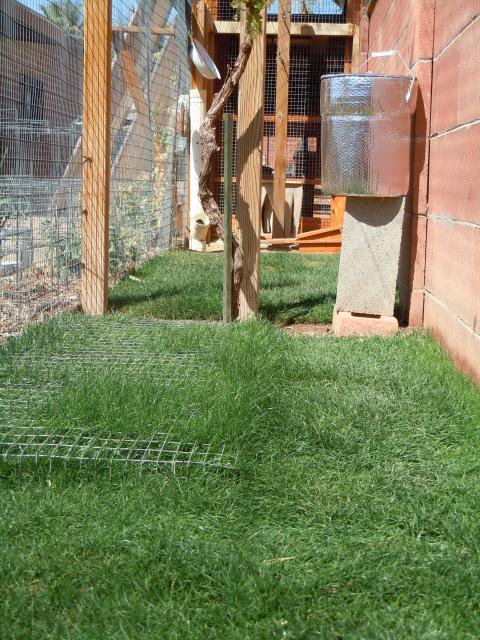
I have a question. I live in Golden Valley, W-A-Y north of you, near Kingman. Our daily temps are lower than Bullhead City but higher than Kingman, normally right in between those temps. I'd LOVE to have grass in my yard for the 'girls,' but that is almost an impossibility, since all we have here is clay, plus the 'girls' are all in tractors. Anyway, I was looking at the last picture you posted, and I am wondering, what is the hardware cloth over the grass for, is it so your girls can't dig the grass up, or is there some other reason that I am not seeing?

Thanks

Photto
 
Hi Phottoman!
frow.gif
I think you're seeing it right. For the past three years I've laid sod down in half of the run right after the first frost when the leaves of the grapevines fall (usually in early Nov.). My girls free range for most of the time, unless we're out of town, in which case they are usually locked up. The grass helps provide something green for them to eat during their confinement. I should note that they otherwise don't spend a whole lot of time inside the run during the winter, when they prefer to move around the yard and hang out in places that are too hot during the summer. So, they don't immediately destroy the grass and it lasts into June. As it heats up in spring, they begin spending the majority of their time inside the run where it is coolest, even though they are free to go anywhere. That's when the grass really starts to take a beating. The wire you see in the pic is a 2' wide X 5' long X 2" deep section of wire left over from the run that helps prevent total destruction of the grass underneath it. It's made from 1" X 2" 14 gauge galvanized wire. As you've deduced, they can't scratch up the roots under the wire so it endures there for a good month or two longer than the unprotected grass. Now as we near the end of July the last of that protected grass is now mostly dead or dying as I've stopped watering it and the grape vines have obscured all sunlight from reaching it. I originally put the wire in there as an experiment and I think I'd recommend it if you had a space that had year-round sun. Mama Hen Chris has a much nicer example of a grass bed protected by wire. She has a wood frame with hardware cloth (maybe vinyl coated?) affixed to the top of it.
 
Last edited:

New posts New threads Active threads

Back
Top Bottom