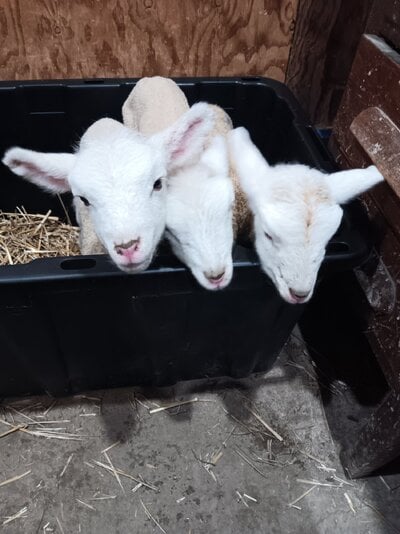
Sheep are something we're not short of in the UK  Where I used to live, down south, I think at one time there were supposed to be more sheep there per square mile than anywhere else in the world!
Ok so, wet adoptions. We'd have singles brought down to the yard, where there were always people around to spot the early signs of a ewe going into labour. We'd have a few little pens made from a couple of sheep hurdles up against the edge of the big singles pen and she'd get moved into one of these. You need to be there ready with a bucket to catch a good slosh of amniotic fluid when it comes. Then take the bucket out of the pen so she can't tip it over.
Grab a lamb and give it a first wash in a bucket of warm (bit above body temp) water with a good bit of table salt mixed in. I've been told a couple of different reasons for doing that - it gets rid of the lamb's old smell, or it helps encourage the adoptive mum to lick it - but whatever the reason, it was part of the process we used that almost always worked. Next, give the lamb a second wash in the bucket of amniotic fluid you collected. Really scrub it in.
At some point either before or after the washing (before is probably easiest), you'll want to tie the lamb's back legs so it can't stand when you put it in with the new mum. Partly this helps convince her it's only just been born, and it also stops the adopted lamb being able to steal the colostrum that the actual newborn lamb needs. Apologies if any of this next bit is teaching you to suck eggs but I'll explain it in detail just in case.
Get about a three foot length (I'm estimating here, you might need to experiment) of baling twine, and tie the ends together so it makes one big loop. Pull the loop tight so you have two "ends" and loop one "end" around one of the lamb's back legs, like this

Do the same with the other "end" of the loop and the lamb's other back leg. Now pull the middle section of twine - both pieces - up between the lamb's front legs and over the lamb's head, so it sits around the back of the neck. You don't want it super tight but the lamb's back feet should be close enough to its face now that it can't stand up. If you go outside the front legs, not between them, the lamb's shoulders won't be in the way and it'll just work the twine down its back until it's free.
Put the wet, tied up lamb in with the adoptive mum as soon as she's given birth to her own lamb. Leave it tied up until the other lamb is standing and has had a good feed.
(I don't have a lamb to hand, but if any of that is confusing I have one chicken who'd probably be willing to act as a model in the morning)
Where I used to live, down south, I think at one time there were supposed to be more sheep there per square mile than anywhere else in the world!Ok so, wet adoptions. We'd have singles brought down to the yard, where there were always people around to spot the early signs of a ewe going into labour. We'd have a few little pens made from a couple of sheep hurdles up against the edge of the big singles pen and she'd get moved into one of these. You need to be there ready with a bucket to catch a good slosh of amniotic fluid when it comes. Then take the bucket out of the pen so she can't tip it over.
Grab a lamb and give it a first wash in a bucket of warm (bit above body temp) water with a good bit of table salt mixed in. I've been told a couple of different reasons for doing that - it gets rid of the lamb's old smell, or it helps encourage the adoptive mum to lick it - but whatever the reason, it was part of the process we used that almost always worked. Next, give the lamb a second wash in the bucket of amniotic fluid you collected. Really scrub it in.
At some point either before or after the washing (before is probably easiest), you'll want to tie the lamb's back legs so it can't stand when you put it in with the new mum. Partly this helps convince her it's only just been born, and it also stops the adopted lamb being able to steal the colostrum that the actual newborn lamb needs. Apologies if any of this next bit is teaching you to suck eggs but I'll explain it in detail just in case.
Get about a three foot length (I'm estimating here, you might need to experiment) of baling twine, and tie the ends together so it makes one big loop. Pull the loop tight so you have two "ends" and loop one "end" around one of the lamb's back legs, like this
Do the same with the other "end" of the loop and the lamb's other back leg. Now pull the middle section of twine - both pieces - up between the lamb's front legs and over the lamb's head, so it sits around the back of the neck. You don't want it super tight but the lamb's back feet should be close enough to its face now that it can't stand up. If you go outside the front legs, not between them, the lamb's shoulders won't be in the way and it'll just work the twine down its back until it's free.
Put the wet, tied up lamb in with the adoptive mum as soon as she's given birth to her own lamb. Leave it tied up until the other lamb is standing and has had a good feed.
(I don't have a lamb to hand, but if any of that is confusing I have one chicken who'd probably be willing to act as a model in the morning)

 Go Team