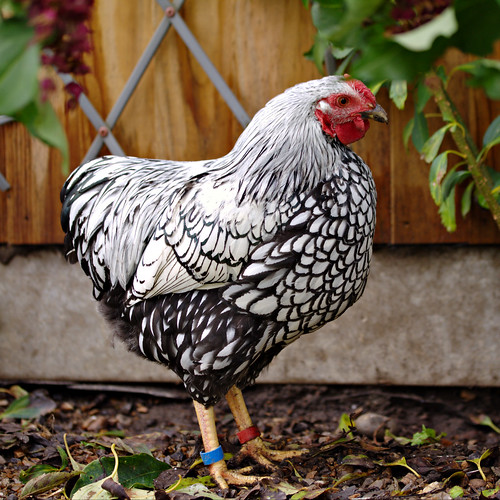
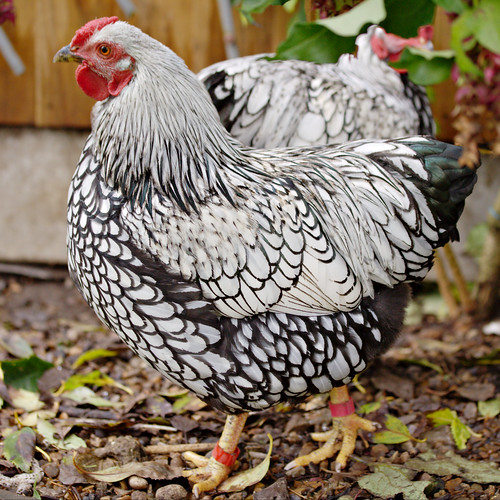
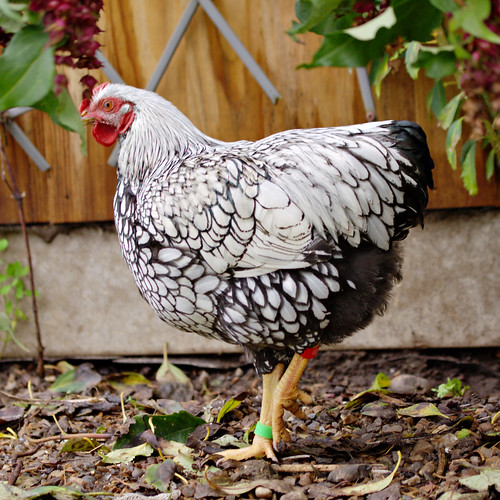
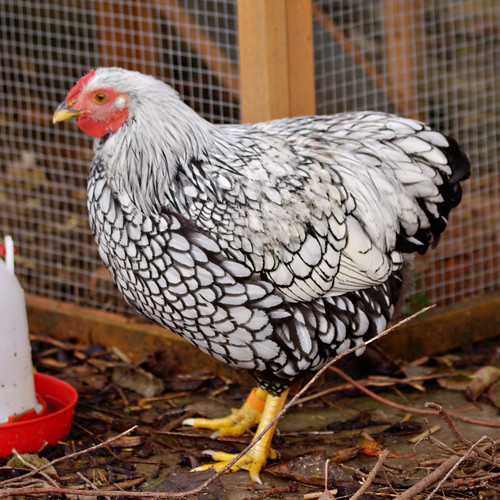
Well firstly, all are very nice birds. They are very "typey" in their shape and profile and have what appear to be appropriate combs, wattles and leg color (some slightly oranger or paler is not note-worthy). And you're right that blue and green are leggier, but at this age, they still have a bit of filling out to do and so often grow into those legs. With regards to shape and underline, blue and green are also less typical in their lack of roundness. They should have a classic "dumpy" shape.
So really just looking at feathering, I would throw out blue as he has too much black. You want the lacing to be clean and distinct with a very narrow black edge to each feather all throughout, including the undercarriage (except for the very bottom which is of course just black and downy). Also hard to tell from the photos, but the black should be very dark, glossy, and have a bit of a blue/green/purple sheen to it, not a dusky grey-blue like you would see in a blue or blue-laced red wyandotte.
Also watch for any muddling of black in the white area of the feather. This is common in production birds and usually appears less on the breast and more on the flanks and saddle. I'm seeing a few black "crumbs" in the white on the lower flanks and saddle areas of pink and green.
So just looking from your photos, I would say that orange would be my pick for breeding if I were only keeping one. He really has the nicest over-all shape and quality, with correct lacing and leg proportion. He does look to still have some growing to do so will get more tail and size, but at this point he clearly looks superior to the other three. And at 20 weeks, I don't consider being just a bit of a "late bloomer" to be a deficit. Maturing much later (or sooner for that matter) could be more problematic. Pink would be my second choice. Followed by green and then blue.
Lastly, and I can't tell from the photos, but you want to observe their movement, over-all action, and weight. Be sure that the one you decide to keep has perfect anatomy, leg scaling, beak position and size.
All that being said, you really do have a nice group of birds there and should not have any trouble selling the three "rejects" as quality birds.