Quote:
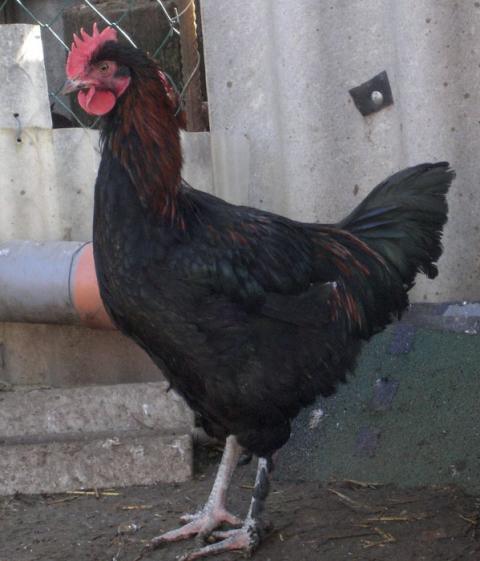
Here I go again on shank color. First how old is he? A lot of the birds I have hatched here, that are from Germany, and theoretically originated in France, have pink legs. Usually not pink all the way up, but pink feet and legs up to the "knees". They are usually cockerels. When they get older and their hormones kick in fully, they usually end up with some slate epidermis - some of the scales will have gray in them, but the legs will still be predominantly pink, as in all the other Marans varieties.
On the ER birchen allele, hormones cause the females to melanize more easily than males. Combine that with the fact that males get a double dose of the Id dermal melanin inhibitor gene, and your cockerels will have much lighter shanks than your pullets.
There are those that believe that pink shanks indicate "wheaten influence", which I think is a broad term that includes any unwanted traits that come from crossing in wheaten.
In all the other varieties, lighter shanks are always better. Wheatens and Whites often have trouble with bluish shanks where they should be pink. Cuckoos don't generally have this problem as the barring gene usually clears up shanks as well. Shank melanization is not completely understood. In general, the eWh wheaten allele is the most difficult to melanize. ER birchens are the second easiest bird to melanize.
But if your BC flock has never thrown a wheaten in 3 generations, and you're not getting straw hackle or mossy, (if I remember right your flock is fairly dark) then I wouldn't suspect that these pink shanks are from wheaten cross in.
Many of the pictures of U.S. BC that I see tend to have shanks that I would say are on the dark side, if not completely missing the Id dermal melanin inhibitors. Roosters that aren't showing at least a bit of pink dermis are probably missing one or both copies of the Id gene. It was only this year that the standard was clarified to state that rooster shanks should be pale slate, not dark slate. So many breeders have probably been using roosters with the wrong genotype for a long time. Combine that with the fact that hens tend to have dark shanks because of hormones and it's difficult to know if your hen is Id (correct) or id+, it is very easy to perpetuate incorrect shank genetics within a flock and to distribute incorrect birds via hatching eggs for a long time.
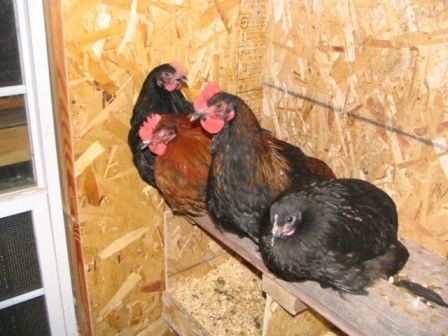
All that to say, maybe your odd pinky footed roo is a step in a more correct direction. Most of the roos I've hatched out here have predominantly pink feet as juvies. Maybe I can take some pictures tomorrow and post them. They are not undermelanized at all. Some have pink feet and solid black feathers on them at 4 weeks. I'm almost finished hatching a bunch of BC's from single matings, all of them from a rooster with predominantly pink/red shanks with some gray scaling in the epidermis. One of the hens was a hatchmate, if not a direct sibling, at least a half sibling. So far there has not been a single wheaten chick. Some of the resulting hens have some light lacing in the upper breast, but the black on the rest of their bodies is nice solid deep black, even with a little green sheen, and some even have copper brown on the top and sides of their head. In other words, no other anomalies have popped up alongside the more pink shanked roos.
This is just my personal experience with the genes I have found here in Europe. I personally like the lighter shanks because they show off the shank feathering better. In other varieties with Id clear shanks (leghorns, wyandottes), the goal is to get the shanks as clear as possible while still maintaining correct plumage color. If you can breed towards clearer shanks while keeping your birds the right color, I'd say that's a step in the right direction.
In a private email from Bev Davis on this topic, she reiterated that BC's should have pink dermis and slate or gray epidermis. I found a couple old pics of a cockerel from the UK. He was very dark, too lightly feathered in shank, and a mean bugger, mean to the hens too. A fox got him early last spring. His shank color is like what I'm seeing on almost all the roosters here.