Heater or heat panel -10

Pics

IowaCHKN

Chirping
Joined
Aug 9, 2025
Messages
17
Reaction score
68
Points
51
Hello all. First winter with chickens. I know they are are built for cold. We get the very cold weather in Iowa here. It was -15 last night. My friend borrowed me his TURBRO heater. I had it on in the 4x6x4 henhouse. I think it was 8 delegrees. Now here's my question. I don't think/want to heat the hen house. My wife thinks would be good just for the extreme cold days to keep it not so fridgide. I was looking at heat panels possibly? Maybe that might be a better option than an actual heat. Anyone have any thoughts on either?

 
I'm not familiar with those products, but I can tell you about the ones I see used around here.

There's something called a Cozy Coop flat panel heater that's meant for the chickens to warm themselves against, rather than heating the entire coop. The manufacturer claims there's "virtually no fire hazard". @Debbie292d uses them as supplemental heat for her Silkies, and she's in a pretty cold area.

Another product I'll likely use in the future is something called a Sweeter Heater. It comes in different sizes and hangs over the roost bar to take the edge off their sensitive combs (which are prone to frostbite).

Hope this is helpful, and best of luck this winter!
 
I'm not familiar with those products, but I can tell you about the ones I see used around here.

There's something called a Cozy Coop flat panel heater that's meant for the chickens to warm themselves against, rather than heating the entire coop. The manufacturer claims there's "virtually no fire hazard". @Debbie292d uses them as supplemental heat for her Silkies, and she's in a pretty cold area.

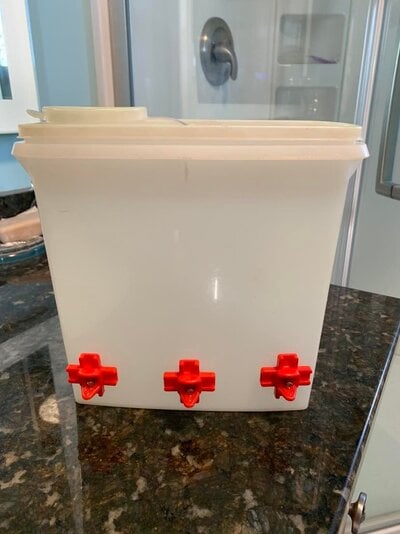
This nipple waterer was right next to a Cozy Coop heater in our growout shed last night, and it froze. The eight silkies in there, which were around 4 months old, were all up next to it so maybe they blocked any heat getting away from it. Still, for this to freeze with 8 chickens and a heater in a small shed, you know it's cold! -11F was the low last night.

Brooder 2.jpg
 
Oh, I’m gonna hear about it, but chickens are not “built for the cold”. As soon as the temp drops below 50F, they start to show cold stress. Cold stress means their bodies start to show physiologic changes in response to the colder temps. These changes mean the chicken is now using energy it would normally use for body repair, keeping hormones balanced, egg production, etc., to keep warm. There’s a lot involved but I won’t get into it here. What you need to understand is that yes, chickens should have access to heat when the temps drop below 50F.

I recommend radiant heat such as the Sweeter Heater. It doesn’t heat the air in the coop, just what is under it. If anyone is confused about how radiant heat works, I’ve got a post here on FB: https://www.facebook.com/share/p/1GCrcTU4P2/?mibextid=wwXIfr

And you don’t need to heat the whole coop, you just need a spot where the birds can warm up if they need to or want to.

And yes, chickens have survived without heat for hundreds of years yadda yadda yadda. The reason that they had to do that was because we didn’t have the ability to safely heat the coops. We do now and we should. We also used to cut open and bleed people because we didn’t know any better but now that we know better we don’t do that anymore. So a lot of people are stuck back in the dark ages when it comes to chicken care and dig in and insist that it should be done that way because it’s been done that way for hundreds of years. We need to move into modern times. We all should want our chickens to thrive during the winter, not just survive.
 
Modern is not always better, just more toys for kids to play with. The basics have always and will always work.

You can use an ebike to get around, or you can exercise, your choice, modern or old school. The e is easier, but the exercise will actually help you without the encumbrance of modern shortcuts.
 
What you need to understand is that yes, chickens should have access to heat when the temps drop below 50F.
This isn't FB, so here, we can state our opinions or experiences on subjects like this, unless we wish to provide proof to back up what we're asserting.

For our silkies, even frizzled and molting (skin exposed), we've kept our coops at 40°F for a decade—using an oil-filled radiant heater in the smaller coop and a non-digital electric heater installed in a wall of the large one. Four growout pens have Cozy Coop radiant heaters. It was -11F with -35F wind chills two days ago, and it will get much worse before winter is over.

Everyone was fine. Proof of that is they lay all winter, although about half as much.

If we had just a day or two of below 32°F in our insulated, dry, draft-free coops, I wouldn't worry. It's when it goes on for several days/weeks, it's common sense that it would wear on the chickens constantly having to keep themselves warm. A little supplemental heat makes them more comfortable.

Another very important reason the coops get heated is for me! I'm old, and I refuse to trudge through snow to bring out water twice a day or deal with frozen eggs. If I had to do that, we wouldn't have chickens.
 
Found a study (which has citations to other studies for a deeper dive): https://pmc.ncbi.nlm.nih.gov/articles/PMC10741227/#B7-animals-13-03824

And an extension service article:

https://extension.umn.edu/small-scale-poultry/caring-chickens-cold-weather
I have done a quick scan of your first citation (emphasis is mine)

"5. Conclusions​


In conclusion, low vs. normal ambient temperature stimulated feed intake and in-creased body weight and FCR. Eggshell color was intensified in laying hens exposed to low temperature. Low temperature elevated skin surface temperature without affecting rectal temperature. Finally, low temperature did not influence stress responses, as manifested by constant yolk CORT concentrations, but altered MDA, total cholesterol, and triglyceride levels. Taken together, our study indicates that the exposure of laying hens to low temperature disrupted the antioxidant system, especially at an early stage of exposure, and altered lipid metabolism (i.e., total cholesterol and triglyceride) without inducing stress responses. The low-temperature-mediated increase in eggshell color seen in this study warrants further study."

Perhaps you could explain how this supports @The Bougie Coop assertions above?
 
Last edited:
This isn't FB, so here, we can state our opinions or experiences on subjects like this, unless we wish to provide proof to back up what we're asserting.

For our silkies, even frizzled and molting (skin exposed), we've kept our coops at 40°F for a decade—using an oil-filled radiant heater in the smaller coop and a non-digital electric heater installed in a wall of the large one. Four growout pens have Cozy Coop radiant heaters. It was -11F with -35F wind chills two days ago, and it will get much worse before winter is over.

Everyone was fine. Proof of that is they lay all winter, although about half as much.

If we had just a day or two of below 32°F in our insulated, dry, draft-free coops, I wouldn't worry. It's when it goes on for several days/weeks, it's common sense that it would wear on the chickens constantly having to keep themselves warm. A little supplemental heat makes them more comfortable.

Another very important reason the coops get heated is for me! I'm old, and I refuse to trudge through snow to bring out water twice a day or deal with frozen eggs. If I had to do that, we wouldn't have chickens.
I am uncertain whether your response is intended to support @The Bougie Coop assertions or not.

Your response is very specific to a single breed and to personal comfort unlike @The Bougie Coop 's very broad brush statements. As you state on BYC we can "state our opinions or experiences". You have done this and folks can accept or reject for their own usage.

@The Bougie Coop has not done this. Rather, very broad statements are made with very specific allegations that are not supported by even the citations provided above.

BYC is frequented by a community that ranges from neophytes to people with decades of experience. I am concerned that the some in the neophyte group would take @The Bougie Coop statements as fact and act on them.

My apologies to any I might offend.
 
Last edited:

New posts New threads Active threads

Back
Top Bottom