Help picking a winner?

I have a question, I don't know that much about tuxes but want to work this out together...I think you both have beautiful tux birds and are both quailified tux experts

I think I know a bird can have 0,1,2 pied genes and I wonder what they look like when you have a tibetan x white cross

I was thinking you could proof it by keeping #1 and #2, if we think they have 1 and 2 pied genes respectively, when crossed against those same hens, we may have slightly different results as the calculator suggests...

breeding both birds back to a solid bird may have different results if they carry different # of pied genes as well. solid bird X 1 pied gene bird= 50% birds with 1 pied gene but solid bird X bird with 2 pied genes would result in 100% birds with 1 pied gene (tux)


eta, btw we also know that the birds are pure "tibetan" EE on the red gene because they breed true tibetan color
 
Last edited:
Just reread this post and its a bit confusing. As a newbie I want to make sure my understanding is correct. As Mobyquail stated my understanding is with Coturnix Quail, a bird will either have 0, 1 or 2 pied genes.

0 pied genes = solid colored bird
1 pied genes = colored bird with varying amounts of white
2 pied genes = white bird

I understand the thread starter is trying to get them to breed to where all the pied offspring r more evenly colored in having the same pied pattern. Or at least that's what I thought they were trying to do. I wouldn't know or have any understanding of how it would b possible to breed for pied by using 2 pied birds to get 100% pied offspring every time as that is mathematically impossible. U can however breed for 100% pied offspring by taking a solid bird over a white bird as each chick would inherit 1 pied gene and 1 color gene but in varying amounts so they wouldn't all b clones of each other. I am just trying to make sure everyone is on the same page here and feel free to correct me if my understanding is wrong.

Don't want to make this more confusing but the words Pied and Tux have the same meaning but Tux is more commonly used and accepted with Coturnix quail. Again correct me if that is wrong also.
 
I was kinda wondering that asking the question of Syble, if she has gotten any solid tibetan birds from crossing 2 tuxedos?

and are we calling a "double pied" tibetan bird a tuxedo when tuxedo really mean "single pied".

when I think double-pied, I think 2 spots, single pied= 1 spot

depending on the base color and secondary color of the bird is the color of the pied spots?
 
I'm new and probably basing most my understanding of quail color genetics with how color genetics work in other types of fowl and how some have explained it to me which makes sense, compared with other types of fowl. Was thinking after I posted that tho that I know there is white bobwhites and unless they r albino, which is completely different, I have yet to see a pied bobwhite so maybe its best I leave the quail genetics to the experts and sit back and learn. Info can b so conflicting so I find I learn best from personal experience and this is my first year breeding Coturnix quail but is def something I will b playing around with and testing myself.
 
I enjoy breeding but honestly this kind of genetics goes over my head... I know the basics but this is where it just gets confusing! All I ever did was take the birds I liked best and bred them, and I got rid of the crummy looking ones and kept the better ones LOL
 
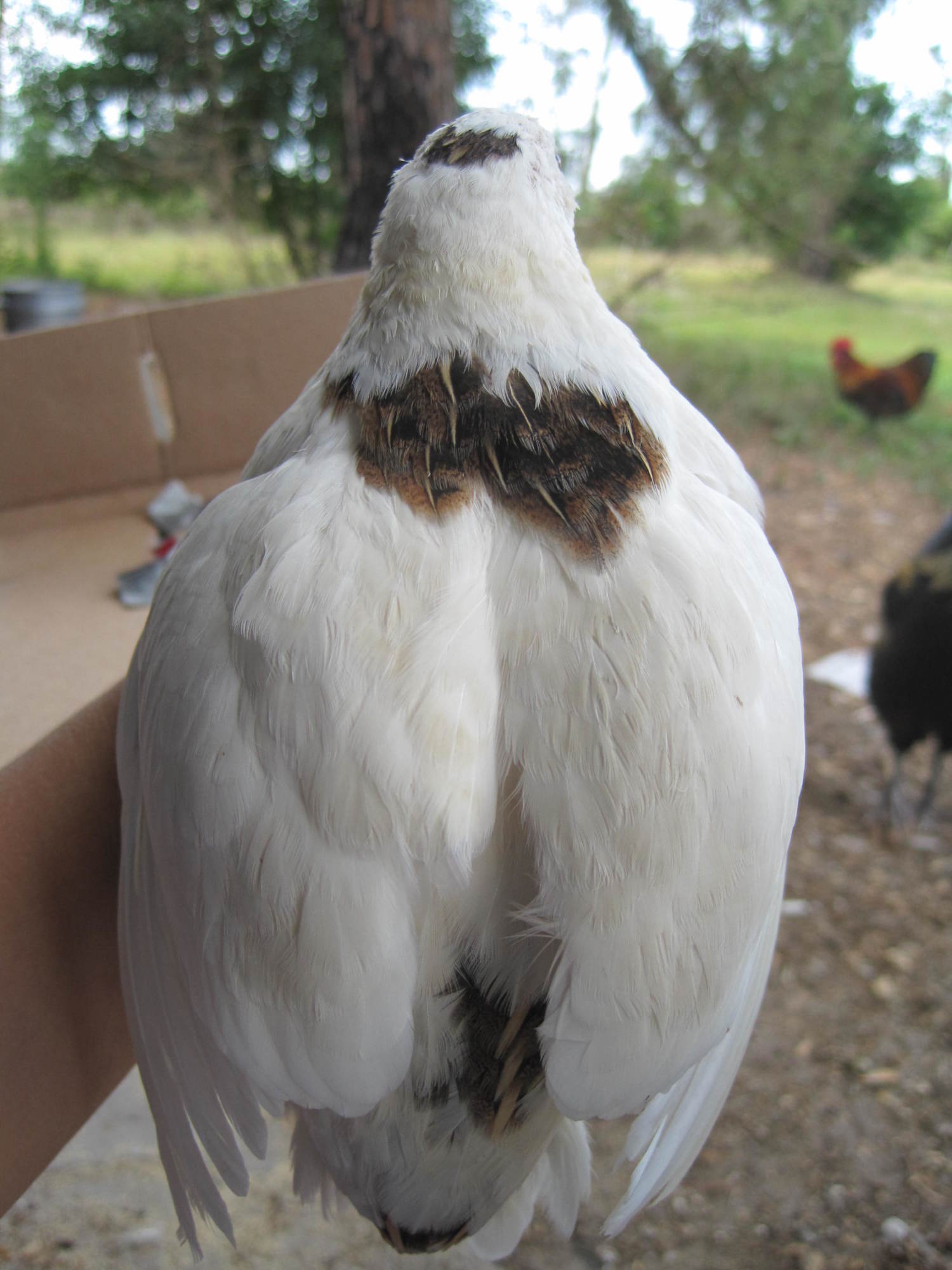
I would say the first one would be in my standards for a qualified tuxedo. The others look more panda to me.

Im asking to keep it clear for the newbs, and because I think panda means doublepied in some circles.

what is the genotype for "panda"? can we add "panda" to the Coturnix Quail Vocabulary for carrying the Pied gene at both alleles? I'm fine with it as long as its defined for all to know.

is Tibetan "Panda" Wh Wh Br+Br+ yw+yw+ EE Pipi+ or PiPi?

in fact my thought is this is how they get italian and/or manchurian "golden" double pied "panda" birds.

if doublepied, pandas should breed true when crossed with pandas. and when crossed with solid birds should produce tuxes.
 
wow, how complex we have gotten lol!

here is my understanding...

tux is a specific physical expression of the single pied gene. where the bird is split in half and ideally color is connected.

pied is technically a tux but has too much white.

what you refer to as the double pied (with 2 spots), should be the white version, which is like 75-95% white, most times with either a fleck of spotting on the head and something like a dime on its back. some have more or less. I had photos of the full range before, but can't find them now.

this generation was done from tux male on assorted solid hens, so the results were only solids and tuxes, but the next generation should have the whiter versions too, I'll be sure to post you some photos in a month and a half or so lol
sib ;)

and i would love some more info on the panda pattern, like how it displays
 
Well we have panda mutation in some wild-type birds. This is controlled by the autosomal recessive allele (s). The background plumage is white.

This is a Texas A and M from Bear Bayou lines. See how the wild type pattern is seeping through causing the panda look to it.


A good publication on the Panda is http://www.ncbi.nlm.nih.gov/pubmed/8228175

Similar genes would take place with your dark range tuxedo but they would be the extended brown gene over the recessive white.
 
Last edited:

New posts New threads Active threads

Back
Top Bottom