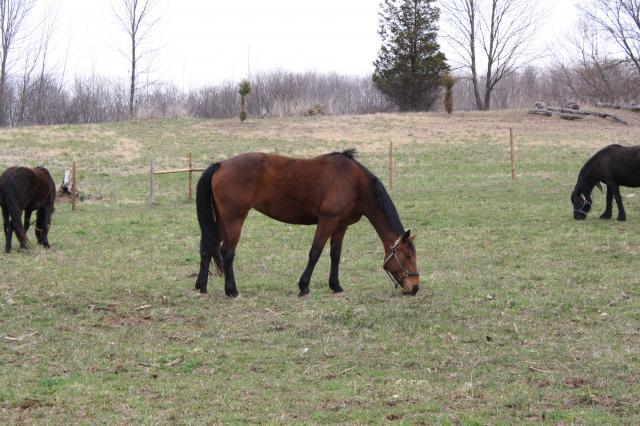
I wouldn't say the horse looks unathletic. Actually she looks like a rather nice horse. What i don't have is a good view of her feet, or a pose in which she has her head and neck up, and her legs positioned well. A good side view really helps one to see the conformation, but to be honest, I really like to see the horse move, feel its legs, get an idea of its temperament....As a horse dealer I knew used to say, 'A picture is worth a thousand words, most of them lies'. LOL.
However, for your stated use, as long as that is a light use, you don't really need to worry much about her conformation. You may want to get some other pics and post them for fun, but remember that even if a horse DOES have certain conformation faults, they may be unimportant for the use you intend. AND keep in mind that an awful lot of people, without realizing it, are critiquing the horse the way it would be in a Halter Breed class, and their critique is not about practical use, but 'How much this horse doesn't look like <my favorite breed>'. A lot of those niceties for the halter ring, they really don't matter a lot. I like to find out the use and critique as relates to the intended use. I might be awfully concerned about how the horse's hocks are angled if he's going to go on 50 mile endurance rides or jump six feet, that may not be as important for an elderly pasture pet and pal for light rides around the home pasture at a walk. And there are a lot of different levels and degrees of 'that don't matter for you'.
The key with a new horse is to find out what's going on in those legs and feet, and based on that and the horse's temperament and disposition, plan for a REASONABLE career and activities for the horse.
For example, our pony had very serious founder before we got him, many times. He was basically a cripple. The plan we came up with was to spend 3 years trying to fix all the damage to the bones of his feet, and THEN decide whether he would be a pasture pet, doing light work, or actually going into a more demanding 'program'.
If she was mine, what I'd be most focused on, is getting a really good, detailed concrete 'Base Line'.
That, more than anything will tell me why she really was turned out for so long and not used.
Horses MAY get turned out and nothing done with them for long periods of time because the rider went off to college, or because the money wasn't there for shows, lessons or trailering out to activities.
However, a good many people turn horses out because they develop a lameness.
A great many people turn a horse out, without really knowing what is causing the lameness - they just stop using the horse. They can't sell the horse if the lameness is too obvious. WIthout a diagnosis, without having tried any actual treatment, without knowing if the turnout period will help or harm the injury - out the horse goes.
This just is not unusual.
Turnout does not magically 'fix everything', as some horse folks often tell me. Sure it might, or it might not. It depends on the type of injury, how severe it is, and how strenuous of a use the horse is intended for.
Turnout can aggravate an injury and turn it into a chronic problem. It can cause an injury to heal, but wind up too tight and stiff to allow for normal, flowing gaits - or comfortable riding.
Turnout can also mean that a problem is simply allowed to progress because it isn't getting the right treatment. For example, if a horse is lame due to severe hoof canker, the only way to get it out of there is surgery and a very carefully planned and carried out rehab period.
Today, a lot of vets have moved away from the old 'Dr. Green' philosophy that all we can do is turn 'em out. Today, vets are often moving toward a shorter, more intensive, and very carefully targeted treatment. Medications help heal the tissue, and new therapies like IRAP can mean that injuries that used to heal badly with a long turnout, now are healed up rapidly with much better results.
WHY have I said all this?
Well, because, number one, you need to get a baseline on your new horse. With portable digital xray machines, xrays of feet and legs are cheaper and more convenient than ever before. We're not put in a position where we have to guess and cross our fingers about what's wrong. Between xrays and the other techniques we have today, we can find out EXACTLY what's going on in there and what will fix it.
But there's more to it - a good many people buy a horse that either shows a lameness right away or develops one once it's in regular work.
Because many people DON'T really treat lamenesses, there is actually a strong likelihood that YOU can take a horse like this and correct what's wrong with it.
There's always a chance you can't, such as with advanced arthritis. But actually, knowing what's really there is GOOD - you can plan the horse's future. This horse might be best suited to be a companion and do very light work. Or she may be much better off with a much more active life.
Some of that really depends on temperament. IT's awful tough to give a horse a very light career as a pet for kids if it's just too frisky to settle down. And if a horse NEEDS a light program, it's REALLY good to know that, rather than setting up a lot of expectation for a dazzling and demanding sport career.
About five years ago, I hurt my foot. Of course I kept walking on it and using it. I restricted my activities so I wasn't causing out and out agony.
The problem was, the foot healed incorrectly. It continued to bother me whenever I tried to do my favorite activities. It was agony even just pulling on a riding boot!
The DO finally looked at it, and took ahold of my foot and wrenched it outward. I SCREAMED!!!!! IT was agonizing. He explained that because I didn't get it treated PROPERLY, it had healed wrong. Every step I took stressed the healed area. After a few weeks of FOLLOWING THE DOCTOR'S ADVICE, LOL, my foot was - well my foot was like a new man! LOL.
But I learned my lesson. FIND OUT WHAT'S WRONG. DO WHAT YOU HAVE TO DO TO GET IT TO HEAL PROPERLY.
How does ANY of this pertain to your horse?
Well, as I said, you need that base line. Next, you need to see if anything in that baseline answers WHY this horse was turned out (NO, actually, I DON'T always believe the seller's story! Frankly if even my own MOTHER sold me a horse I'd be looking it in the mouth).
Next, when you put the horse into work, periodically, you re-assess. While another set of xrays is ideal, the vet can also 'flex' the horse's joints and jog her to check to see that she's continuing to take the exercise well.
Trail riding CAN be quite strenuous. Some people really do the distance, the speed and the terrain. For others 'trail riding' means a relaxed slow 15 minute walk on level terrain. So you have to kind of know yourself, what you plan to do with the horse and how intensive it's going to be. The more demanding the work is going to be, the more you need to get an accurate idea of how sound the horse is...and the more you'd be particular about her conformation.


 Lacy will be going out for 90 days training next month and I have been looking for another horse to keep my other mare, Pie, company as well as another trail horse since we will be missing Lacy all summer.