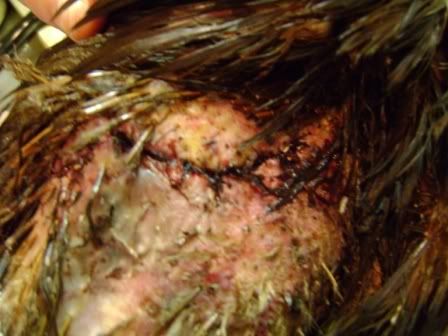
I ripped off my chicken's neck meat!!!!

That DOES sound very serious, IS veterinary care an option for you/her?

How is she behaving at this point? I am just wondering if already shocky & terribly compromised, will the stress of sutures crash her? I would do as few as possible, as quickly as possible... you will want it to be able to drain a bit anyway.

Systemic antibiotics and supportive care are going to be a must, if going to have a chance to survive.

How does she seem to YOU? It's always so hard to know what to say/advise when I can't see her!!! Lethargic? Shocky? Breathing normally? Etc.??????????????
 
The hen survived the night and is up walking around this morning. I haven't gone to look at her yet but I can tell she up, but moving a little slowly.

Vet is not an option.


I will try it if there's some way to sedate the bird? Any suggestions?
 
If she was/is bleeding internalely, then there is more going on then just "ripped skin".
I agree with Suellyn, chances of her crashing are going to be very good because she is already stressed!! You can not wait to long to put sutures in her, and it needs to be done quickley.
 
Quote:
I am not so sure I would try and sedate her. Have you started her on antibotics? I would do that asap if not.
 
1.) Systemic antibiotics (!!!!!!) ASAP.

2.) Supportive care; heat, food, water with pedialyte or vitamins, confine to quiet area where she can heal.

3.) No safe way to sedate without veterinary-quality drugs, I wouldn't do it. Any type of anesthesia depresses the whole system- heart rate, breathing, etc., and without proper dosage/monitoring (i.e. gas anesthesia machine or well-measured injectable drugs) it will probably do more harm than good.

4.) How is the skin flap? does it look "alive" with a blood supply going to it, or does it look like "dead skin" dry, darkening, etc. If dead/dying skin, then it would not re-attach anyway.

5.) I know this would be hard 'cause it's her NECK, but can you gently clean the area and then try to wrap it a bit? If you can keep any viable skin against her neck for a couple days, it will probably re-attach without sutures.

Edited to add: okay, this idea may be a bit goofy or not work, but would a sock or stocking with a hole cut out at the "toe" work as a makeshift bandage to keep skin in place???? I would clean it, apply triple antibiotic ointment (to help prevent infection AND to keep it from sticking to bandage and re-ripping), cover with gauze padding, then try to put sock over her head around her neck to try to keep it stable... ???????????????????????????????????????
 
Last edited:
Edited to add: okay, this idea may be a bit goofy or not work, but would a sock or stocking with a hole cut out at the "toe" work as a makeshift bandage to keep skin in place???? I would clean it, apply triple antibiotic ointment (to help prevent infection AND to keep it from sticking to bandage and re-ripping), cover with gauze padding, then try to put sock over her head around her neck to try to keep it stable... ???????????????????????????????????????


Let me say that sounds like nothing short of genius to me!
Great idea should work!
SandL:best of luck​
 
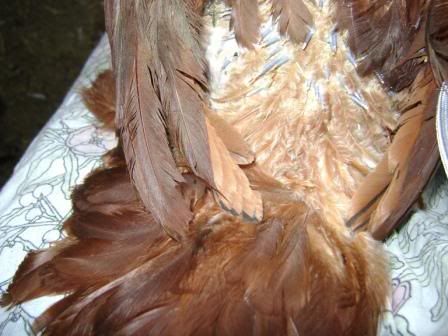
I have sewn up many hens whose whole back was open and exposed - skin ripped by roosters. I used regular needle and thread. All did well and feathers grew back and all are alive and healthy today. I did finally buy chicken saddles for the them to wear but that's another story.

My vet did finally give me a box of sterile pre-threaded needle with dissolvable sutures and you may be able to get one from your vet because I now use those and it makes it sooooo much faster and easier.

But, using needle and thread:

First clean with Betadine and wash wound well.

Apply stitches to reattach skin.

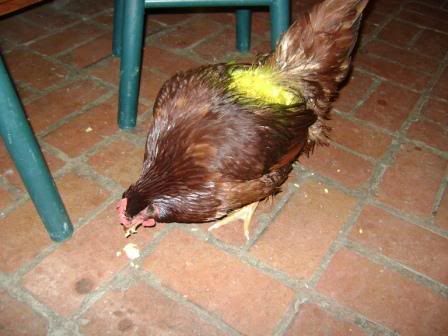
Clean again with Betadine. Then apply Neosporin to wound. I also spray with Furall, it's purchased at feed store. It's a yellow antibacterial spray that helps the wound dry and repels flies and prevents others from pecking at wound. But I then also isolate the wounded bird till healed. One the worse of the worse I've recleaned the second day but on most I just let it start to heal and dry. I don't cover the wound. On some that were so ripped up I didn't think they would survive, I gave 1 cc of Pen G after surgery and another for the next couple of days but I've found that none of them ever got any infection and all healed just fine without the shots. I add Terramycin to their water while isolated that first week.

I normally operate on them alone and they just lay calmly till I'm done and then get up and eat a treat. Trick is to cover their head so they can't see and lay them on their side. You can wrap them in a towel if you are only needing to operate on their head, neck or feet and they will lay calmly and can't flap and move around.

Here are some pics of one of them. Warning GRAPHIC pics:

hensback1.jpg


hensback1b.jpg


hensback1c.jpg


Immediately after stitches - having a treat on kitchen floor

hensback1d.jpg


A couple of weeks later:

hensback2.jpg
 
wow Ruth, nice stitch job. How much did she move when you were putting them in? I like to keep this stuff in the part of my brain where the *just in case* file is
big_smile.png
 
Quote:
Like I said in my post, I cover their head with a towel and lay them on their side and they rarely move at all. I'm always having to operate alone. I have found that with the package suture kit from the vet, they don't even flinch because the needle is a cutting needle and is so sharp it goes right through the flesh quickly and easily and the "thread" pulls through without curling up and knotting up on itself.

But even when I was using regular needle and thread I could do it alone but the needle is hard to push through the skin and sometimes I'd have to tug a little to get it all the way through and she would flinch. So if possible, stop by the vet's office and ask to buy a pre-threaded suture needle. My vet gave me a whole box of 30 because she knew how often I was having to sew up animals around here and she said the box was a sample box that had been given to her and the date was expired. Maybe your vet will also have some expired ones that they will give you. Why there would be an expiration date on a needle and thread I have no idea but they are lifesavers. Just be careful - those needles are really sharp - I drove one right through the chicken's skin and into my finger on the other side before I learned how sharp they were.
 

New posts New threads Active threads

Back
Top Bottom