Quote:
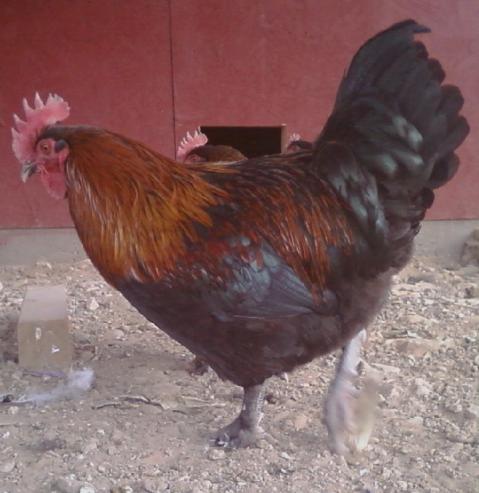
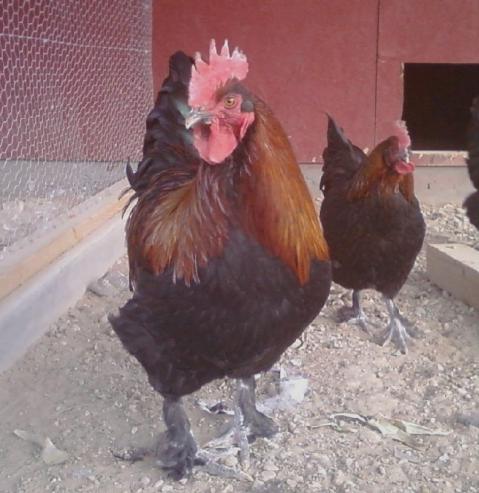
Good Points. I noticed the rooster especially pops out too...The lack of full coppering color to the tip of the hackle feathers, the extreme red on the breast (I think he's the rooster carrying wheaten culprit too) - unfortunately a lot of black coppers get bred to wheaten roosters because people don't notice the wheaten triangle in the wing..
to add...
The mossy hen probably has the partridge gene too. She was probably not a dark black chick, but had a reddish hue to her chick fluff when she was hatched. I have one of those too. She could also have the wheaten gene. She's going to go into my layer pen this spring, but I did hatch some eggs out of her because she lays rediculously nice eggs.
As far as the wheatens, yes, a rooster and a hen both have to carry the recessive wheaten gene. I've understood that if BC x BC delivers any wheaten chicks at all:
1/4 wheaten
1/2 are BCs that carry recessive wheaten
1/4 are BCs and won't carry wheaten at all
I have heard, and now I see in my own, that Wade Jeane birds tend to notorious for carrying the wheaten recessive gene than some of the other lines. Teasdales sometimes do as well, but I only have wheaten teasdales any more and no black copper teasdales, so I haven't had that issue. I believe mine have all had the wheaten fluff with the black line on the head and the two black side spine shadow stripes as well - not like a standard wheaten with all yellow fluff. Black copper breeders and some wheaten breeders consider this a fault. Black copper breeders don't want the recessive gene and will cull heavily to rid it, the wheaten breeders are a mixed bag - some cull it because of the other undesirable genes that were passed from the black coppers (a true wheaten wouldn't have the black in the fluff), others believe it is the path to darker eggs and the black in the fluff is immaterial.
One thing to remember, breeding these marans is strictly each to his own. Some focus on the proposed standard, while others focus on the egg color. To me, egg color is what makes them distinctive and is what is most important, but in order to get them APA approved, a standard is going to have to be met. As it is proposed now, that means feathered shanks, no mossiness, no white feathers, no white fluff in the tail, 45 degree tail set, and so on. If you are breeding to sell chicks or eggs, or even give them away, please consider this. There has to be a balance here or the marans will never get approved.