Molting Question

alwaystj9

Small goats & big chickens + 1 old horse
Premium Feather Member
6 Years
Joined
Aug 20, 2019
Messages
1,213
Reaction score
3,243
Points
467
Location
SE Louisiana
Is anyone aware of any correlation of molting and breed? Do some breeds molt more or less, for longer or shorter than others? Just curious.
 
Things also change between your location (weather) and your feed. Molts can go by faster with extra protein, but timing that feed early is very difficult, and it's alright if you provide it when you notice molt instead of the start of it. There isn't any correlation with breeds and molt to my knowledge.
 
Is anyone aware of any correlation of molting and breed? Do some breeds molt more or less, for longer or shorter than others? Just curious.
That's actually a great question I've never heard asked!

To my knowledge, as well, it has nothing to do with the breed. But some hens seem to molt harder and longer than others.

I have two silkie hens of around 30 that lost nearly every feather and took about a year to get back to normal. My other ones get through it much faster and only lose half their feathers.

They are already on high protein feed (20%), so I don't give them anything more or less. They do get scrambled eggs about once a week, and those are high-protein so maybe help. I just don't want to overdo it.
 
Is anyone aware of any correlation of molting and breed? Do some breeds molt more or less, for longer or shorter than others? Just curious.
Good question. There are two parts to molting. One part is how fast the feathers fall out. This is controlled by genetics but I'm not aware of any correlation to breed. With some chickens the feathers fall out in clumps, they may go through a molt in a month or so. You can see bare spots. There are several "molting contest" threads on this forum, you can see what it looks like when the feathers fall out in clumps there.

Others may take four months or so before all of the feathers fall out. Feather loss is gradual. The slowest don't look that rough while molting, no bare spots. You generally cannot tell by looking that these are molting, but you may see loose feathers flying around. Most chickens are in between these extremes.

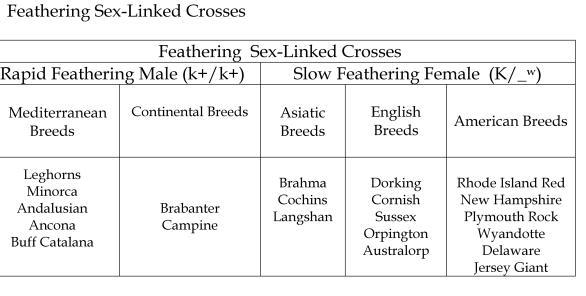
The other part is how fast the feathers grow back. Again it is genetic, this is what enables feather sexing in newly hatched chicks. Some chickens' feathers grow back rapidly, while others grow back fairly slowly. One way to demonstrate this is the barring gene. If the feather grows back rapidly the barring is a cuckoo pattern like the Cuckoo Marans or Dominique. Pretty broken up when looking at the bird as a whole. But a good quality Barred Rock has slow growing feathers. When they come in the barring is fresh and crisp.

I took this chart from Tadkerson's post on making sex links. He does not list all fast or slow feathering breeds but does show that there is a breed correlation.

13371_sexfaether.jpg


Here is the link to Tadkerson's sex link thread.

https://www.backyardchickens.com/threads/sex-linked-information.261208/

@alwaystj9 the overall speed of the molt is going to be mostly controlled by how fast or how slowly the feathers fall out. The speed that they grow back will have a minor contribution to that but they can't grow back until they fall out.
 
Molts can go by faster with extra protein, but timing that feed early is very difficult
If you feed 20% year round, you won't have to worry about timing extra protein just right. 20 is ideal anyway, for any age chicken and any time of year.
 
If you feed 20% year round, you won't have to worry about timing extra protein just right. 20 is ideal anyway, for any age chicken and any time of year.
Mine still love their whole feeds, 50/50 Kalmbach Chickhouse and Henhouse, which I feed as a mash. They are pretty meh about the 20%, which is always available in a feeder. Flaked oyster shell available on the side.

But two are in molt, and guess who are suddenly chowing down on the 20%?😁

It’s remarkable how well they know what they need.
 

New posts New threads Active threads

Back
Top Bottom