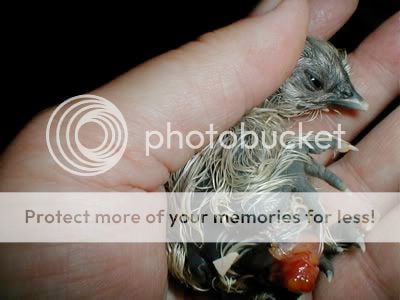
I hatched all my chicks under a broody and had few with curly toes
Humm... I've heard of it happening under hens a few times but it doesn't happen here... don't know what to make of it.
Follow along with the video below to see how to install our site as a web app on your home screen.
Note: This feature may not be available in some browsers.
I hatched all my chicks under a broody and had few with curly toes
No I had to force hatch him early (maybe 12ish hours early) b/c he was shrink wrapped, not fully absorbed yolk sack, huge abd hernia, splay legs, curled toes, and extreme weakness. It was rocky at first but he came out a fighter.
Humm... I've heard of it happening under hens a few times but it doesn't happen here... don't know what to make of it.
Maybe I have broodies with broken thermometer?!?
Haha! I do wonder what the exact cause is though. Is it temperature, humidity, egg positioning(some of the peafowl people believe this is a big contributor to leg/toe problems in peachicks), diet of the breeders, genetics, etc....
Did you see problems happening with the climate? Cold/cool/hot temps while the hen was sitting?
With the golden pheasants the difference between incubator vs. hen hatched was so obvious and strong.
Chicks born with normal toes only to have them eventually kink/crook later on is genetically caused.
I have a few frizzled and smooth Easter Eggers with crooked interior toes. Do you happen to know how dominant the gene for this abnormality may be? I only have one smooth EE cockerel to use for breeding, and while his comb, feathering, body shape and disposition are quite favorable, he has that darn crooked toe.
Can you please explain me what abd hernia is,I heard it before, but never found what exactly it is
Oh I think I got it! I even visualised it looking like the picture without even looking it! Thank you so much for making this clear for me!In a new hatched chick there is the "umbilical" cord like part that connects the chick and the egg sac, it connects to the abdomen just in front and between the lower legs. This is a very weak point and is easily ruptured. The skin was ruptured on Rudy, sometimes the hernia is small and easy to reabsorb. Rudy's was very large. I had to make a band aid / overall type of body cast to hold it in place and give enough time to self resolve. I made it out of coban (vet wrap) as it shrunk I made the bandaging smaller. This is not my pic but one I found online, Rudy's was much bigger![]()
well, I see...Ahh that tough case bird again! There's too little information on him plus he looks too much like a possible cross between a black and a buff or red chicken. Buff and reds are genetically extremely complicated with many different genes that could be present, especially in the buffs.
That direct page will not work for this bird.. because that page only has options for "pure" color/patterns and this bird is not.
For him, would have to use this:
http://kippenjungle.nl/kruising.html
because it is more flexible but you really have to know all the genetic notations.
I thought of something else, is he much older now than in picture now? does he have the duckwing patch or is he crowwinged?
If he is crowwinged, then he is most likely E^R but the second part is impossible to be sure of.. could be E^Wh, e^b or e+ but I don't think the last one is very likely. I would try E^R/E^Wh for his E option.
He probably has at least one Co.. so either Co/co+ or Co/Co Same for Darkbrown, Mahogany,
He is s+/s+
as for the other options, he is the default(the ones marked with a +)- example, for barring he is b+/b+