Name: Koi (Cyprinus Carpio)
Experience Needed: There is a learning curve with koi. Many people lose one or all of their koi while they are in this learning curve. You must lean how to monitor water quality and correct it if the parameters are off. You must also learn how to recognize, treat and prevent koi diseases. There are many forums to help you with this. You can't just stick koi in a pond and expect them to thrive without spending quite a bit of time learning about them.
Origin: Koi are a species of Carp. They are related to goldfish and common carp. They are thought to have originated in western Asia and were introduced into Japan later in, probably through the food trade. During the 1800's, rice farmers noticed some of their carp with different coloring than regular carp and begun to cultivate the carp for colors, which lead to the many different color varieties that we have now. At some point, koi were crossed with longfin Indonesian carp and the resulting offspring had long flowing fins. These are now known as "butterfly koi" or "longfins". Technically, they are not koi, but are closely related.
Diet: Commercial koi food. Select one with no corn in the ingredients because koi cannot digest corn. It's simply a filler that does not provide the koi with any nutrition and clogs up the filter.
Temperament: They are fish....not much temperament. Some do seem to enjoy human interaction though and happily eat out of your hands. They seem to recognize certain people as well.
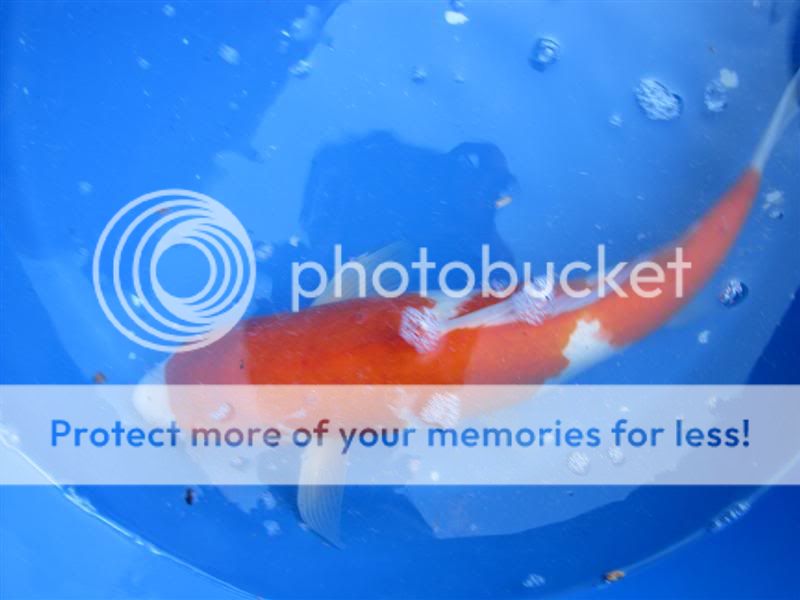
Colors: Koi come in a number of color varieties, each with a Japanese name. Kohaku (white fish with red markings), Sanke (white fish with red and black markings), Shiro Utsuri (black fish with white markings) are only a few of the dozens of color varieties.
Environment: Koi are only suited to live in ponds. They are not suitable aquarium fish because of their size. Koi can easily grow to 24" by the time they are 3 years old and often reach well over 30". For this reason, they should be in ponds that are no less than 1000 gallons, allowing a bare minimum of 300 gallons per fish. Most advanced koi keepers give each koi 1000 gallons and keep fish in ponds that are at least 4' deep, some much deeper (my newest pond is 7' deep).
Family: Koi must be kept with other koi. They are school fish and will not do well if kept alone. They can also be kept with goldfish (although they may breed with the goldfish, the result is sterile)
Additional Notes: Koi range in price from a few dollars to hundreds of thousands of dollars. Most koi are not worth as much as people think they are. The valuable koi are not only large, but they are perfect in every way from the shape of their bodies, the quality of their skin, the perfection of the markings. This can be a very fun but also very expensive hobby because of the cost of building the pond. And if you become interested in showing koi, the cost of the show quality koi can be very high. It's still quite a lot of fun.
This is one of my ponds. It's 10,000 gallons:
This is a Shiro Utsuri
This is a Kohaku
This is a Shiro Bekko (white with black) and a Yamabuki Ogon (yellow)