Hi there:
Love em!
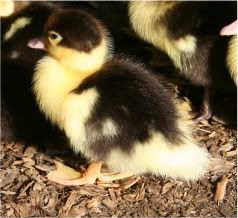
Yes, it they could be duclairs.
Recall also that the Magpie pattern of the two poor deceased Angels is but ONE version of the more general 'Duclair' (aka Piebald, Parti-Colored, Colored and White) color expression.
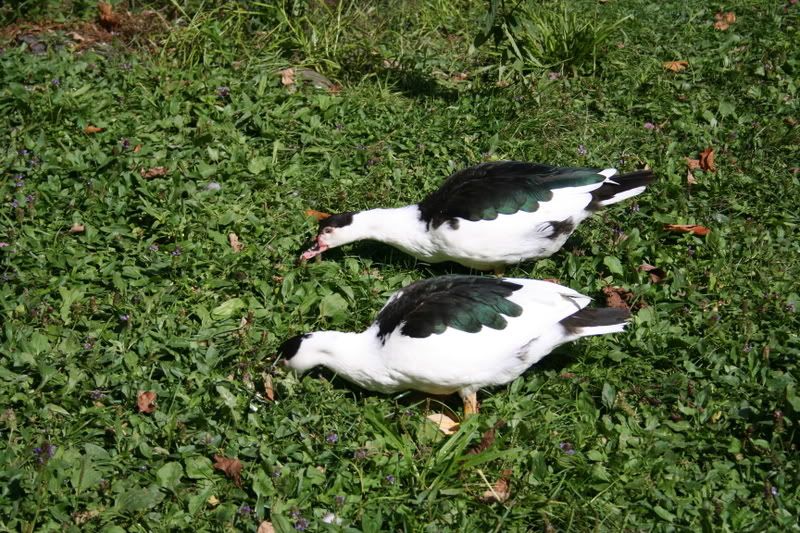
A duclair may also have a white head.
The Pied genotype is HIGHLY variable in its expression, so a Pied bird with that genotype may look pretty different from another Duclair carrying that same genotype.
Some Parti-Coloreds may have much more colored than others and still all of them can be true genotypic "Particolored" (Duclairs)
Your little black Sambo should be all black. He carries the 'atipico' gene, just like his daddy, it would seem. The atipico differs from the great Wild Type in only this: Atipico extends darkness throughout the duckling and reduces the amount of brown on the underparts of the adult bird.
The Atipico (called 'Black' muscovy in the standards) also leaves a bumpy and what should be a practically ALL RED caruncle. Unlike the Wild Type which has a smooth facial patch and mostly black (I prefer this feature to the warty, red caruncles)
You have Wild Type babies there, also. They are the ones that look almost exactly like baby mallards. However, if any of your "Wild Types" sports, as a duckling, a PINK BILL, that bird will not be a good WT representative. Such a bird carries a single gene for white and will be--not a Duclair--but 'just another blotchy black and white scovy'
Blotchy black and white or not--scovies are the best. And Ann, how tame mine are!!!
ETA: The black birds, with the yellow spot or bib on the front, are also Atipico--it woiuld seem. If you have any with black legs, I would say they will surely be 'Blacks'. If you have any blackies with a yellow bib THAT ALSO HAVE YELLOW AND BLACK LEGS, these will probably be some random measure of black and white. That is, they also carry a single gene for white. But a solid black duckling with black legs and a black legged black duckling with a little white bib, though they appear different now, SHOIULD BE genotypically AND phenotypically IDENTICAL.





 BYC's 52-week Photography Challenge. Week 4: (Jan 26 - Feb 1, 2026). Theme: Books!
 Wind chill doesn’t count, right?
 BYC's 52-week Photography Challenge. Week 5: (Feb 2 - Feb 8, 2026) Theme: Nature


