Quote:
Good morning.
I do not have a waiting list, but it's important to note that I don't sell chicks or eggs. Adult birds only.
With a variety like this, it wouldn't be advisable to go with chicks or eggs anyway. How would you know what you are getting?
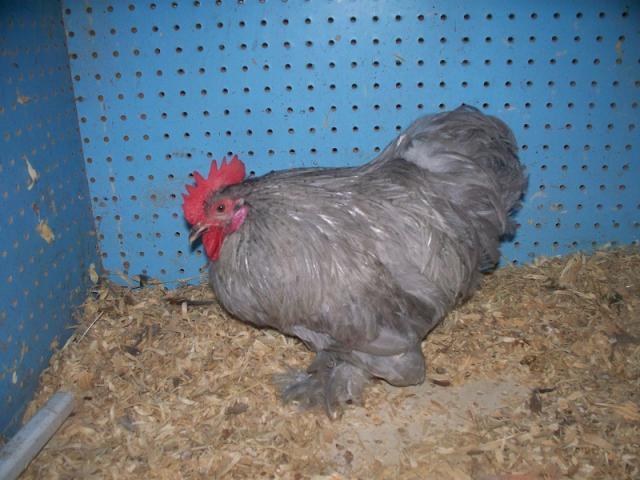
Something to keep in mind... It is my intent to work toward a qualifying meet for Self-Blue Cochin Bantams sometime in the future. That said, when I am satisfied that my Self-Blues are to a point in my breeding where I am comfortable letting some go, I'll be looking for breeders willing to continue breeding and improving the Self-Blues, and willing to attend and exhibit the required number of birds for such a qualifying meet. I am currently on the f3 generation, so the f4's will again be Self-Blue. If I am not satisfied with the f4 progress, I will then go back to Blacks for the f5 generation, meaning that f6 will again be Self-Blue. Certainly by f6, they should be fairly nice with consistent results. The f3's have much better feather quality than the f2 Self-blues, but what I've noted in the short time that I've been working with Self-Blue, is that they tend to have poor feather quality compared to the other varieties. Hopefully, the infusion of good characteristics from my Blacks will help in that department. Also, and I've made note of this in previous posts. The leg color on most of what I've seen in Self-Blue Cochins to date is incorrect. All varieties of Cochin Bantams call for Yellow, or swarthy yellow legs, and that is also the leg color I am breeding for in the Self-Blues, so as to remain consistent with the current Bantam Standard descriptions. I have culled most of the non-yellow legged birds in the f3 generation, but the best typed cockerel (previous post), has white feet. So, in using him for breeding crossed to a yellow legged female, I should see 50% yellow legged offspring. When you consider that only 25% of the f4 generation will be Self-Blue and then only half of the 25% of the chicks out of any breeding I use that male in will have yellow legs, it means a considerable amount of hatching, which I knew going into this would be required. 75% of what's hatched can be culled out of the incubator in the f4 generation because they'll be black.
If I am satisfied with the f4 progress I intend to show some Self-Blues at the Crossroads Show in Indianapolis next October. I won't know until next year if I'll have any to sell.
As far as qualifying meet requirements for the ABA. I will have to check to make sure, but I believe, for a new variety, that there must be a minimum of 25 Birds exhibited in all four classes, by 5 or more exhibitors. I believe the qualifying meet has to be at either the semi-annual or annual meet. A new breed would have those same requirements but at both the annual and semi-annual. I'll look tonight and confirm what I've said is true.
I didnt' mean the above to sound uppity or snobbish, I just want to share my intentions and get across that I won't let any of the Self-Blues go until I think they are ready. I am treating them like a fine wine.
Tom
Maybe I can save you a few minutes tonight, Tom - I think these admission requirements are still current:
AMERICAN BANTAM ASSOCIATION
REQUIREMENTS OF ADMISSION OF NEW BREEDS AND VARIETIES
The Standard Committee makes rules and sets fees.
All proposed changes in Bantam Standard are to be published in the Quarterly to all comment by members.
Qualifying meets for both new breeds and new varieties must be held at each of the shows hosting the ABA Annual or Semi-Annual Meets.
NEW BREED:
There must be a minimum of 25 birds in each variety to be qualified within the new breed, exhibited in 4 classes (cock,
hen, cockerel, pullet) by a minimum of 5 breeders.
NEW VARIETY:
There must be a minimum of 25 birds exhibited in 4 classes (cock, hen, cockerel, pullet) by a minimum of 5 breeders.
NO CHANGES are final until recommended by the Standard Committee and approved by a majority vote of the Board of Directors at an Annual or Semi-Annual Meeting.
AMERICAN POULTRY ASSOCIATON
ADMISSION OF NEW BREEDS AND VARIETIES
A petition for recognition of any breed or variety must be sent to the Secretary giving the history of it's origin, breeding background & facts of an educational nature.
Must include proposed name of breed or variety with the standard for shape, color and weight. Applications to both associations (ABA & APA) must be of the same description, etc.
Affidavits need be included from not less than five breeders that they have bred the breed or variety for not less than five years and it produces not less than 50% of all specimens reasonably true to type, color, size & comb.
Breeds or Varieties need to have been exhibited for two years prior at a show officiated by a licensed APA judge. The secretary will contact these judges for his or her confidential opinion of the quality and uniformity.
A $$ deposit of a sum sufficient to defray the actual cost of placing the text in the Standard shall be received with the petition to be returned if this case is rejected.
The petition will then be referred to the Standard committee who shall name a qualifying meet at a prominent show to be judged by a licensed APA judge.
This meet shall consist of not less than fifty (50) specimens exhibited by five (5) exhibitors in all classes of cock, hen, cockerel, pullet.
When satisfied the committee shall then recommend it's acceptance by the Board of Directors, upon which it becomes a recognized breed or variety.