Tadkerson has an excellent post about the three ways to make sex links to start his thread. I highly recommend it.
https://www.backyardchickens.com/forum/viewtopic.php?id=261208
Certain traits are passed down from one parent only to a son or a daughter, but not both. Those are called sex linked traits since sex of the offspring determines whether they get the trait or not. Size, some patterns, pointy hackle and saddle feathers are some. The traits that are of interest are the ones that can be seen in the chicks right after they hatch. There are three that can be used, that the mother only gives to her sons, not her daughters. These only work when the mother and father are pure for this trait, no recessive genes hiding behind dominant ones.
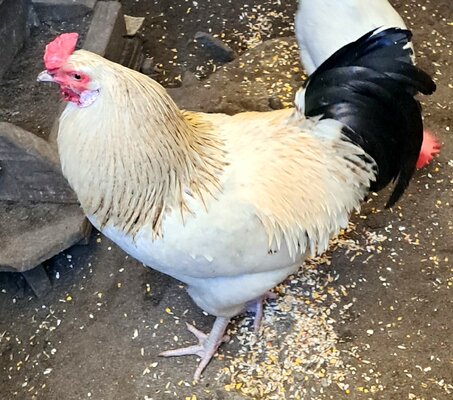
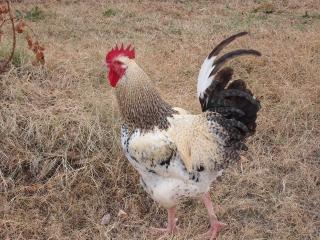
Red sex links are possible when the hen has a Silver gene and the father has a Gold gene. The Silver gene dominates the Gold gene. The Gold gene still has some effect, hence a reddish tinge in some of the adult plumage, but at hatch, the Silver dominates and gives yellow down. The female offspring get a Gold gene from their father and do not get a Silver gene from mother, so their down is red or reddish colored, shade depending on other genes mixed in. The male offspring get both Silver and a Gold, so they have yellow down. Usually the offspring is real easy to sex. Your Speckled Sussex hen has the Gold gene. Your Light Sussex roo should have the Silver gene. Your hen will give a Gold gene to both her male and female offspring since Gold is not a sex linked gene. Your rooster will give a Silver gene to both his male and female offspring. So both male and female chicks will have yellow down and will not be distinguishable at hatch.
Which chickens have the Silver gene can get a bit complicated since Silver, Recessive White, and Dominant White all give white chickens. Silver is the sex linked gene, not the white genes. Light Sussex should be Silver, but some breeds like the White Rock, may be either Silver or White. When I read the real experts (I am certainly not an expert) they often say things like "A White Leghorn is normally dominant White". To me, that means usually but not always. And it is not just one gene in play There are several genes that influence pattern and color.
With black sex links, the gene that is of interest is the barred gene. If the rooster does not have a barred gene and the female does, the male offspring will be barred and the female offspring will not. If the chick is a solid darker color, a light spot can be seen on the red of the male offspring.
With feather sexing, you take a rooster that is pure for rapid growth of certain feathers and cross him with a hen that has a slow feather growth trait for those same wing feathers. The resulting female chicks will have longer feathers than the male.
Tadkerson explains it a lot better in his post and gives a whole lot of examples of which breeds and colors work.




 anyone???