http://kippenjungle.nl/sellers/page1.html#t2
has a great introduction to genetics
"DNA, genes and chromosomes:
I am intentionally avoiding jargon. However, there are a few basic terms that are necessary.
A
gene is a piece of DNA that carries information about a specific trait.
A
chromosome is a string of genes connected together (although most of the chromosome is DNA that has no known function or no genetic activity).
An
allele is a gene that is a member of a set of genes that all belong to the same locus, or location, on a chromosome. These genes are often thought of as being related to each other through mutations (one allele could be a mutation of another allele) or they could be mutations of an ancestor gene.
Chicken
s, like people, usually have two of every chromosome. The chromosomes in a chromosome pair are not identical, since one comes from each parent. A gene is said to be
dominant when only one gene (rather than two) is sufficient for the expression of that trait to which the gene corresponds. Some genes are referred to as
incompletely dominant. The expression of these genes is inhibited by (usually unknown) modifying genes. When the inhibiting, modifying genes are not present, the incompletely dominant gene expresses. This interaction with modifying genes is responsible for the seemingly random nature of the expression of incompletely dominant genes.
The sex chromosomes are unique in that there are two types, a long sex chromosome, the Z chromosome, and a short sex chromosome, the W chromosome. The female has one long and one short sex chromosome, she has ZW sex chromosomes. The male has two long sex chromosomes, he has ZZ sex chromosomes. For this reason, the female has only one copy of some genes that are on the long, Z, sex chromosome.
The genes that are not on the sex chromosomes are called ‘autosomal’ or autosomes. Both male and female chickens have two of these genes. Chickens have 39 pairs of chromosomes (78 individual chromosomes). Most of them are tiny and referred to as ‘dot’ or micro chromosomes.
An important point is that, when we talk about adding or removing a gene, say frizzle, F, we don’t intend that the chromosome is lengthened or shortened by the addition or deletion of that gene. Rather the frizzle gene, F, replaces the gene of the wild-type jungle fowl, f+, when it is added, or, it is itself replaced by the wild-type jungle fowl gene, f+, when frizzle is removed. I used the frizzle gene as an example here, but the statement applies to all genes.
Generation notation:
The original members of a mating are referred to as the parental (P) generation. The first generation of progeny from the parental cross is referred to as the first filial generation, F1. The progeny of a cross in which one or both of the parents are from the F1 generation is an F2 generation (F1 x F1 = F2) and so on.
Homo / hetero / hemi – zygous…genotype and phenotype
For the interested reader who might like to know the meaning of these terms, I have included this brief description. A bird that has one gene, rather than two, for a specific trait is said to be heterozygous for that trait. A bird that has two genes for a given trait is homozygous for that trait. The genotype is the actual set of genes. The phenotype is the appearance or visual characteristics…what you can see. For example, a bird that is heterozygous (has one gene instead of two) for a given dominant trait may look the same as, or similar to, one that is homozygous (has two genes) for that trait. They both have the same appearance or phenotype. Because the female fowl have differing sex chromosomes, the long one, Z, and the short one, W, the Z chromosome has gene locations that the W chromosome does not (see above). Sometimes when referring to these genes that have no counterpart on the W chromosome, the female is said to be hemizygous. Since the female can have only one copy of these genes, there is an apparent overlap in the meanings of 'heterozygous' and 'hemizygous'.
How to predict the outcomes of breeding events for non-sex-linked and sex-linked traits
Non sex-linked traits:
Both parents have two genes for a given trait. Let’s consider the gene for frizzle plumage, F, and agree that we will represent the lack of the frizzle gene with f+. The superscript ‘+’ indicates that the gene is present in the wild-type fowl which, with respect to chickens, is the red jungle fowl. Here, I apply the jargon immediately above, but will minimize the use of it from now on. A bird is said to be heterozygous for frizzle if her genotype is (F, f+) and homozygous if her genotype is (F, F). Since frizzle is dominant, both genotypes will have the same (or similar) appearance or phenotypes. (In this particular case, frizzle shows a 'dose effect' and the frizzle homozygote has brittle feathers that usually break off so the homozygotes can be almost bare. There is a common recessive modifying factor, mf, that reduces the influence of the frizzle gene.)
To determine the genetics of the offspring, one takes the four possible combinations of the genes of one parent with the genes of the other parent. For example, let’s consider a cross between a bird that has two frizzle genes, homozygous for frizzle, (F, F) and one that is without frizzle, (f+, f+). It helps with the bookkeeping for our purposes here if we (artificially) number the genes: (F1, F2) and (f+1, f+2) so that F1 is the first frizzle gene of the first parent, F2 is the second frizzle gene of the first parent and so on. The four possible pairs that can be made by combining these genes are: (F1, f+1), (F1, f+2), (F2, f+1) and (F2, f+2). Since frizzle is a dominant trait, these four gene combinations will result in chickens with frizzle plumage (they will all have the same or similar phenotypes). In practice one would not number the genes as I have done in this paragraph. I numbered them to distinguish the four combinations, since they are all genetically the same. One would normally write: (F, F) crossed with (f+, f+) gives (F, f+) times 4.
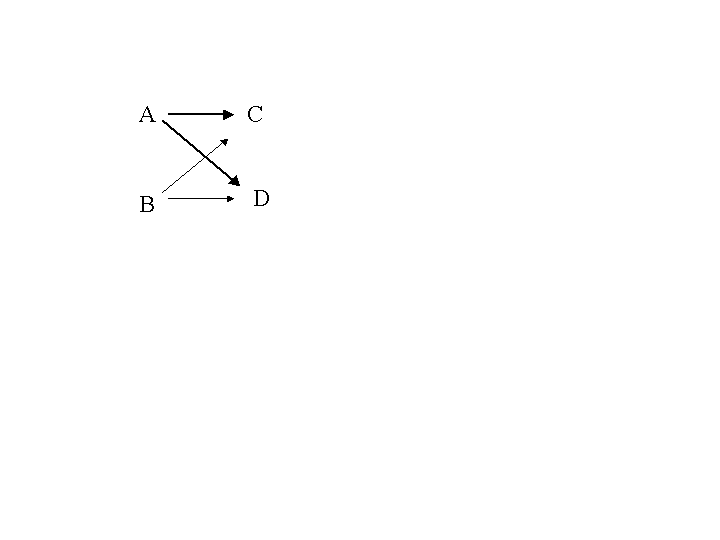
So, in order to get the four combinations of the genes of the two parents, just take the first gene of the first pair with each gene of the second pair, then do the same thing with the second gene of the first pair. The figure below illustrates how to get the combinations of genes of one parent, (A, B), and the genes of another parent, (C, D). The four possible combinations are (A, C), (A, D), (B, C) and (B, D).
""