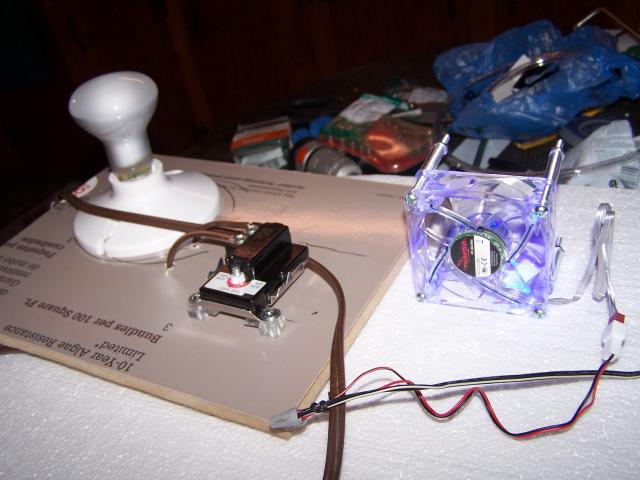
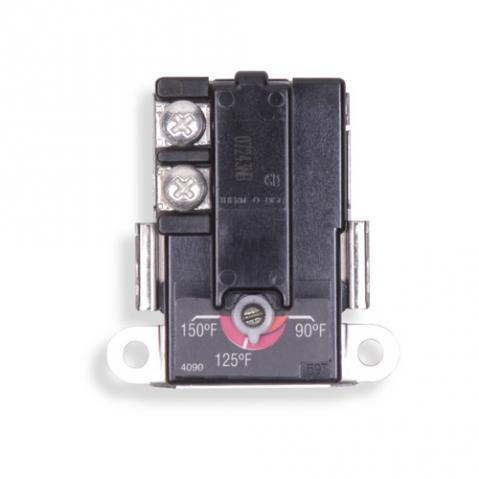
wava1vaughn In this type thermostat*, you have a dial that can be turned with a small screwdriver. It's notched and the service area is marked 90 degrees to 150 degrees. You set the notch in about the 100 degree area. The thermostat comes with directions to wire it to a water heater, but in this case, you will wire one set to the light socket and the other out to your power source. I spliced an old indoor extension cord for my wire and plug. My husband helped with routing the wires the first time. We would plug it into a surge protector outlet strip to test if we had it right. When we didn't, it popped the switch on the strip. When it didn't pop the switch, we adjusted the setting on the thermostst to see if it turned the bulb on and off. We're not exactly highly trained professionals, but it did get it right and we didn't blow anything up, LOL! Once you get it right, when the bulb raises the temp in the bator to what you've set (shooting for 99.5) the thermostat clicks the bulb off. And if it drops, it will turn it back on.
Here are the issues: great as that sounds, the setup isn't as fine tuned as to be 100% useful. Using a light bulb will heat the space quickly, but not maintain the temp. When the bulb is off, temps drop quickly and it takes awhile for the thermostat to register and turn the light back on. Also depending on your "shell" (or box or cooler) it can get hot enough to melt the walls. Another consideration is, unlike bators that have the heat source over the eggs, your light is usually going to be placed on the side, meaning one side stays warmer more constantly, leaving your eggs to heat unevenly.
A fix to consider is two heat sources, a light that stays on that never heats higher than say 95 degrees. For this I've also consider a ceramic heat source for reptiles. Nice, kinda pricey, though. Putting a fan in the opposite corner will help circulate the air. Again, in my case for the 2x2 box, having two fans were helpful. You can design your incubator to open to the front, putting the light on the top side, but then you are starting to put more work into it than a simple basic incubator (my problem! Each solution made it bigger and more complex)
The smaller the area of your box, the easier it will be to maintain a constant temp, so this really is an inexpensive way to go if you just want to hatch a few eggs. Then, if you decide to get totally into hatching, you can invest in a pre-made incubator, or use what you've already made to make a larger one. You might be able to tell in my picture, instead of wiring everything directly in the box, I attached mine to a board to make it removable.
There are other aspects to consider, if you look at the other ones people have made. You might want to put a divider to seperate your heat source from the eggs, or add a wire rack. You can do turners. For a humidity source, I've found spreading the water surface out helps best, instead of using a tall jar, I use wet papertowels on the bottom, and clean mayonnaise jar lids. The microwavable dinner trays are great too. Anything you use in the box, you will want to be waterproof. The humidity will cause mold to grow on wood. That's why styrofoam and plastic is used. I used the caulking wherever my wood came in contact with the inside of the box. But that led to another thing to consider, outgassing. Any product used can cause gases to form in your incubator, killing your eggs. Run it empty for awhile, with it closed and with it opened. Make sure the bulbs you use don't contain Teflon (or PTFE) some flood lights do.
And now, I've rambled on quite awhile! If anyone wants this post moved, let me know. But with the questions being asked, I thought this would be fine here. It just summarizes what I've experienced. There really is a lot of info, ideas, trouble-shooting, guides, etc out there. The is just the culmination of what research I did and my experiences. "Your mileage may vary" etc
edit to add: You don't see it in my pictures, but you will need to put air holes in the walls. That's also discussed on the other sites. You might want to make them closeable or just put several small holes, like you'll find on the styrofoam box type incubators.
*Water Heater Replacement Lower Thermostat
http://www.lowes.com/pd_26359-135-6...rice|0&Ntt=water+heater+thermostst&facetInfo=