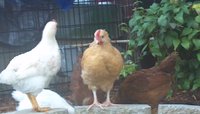
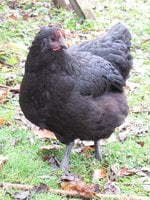
USA APA: Buff, Black, White, BlueSplash in not recognized at this time.Also there are a few other colors of Orpington Projects under way in the USA as of today.
Breed Size
Large Fowl
APA/ABA Class
English
Color
The original breed colours/varieties are black, white, buff, blue and splash
The popular Orpington breed originated from the town of Orpington, Kent, in south-east England, where the original black Orpington was bred by William Cook in 1886. (Mr Cook also created the Orpington duck breed). Mr Cook crossed Minorcas, Langshans and Plymouth Rocks to create a new hybrid breed, from which he selected to breed a black bird, that would also exhibit well, by hiding the dirt and soot of London.
The breed was shown in Madison Square Gardens in 1895 and its popularity soared. Its large size and soft appearance together with its beautiful colours make it very attractive breed and as such its popularity has grown as a show bird rather than a utility breed. Hens are fairly often broody and are good mothers. Although rather heavy, they are able to fly small distances but rarely do so.
The original breed colours/varieties are black, white, buff, blue and splash. Although there are many additional varieties recognised throughout the world, for example the Jubilee Orpington, only the original colours are recognised by the American Standard, the Buff being the most common colour. In the beginning of the twentieth century, Herman Kuhn of Germany developed a Bantam variety of Orpingtons and the Bantam retains the appearance of the LF Orpingtons, but in a smaller size. There is a large variety of colours in the Bantam version, including black, blue laced, white, buff, red, buff black laced, barred, buff Columbian, and birchen.
Orpington hen with chick
Orpington chick
Orpington hen
Orpington juvenile
Orpington rooster
For more about Orpingtons and their breeders's and owners' experiences with them, see our breed discussion here:
My orpington has the softest feathers ever and I love the color of the feathers too, she is big and cuddly. She is VERY hard to catch and hates me and the new chicks I introduced to the flock, though.
We have Buffs too. They are all very friendly. We gave one to our friend, who gave it to his 5 yr old daughter. She carries her around like a pet dog and the hen followers her everywhere. They are a great breed for first time owners, since they are so easy to be around.
I think I know why now... it's the feed I'm giving her. I guess layer feed has some egg laying enhancement qualities that all flock feeder doesn't? Still, I think I'd rather stick with the alternatives because I don't want to go crazy with the antibiotics
I agree, I have 2 buff orpingtons and 2 bantam lavender orpingtons. Out of my entire flock, although extremely bold and inquisitive, (always first at back door) they are vicious and really attack anything they don't like. One has also started to pull all the others feathers out even if they are much bigger than her. Also bites fingers very hard! Seems too much coincidence as I have over 8 different breeds and the four orpingtons are all the same in the size group. Still great characters but I think would be better to keep as a flock of sole Orpingtons.
Subverting their natural flight instincts with mealworms works almost TOO well. I have one (the one and only Kid) who will literally take a running start and go right up my back to sit on my shoulder while I sorted my mealies....So sit on a milk crate, offer something *yummy* and move them into 'come on my lap and get goodies' mode. Takes time and worth it!
I have 5 Buff Orpingtons, 4 pullets and 1 rooster. They are one week old now and growing so fast, I swear you can see them sprouting new feathers. I am hoping they will be more friendly than my other hens.
We had Orphington's last summer and we loved them. Our Orphington hen was the most docile of the flock we had. My kids could catch her and hold her anytime, and we even showed her at the local fair. In fact I got Orphington chicks again this year and look forward to watching them grow.
If you have a Rooster..... roosters will tend to be agressive no matter what the breed.
I have 5 Buff Orpington chicks, 3 weeks old. They are growing a lot of feathers now. Kind of scraggly looking, but cute. I like to sit and watch them. Our grandchildren come over everyday to see how much they have grown. I hope they are all tame enough that the grandkids can hold them. I have 5 hens, 1 RIR, 1BPR, and 3 SLW. Not getting very many eggs due to short daylight hours here in mid-Texas.