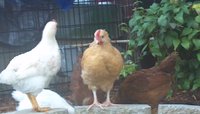
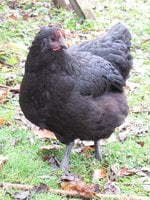
USA APA: Buff, Black, White, BlueSplash in not recognized at this time.Also there are a few other colors of Orpington Projects under way in the USA as of today.
Breed Size
Large Fowl
APA/ABA Class
English
Color
The original breed colours/varieties are black, white, buff, blue and splash
The popular Orpington breed originated from the town of Orpington, Kent, in south-east England, where the original black Orpington was bred by William Cook in 1886. (Mr Cook also created the Orpington duck breed). Mr Cook crossed Minorcas, Langshans and Plymouth Rocks to create a new hybrid breed, from which he selected to breed a black bird, that would also exhibit well, by hiding the dirt and soot of London.
The breed was shown in Madison Square Gardens in 1895 and its popularity soared. Its large size and soft appearance together with its beautiful colours make it very attractive breed and as such its popularity has grown as a show bird rather than a utility breed. Hens are fairly often broody and are good mothers. Although rather heavy, they are able to fly small distances but rarely do so.
The original breed colours/varieties are black, white, buff, blue and splash. Although there are many additional varieties recognised throughout the world, for example the Jubilee Orpington, only the original colours are recognised by the American Standard, the Buff being the most common colour. In the beginning of the twentieth century, Herman Kuhn of Germany developed a Bantam variety of Orpingtons and the Bantam retains the appearance of the LF Orpingtons, but in a smaller size. There is a large variety of colours in the Bantam version, including black, blue laced, white, buff, red, buff black laced, barred, buff Columbian, and birchen.
Orpington hen with chick
Orpington chick
Orpington hen
Orpington juvenile
Orpington rooster
For more about Orpingtons and their breeders's and owners' experiences with them, see our breed discussion here:
My orpington has the softest feathers ever and I love the color of the feathers too, she is big and cuddly. She is VERY hard to catch and hates me and the new chicks I introduced to the flock, though.
I'm glad the Orps are doing OK for some of you. I'm sure most people have breeds they hate and love. Orps are just one of those that I have developed a disliking for. I don't think I will get anymore anytime soon.
I have an average flock size of 40-50 birds. I've only had 3 hens go broody in 3 years. Two of them were Orpingtons. They're not the best layers, for sure...I think I get 3 or 4 eggs a week when they're not broody. I guess it just depends on what your priorities are. I enjoy looking at my fluffy blue Orp girls, and my Orp roo is a gentleman and a good protector. The hens make good mamas & I have plenty of other chickens to pick up the egg laying slack.
And stake, one more thing I'll admit. Writing "I cannot believe these useless overeating fat featherballs are currently the number 1 chicken on BYC." was probably a bit over the top even though that is how I feel about them. So I have removed it. But understand that I wrote that when I had come in frustrated with them. I had spent a fair amount of money on medication to help them orps and save them. Only to find they keep getting ill after they get better. And the rest of the flock does not want to know them either.
I think what some of us are trying to say is that they are, by and large, an enjoyable bird to have for many people. Everyone has their likes & dislikes, and 2 months with a couple of birds may not be enough experience to dismiss an entire breed. We're all people with opinions, I have my own breed biases. I will not EVER have a Rhode Island Red, and the whole batch of Silver Laced Wyandottes I got this year were aggressive, pecked all the other chicks bloody. I gave all 8 of them away. That doesn't mean I won't try again..I'll just try them from a different source next time.
Yes we all have our biases. This review is the opinion I have formed of Orps. Why some people are hating on me for it, I don't know. You may not ever have RIR, but they are one of my personal favourites. Time I did a RIR review I think, a very positive one of course.
Here's the thing - Orpingtons have earned a reputation as one of the best dual-purpose birds available, not just for pets. If I had gotten two that didn't seem to fit this, I'd assume it was because they were from poor quality stock, not the breed.
Love your review and can't wait to show it to my son who has always been telling me they would swim! How adorable! We have two Wyandottes and now have five young Orpingtons--three of which are splashes, one is silver-laced, and one is a mix, I think of the two. We got them as hatching eggs from an Orpington breeder near Orpington, Kent. Four of them have just started crowing so I am looking for homes for them. They are so tame and cuddly, and have such sweet faces.
I forgot to mention the good news about Orpington cockerels: they do not fight, but establish a pecking order so you can keep more than one cockerel. My concern is the crowing as we live in a densely populated small city.
"For those just wanting a pet quality bird, the Orpington might fit the bill"
From reading around the net and BYC on what a lot of people have to say about Orps, that's what Orps are mainly about and why they have such a high rep - pets. For practicality and the pocket there are a number of better DP birds which get overlooked just because they are not as cute and fluffy or make as good pets.
At night, our Orpingtons line up and patiently wait in the cold for us to put them into the hen house with a goodnight cuddle. Our other hens have never done this but just go straight into the hen house to roost. It is true Orpingtons are amazingly sweet pets.
We have 2 BO's from Meyers Hatchery. They are the sweetest and friendliest in our flock. One of them got injured, and we thought we had lost her, but she bounced back with lots of TLC, as our "special needs" girl. She went broody and we gave her some eggs to hatch...She was a star mommy, and is also a lovey lap chicken...but the bottom of the pecking order.