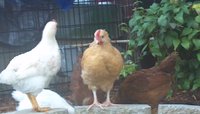
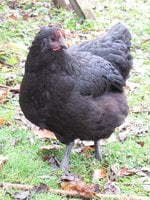
USA APA: Buff, Black, White, BlueSplash in not recognized at this time.Also there are a few other colors of Orpington Projects under way in the USA as of today.
Breed Size
Large Fowl
APA/ABA Class
English
Color
The original breed colours/varieties are black, white, buff, blue and splash
The popular Orpington breed originated from the town of Orpington, Kent, in south-east England, where the original black Orpington was bred by William Cook in 1886. (Mr Cook also created the Orpington duck breed). Mr Cook crossed Minorcas, Langshans and Plymouth Rocks to create a new hybrid breed, from which he selected to breed a black bird, that would also exhibit well, by hiding the dirt and soot of London.
The breed was shown in Madison Square Gardens in 1895 and its popularity soared. Its large size and soft appearance together with its beautiful colours make it very attractive breed and as such its popularity has grown as a show bird rather than a utility breed. Hens are fairly often broody and are good mothers. Although rather heavy, they are able to fly small distances but rarely do so.
The original breed colours/varieties are black, white, buff, blue and splash. Although there are many additional varieties recognised throughout the world, for example the Jubilee Orpington, only the original colours are recognised by the American Standard, the Buff being the most common colour. In the beginning of the twentieth century, Herman Kuhn of Germany developed a Bantam variety of Orpingtons and the Bantam retains the appearance of the LF Orpingtons, but in a smaller size. There is a large variety of colours in the Bantam version, including black, blue laced, white, buff, red, buff black laced, barred, buff Columbian, and birchen.
Orpington hen with chick
Orpington chick
Orpington hen
Orpington juvenile
Orpington rooster
For more about Orpingtons and their breeders's and owners' experiences with them, see our breed discussion here:
My orpington has the softest feathers ever and I love the color of the feathers too, she is big and cuddly. She is VERY hard to catch and hates me and the new chicks I introduced to the flock, though.
So pretty. We saw some of these chickens at a poultry show, and were surprised at how large they were- some seeming the size of medium sized dogs. What's the egg-feed conversion like?
It's hard to tell as I feed her with all the rest. I've only got 7 hens at present so they all feed from the same area at the same time. She's no more aggressive at the dinner dish than the rest of them but I will say that she's a good forager so she's probably getting whatever extra she wants that way. She's in front of the line if I bring them treats, for sure!
Orpingtons are wonderful chickens. I recently purchase some Lavender Orpingtons, and they are about a month old now. They are so friendly and calm. The Orpingtons tend to look larger than they really are due to their fluffy feathering.
I have always heard wonderful things about BO's and my experiences have been the opposite. My buffs also pick on my other birds and none of them have been friendly. Some have been outright mean and have pecked at people and twisted their skin and mine. I have some new pullets from a different breeder and they are flighty and are already picking on the other birds. I have many other birds that are friendly and make great pets so I don't see any reason for it...............
I know, it is crazy. we have a barred rock and everybody said they pick on BOs and other docile birds, but they are the one that get picked on, by the "Docile" chickens
I'm glad I'm not alone. I wish my BO's were like the ones that I read about but it's OK. I never would have found out how great Speckled Sussex really are. The SS are a well kept secret and I highly recommend them to all. Thanks for the post. Good luck and God Bless.
Bless you Brummie,
I have had many orps. Some were wonderful and I would have lots of those. Some colors though were standofishish and down right mean to other hens. I think if you get good stock from someone with gentle hens that lay well you are better off. Please do not be offended by others, we all have a right to our own interpretations of things.
I had two Named Mini and Molly I could tell them apart. But they were free ranging and when they went to the coop a Darned stray cat got into their and killed both of them and two Bantams!
Hi! I agree with most of this review but wanted to add some additional information with regard to this breed's heat tolerance. I live in one of the hottest parts of the country if not the world (West-central Mojave Desert). I have been breeding and raising buffs (as well as Plymouth barred rocks) for about three years now and other than preferring to hang out close to the kiddie pool on hot days, they tolerate extreme temperatures quite well in my opinion IF they are provided plenty of shade and a shallow wading pool to wet their feet on 100+ degree days. I cannot speak to the humidity aspect - relative humidity stays low here nearly year-round (average 7% to 17%). The only effect I have observed when we get an extended heat wave is a moderate drop in egg production (from about 2 eggs every three days per hen to more like an egg every other day). They do pant routinely when heated but that is their normal method of body temp regulation just like a dog.
LOL! Wish I could help you - I actually was looking at the comments figuring people were wondering why you starred so low for what your review said and now I see it's you trying to figure out how to adjust it!
Your birds are beautiful! We are new to chickens this year. We have 11 BO, 6 have turned out to be roos. They are only 12 weeks old but are very big already. They love to free range in our back yard and are the first to snatch up any bugs that get in their way. lol