Light, Buff, Dark, Gold, Black, White, Blue, and Blue Columbian.
Breed Size
Large Fowl
APA/ABA Class
Asiatic
There has been considerable controversy over the true origins of the Brahma breed, but appears to have developed in the US originally, from birds imported from China. They were send off from the port of Shanghai and were thus known as "Shanghai birds". Brahmas as we know them were first exported to England in December 1852, when George Burnham sent nine "Gray Shanghaes" to Queen Victoria as a gift. The Dark Brahma variety was developed by English breeders from this stock and later exported to the United States, where the Brahma was the principal meat bird from the 1850's to around 1930. Some of these birds were very big, with males weighing in at up to 18 lb and females at 13 lb.
The Light and Dark Brahma were developed and included in the first edition of the American Poultry Association's Standard of Perfection in 1874 and the Buff variety was added in 1924. The Australian Poultry Association has accepted black, blue, partridge, crele and barred varieties of Brahma in addition to the standard light, dark, and buff.
Brahma eggs
Brahma chick
Brahma juveniles
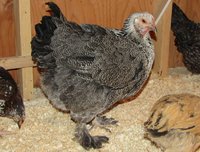
Brahma hen
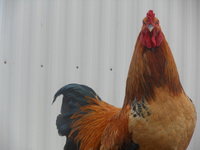
Brahma rooster
For more about Brahmas and their owners' and breeders' experiences with this breed, see our breed discussion here:
Pros: So fluffy!
Cuddly
I love the feather pattern!
Cons: not heat hardy
My brahma is so cuddly and fluffy. I love her so much even though i'm pretty sure she hates me. I'm in New England, and we have cold winters (why I got a brahma) and very hot summers (which i forgot to consider). Also very unpredictable weather. My Light brahma is very big and covered with dense fluff, not great when we got a heat wave this year. However I'm definitely getting more brahmas, I love their massiveness, maybe a buff.
Could but I doubt it. I've heard of too many Brahma crosses to think he'd hurt a hen just by his weight--has more to do with how rough about it he'd be because even little roos can really tear a hen up and make her miserable. Brahmas are big and fluffy, but they're not broad breasted turkeys or anything. Nobody's gonna die (unlike potential BB matings). Brahmas just don't get that much bigger than other standard breeds. I've heard of twenty pound roosters mating with normal standard hens, and nobody getting hurt in the process.
My boys turned horny around 4-5 mos--just a bit before most of the girls started laying. He'll definitely be there before 6mos, but he's not going to be attractive by 6mos. Brahmas take a long time (like Jersey giants) to get as big and fluffy and showable as possibly. Generally takes upward of nine months and can take a couple years, depending on your roo.
Concerning roosters in general, get a sweet one who's easy on the girls and you won't regret having him.
Thanks! You've really been a help! I really love all of the feather-legged breeds in the Asiatic class, so hopefully I'll be able to raise a few Brahmas.
Fly strike occurs when there is an open wound on the bird or feces buildup around the vent. Flys love the warm moist environment and will lay eggs there. Once hatched the maggots will feed on the flesh. It is not uncommon and can be easily missed as the feathers hide problem areas.
I hope you have found him a good home where people won't confuse him with the cat or dog. I'll never understand why people insist on 'holding' or petting chickens...especially cockerels or cock birds. it's just not in their nature to be dominated by anything like that.
People should be happy with such a chicken that keeps his distance and doesn't flog their chins to the bone.
does she have feathers on her feet? I have two pullets that look like yours but have no feathers on their legs. I think mine are delewares. Nice calm chickens
My neighbor has several of these and his whole family loves them. Like all good things, there is a down-side. He's working on a system to have the eggs move out of the nest or at least from under the cloddish feet of these massive birds because co many are getting mashed by the birds, especially the pullets.
I'm going to watch closely how he manages this project because we are getting into quite hefty birds as well and might learn something from his efforts.
I've not had problems with mine getting along with BOs, Australorp, Buckeye, and Egyptian Fayoumi. Actually, the light Brahma roo seems to like the Egyptian Fayoumi more than the Brahmas, LOL.
My neighbor has had horrible luck, though. Her Wyandottes and Dominques are really nasty to her Brahmas.
Used to have 2 brahma's in the past and what is written all over about their character is a fact , very lovely birds yet I'm afraid they are too friendly if in a mixed flock towards the other birds . Lookes as if they were just fine being bullied all the time and they get broody constantly . It was a hard winter and yet they both decided to go broody ?? after they went trough the winter and were broody of , the first sun was enough for them to go broody once again , once stopped they started again a few months later when the temperature outside got up , and they were steady about their choices . Nothing worked to get them broody of so I sold these but going to purchase a few back because it is indeed a very nice bird , can't wait untill next month ( They are already reserved for me ) just very gentle snuggles !