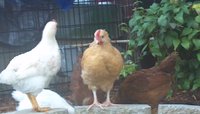
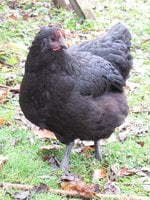
USA APA: Buff, Black, White, BlueSplash in not recognized at this time.Also there are a few other colors of Orpington Projects under way in the USA as of today.
Breed Size
Large Fowl
APA/ABA Class
English
Color
The original breed colours/varieties are black, white, buff, blue and splash
The popular Orpington breed originated from the town of Orpington, Kent, in south-east England, where the original black Orpington was bred by William Cook in 1886. (Mr Cook also created the Orpington duck breed). Mr Cook crossed Minorcas, Langshans and Plymouth Rocks to create a new hybrid breed, from which he selected to breed a black bird, that would also exhibit well, by hiding the dirt and soot of London.
The breed was shown in Madison Square Gardens in 1895 and its popularity soared. Its large size and soft appearance together with its beautiful colours make it very attractive breed and as such its popularity has grown as a show bird rather than a utility breed. Hens are fairly often broody and are good mothers. Although rather heavy, they are able to fly small distances but rarely do so.
The original breed colours/varieties are black, white, buff, blue and splash. Although there are many additional varieties recognised throughout the world, for example the Jubilee Orpington, only the original colours are recognised by the American Standard, the Buff being the most common colour. In the beginning of the twentieth century, Herman Kuhn of Germany developed a Bantam variety of Orpingtons and the Bantam retains the appearance of the LF Orpingtons, but in a smaller size. There is a large variety of colours in the Bantam version, including black, blue laced, white, buff, red, buff black laced, barred, buff Columbian, and birchen.
Orpington hen with chick
Orpington chick
Orpington hen
Orpington juvenile
Orpington rooster
For more about Orpingtons and their breeders's and owners' experiences with them, see our breed discussion here:
My orpington has the softest feathers ever and I love the color of the feathers too, she is big and cuddly. She is VERY hard to catch and hates me and the new chicks I introduced to the flock, though.
Do you have a picture of Penny? or one of Whisper and Penny together, i have two buff Orpington hens they both are really tamed and they let me grab them and hold them, their names are Bertha which is the one in my profile picture and the other one is Alicia, shes a bit more aggressive towards other chickens.
I got 2 buffs and a white rock for Valentine's day from my husband. I named one of my buffs Peep because of the sound she makes. My husband calls her Pete and the other buff re-pete. Now the names have stuck.
I for one appreciate your honesty describing your personal experience. Having had my first choice fail in the incubator, I'm having to start all over researching the remaining choices available to us, and I don't just want to hear the the positives. I'm sure every breed has its flaws, at least in certain circumstances, and if all we ever heard was the best case scenarios ... well, I like to hear both sides of the story every chance I get.
I know this is an old review but I'd like to make q point, even though I have no 'dog' in the discussion. SoManyHats contends that the Orpington has earned the reputation as one of the best dual-purpose breeds available and I must contest that. It is a delightful breed but they have earned the distinction of being the most POPULAR breed on BYC and that's fine but defined qualities and popularity on a given forum might muddle the waters, just a bit. JMHO
I bought four orpingtons about three weeks ago and they are the sweetest little things. They are so funny to watch too. They are so docile, that they'll even perch on my shoulder and lay down!
That is typical of Orpingtons. Lovely birds to keep. I previously had one that would run to me when she sees my and I then had to pick her up and carry her on my hip like a baby. She would go up the roosting slats that I had provided for them but was too scared to jump down in the mornings. I had to go and pick her up and place her on the ground.
Thank you for all your help. How on earth am I going to get some of those eggs into South Africa. By the time it is allowed into the country after quarantine the eggs would be 3 months old. They are beautiful birds. I would have loved to add some of them to my flock.