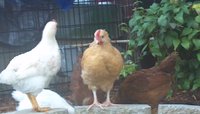
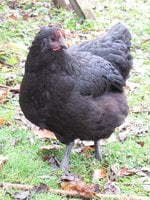
USA APA: Buff, Black, White, BlueSplash in not recognized at this time.Also there are a few other colors of Orpington Projects under way in the USA as of today.
Breed Size
Large Fowl
APA/ABA Class
English
Color
The original breed colours/varieties are black, white, buff, blue and splash
The popular Orpington breed originated from the town of Orpington, Kent, in south-east England, where the original black Orpington was bred by William Cook in 1886. (Mr Cook also created the Orpington duck breed). Mr Cook crossed Minorcas, Langshans and Plymouth Rocks to create a new hybrid breed, from which he selected to breed a black bird, that would also exhibit well, by hiding the dirt and soot of London.
The breed was shown in Madison Square Gardens in 1895 and its popularity soared. Its large size and soft appearance together with its beautiful colours make it very attractive breed and as such its popularity has grown as a show bird rather than a utility breed. Hens are fairly often broody and are good mothers. Although rather heavy, they are able to fly small distances but rarely do so.
The original breed colours/varieties are black, white, buff, blue and splash. Although there are many additional varieties recognised throughout the world, for example the Jubilee Orpington, only the original colours are recognised by the American Standard, the Buff being the most common colour. In the beginning of the twentieth century, Herman Kuhn of Germany developed a Bantam variety of Orpingtons and the Bantam retains the appearance of the LF Orpingtons, but in a smaller size. There is a large variety of colours in the Bantam version, including black, blue laced, white, buff, red, buff black laced, barred, buff Columbian, and birchen.
Orpington hen with chick
Orpington chick
Orpington hen
Orpington juvenile
Orpington rooster
For more about Orpingtons and their breeders's and owners' experiences with them, see our breed discussion here:
My orpington has the softest feathers ever and I love the color of the feathers too, she is big and cuddly. She is VERY hard to catch and hates me and the new chicks I introduced to the flock, though.
I have 4 breeds of hens, EE,Rhode Island Reds, Rocks, and Buff Orph. I have six of them. If they see me, they come running. If I pick up a shovel, they think it is worm time and chase the EE's away. Great layers. One tends to get broody. Two of them will let you scoop them up and snuggle. The rest, not so much liking the touching, but will follow you anywhere if there is a thought of food. The more you handle, cuddle, and treat your birds... the friendlier they are. It is what they get used to.
Our Buff is very friendly! We handled her from day 1 and every day beyond that. She is the favorite in our pen because she isn't flighty, does have a docile, interesting nature, keeps an eye out for danger and has been saved from predators because of that. She does not mind being held! Great for my special needs dd.
I love my Buff Orphington girls! They are so sweet and love to come sit in our laps when we are in the yard with them. They also crack us up as they are the first to hit the sand bath EVERY day. My Orphnigton girls are also most likely to walk up to our dogs and oten ollow them around the yard.
This is my 1st round with chickens, & we ordered 4chicks, (about 5 years ago) since Ive read so much about their docile personalities. We handled them when young, but I think they are the best! If I had to do over again I would do the same!
This is my first time as well. I can't even imagine not picking them up and snuggling them so sweet.
Coop will be built soon n will have the chicks in about 2-3 weeks can't wait
I had to tell my kids to stop putting the pullets on head & such, because, I heard one gal that handled hers so much & they were so friendly,(putting them on shoulders & head) so when they got older, & she walked out of her house they would fly up to her & try to land on her. Kinda looked like she was getting attacked, but not. She also had to warn guest & kids, of the possibilities.
Gynee,
HI! In terms of handling, you want to handle them It allows you check for all kinds of reasons. Knowing how to calm and control them by gently turning them upside down is a good skill. No they should be plopped harshly on their heads daily. You can either handle them regularly so they know you or spend your time chasing them when you do need to do something. Your choice. Our rule is wash your hands before and after holding them. We have not had an issue. Mine have been holding theirs since they were young. At 4 years old, my special needs DD could handle a large hen easily because she knew what to do. Having a small home flock is different than having a large commercial operation. Hopefully you'll be able to learn and enjoy your flock. Buff Orpingtons are a good starting place. Hope this helps you.
HI Karen, You are welcome! We do like ours. They are consistent layers, have a gentle nature, are curious and easily handled. They did weather the cold easily here in MD with temps dropping to 0 for weeks at a time in an unheated but insulated coop. They enjoyed being out in the cold snow to eat and relax. I would readily get another one again from a good breeder!