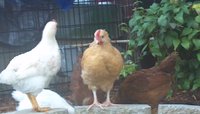
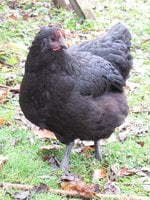
USA APA: Buff, Black, White, BlueSplash in not recognized at this time.Also there are a few other colors of Orpington Projects under way in the USA as of today.
Breed Size
Large Fowl
APA/ABA Class
English
Color
The original breed colours/varieties are black, white, buff, blue and splash
The popular Orpington breed originated from the town of Orpington, Kent, in south-east England, where the original black Orpington was bred by William Cook in 1886. (Mr Cook also created the Orpington duck breed). Mr Cook crossed Minorcas, Langshans and Plymouth Rocks to create a new hybrid breed, from which he selected to breed a black bird, that would also exhibit well, by hiding the dirt and soot of London.
The breed was shown in Madison Square Gardens in 1895 and its popularity soared. Its large size and soft appearance together with its beautiful colours make it very attractive breed and as such its popularity has grown as a show bird rather than a utility breed. Hens are fairly often broody and are good mothers. Although rather heavy, they are able to fly small distances but rarely do so.
The original breed colours/varieties are black, white, buff, blue and splash. Although there are many additional varieties recognised throughout the world, for example the Jubilee Orpington, only the original colours are recognised by the American Standard, the Buff being the most common colour. In the beginning of the twentieth century, Herman Kuhn of Germany developed a Bantam variety of Orpingtons and the Bantam retains the appearance of the LF Orpingtons, but in a smaller size. There is a large variety of colours in the Bantam version, including black, blue laced, white, buff, red, buff black laced, barred, buff Columbian, and birchen.
Orpington hen with chick
Orpington chick
Orpington hen
Orpington juvenile
Orpington rooster
For more about Orpingtons and their breeders's and owners' experiences with them, see our breed discussion here:
My orpington has the softest feathers ever and I love the color of the feathers too, she is big and cuddly. She is VERY hard to catch and hates me and the new chicks I introduced to the flock, though.
I agree I have 4 hens that I got on Good Friday this year and they are so great. I have one named Roxie, she is the "runt" and comes to me as soon as I enter the coop. My other ones, Jenny is the boss, Dixie is my scratcher and I have yet to come up with a name for the fourth one.
Wow, we have DIFFERENT comments xD ! Personally I love orpingtons, real friendly, good layers. RIR tho, mean little brats, would never get them. But ya, good layers but still wouldnt get RIR again
What kind of coop did you have? Are there special tips for coop construction that guard against raccoons? I am sure your coop was secure, but raccoons are very clever and very determined. I know wildlife rehabbers who do a double lining of chicken fencing with at least a six inch gap in between for their baby squirrel cages so that the raccoons can't reach in and grab them.
imbator - don't know what you chose to do abt. nesting boxes, but....
mine have a nesting shelf (w/ ledge to hold nesting material in) and a couple of divided spaces on one end for separate nests. Entire length is 4 feet. Orps usually lay in the shelf area, wyandottes in the individual nests. Orps often cuddle together and lay into the same nest at the same time.
Hello, Sandbellie,
My Buff Orpingtons are my first flock (with 3 leghorns 'thrown in', I was wondering what size of nestbox would be appropriate, since they are going to be bigger birds. Also, which height would you recommend for roosting? Thanks!
Cheryl