Quote:
You're welcome. Well, the first thing is probably obvious and that is anything that is more than just a fault but would DQ the bird from being shown. I started with chicks from one of the top breeders in the country and who had been breeding for a long time. We talked and traded emails prior to my getting the birds so I had some idea of his history and some idea of the problems I was likely to encounter. The eggs I first set were the very eggs from those chicks so I knew, for example, that I might see some feather-legged or perhaps clean-faced chicks show up after my first breeding. But I also knew that I wouldn't be getting any green-legged birds or such.
But to be completely honest, I pretty much went into this blind. Even with a good deal of due diligence there is only so much one can glean from questions. Ergo, the reason for starting with 15 different breeding pens/lines. From there it was the process of elimination. If I got chicks with feather-legs in a particular line, I'd see if any other lines resulted in the same. If so, I could figure out pretty quickly if it was due to the father, mother, or both. Then I eliminated that particular father/mother and, of course, any of the chicks. If the father and mother contributed, then that whole line could be eliminated. As well as other lines unless there was a significant reason to keep it and work on eliminating the fault later on.
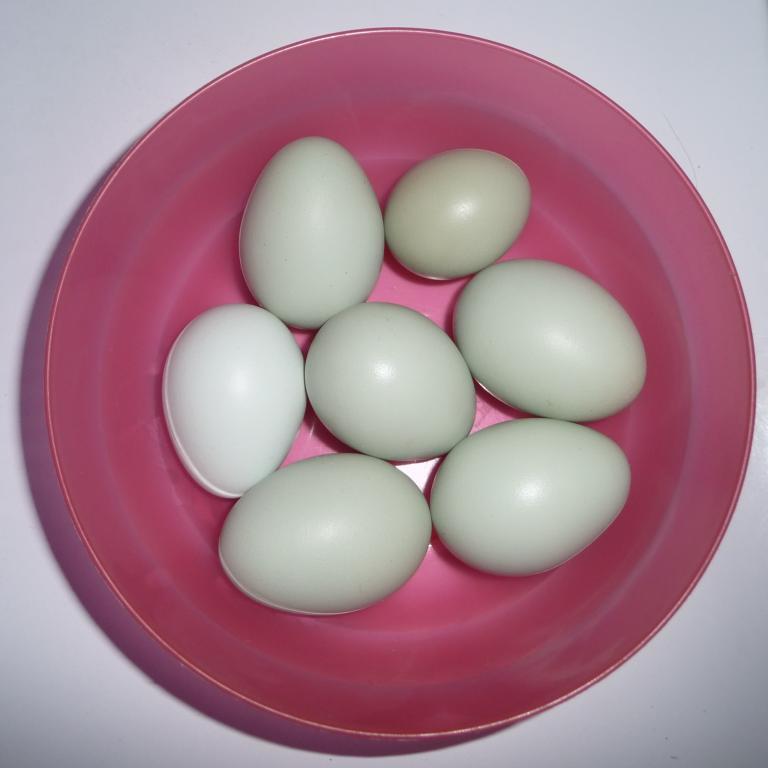
Once the DQ's are eliminated, I looked for major faults. For instance a really bad comb or very poor eye color. I was also concerned early on about egg color. But I ran into a problem with one of my lines - #13 I think - a few years ago where I determined that there was a brown egg gene present. About the same time, I ran into a problem where I'd have birds for over 9 months that wouldn't give me an egg. So I'm like, who cares if I can produce the best looking W/BW Ameraucana anyone has ever seen IF it never lays an egg? So I had to move productivity up on my priorities. I was able to do so while getting rid of the brown gene at the same time. However, that left me with one line that laid a white egg.
After the major faults, I think it's pretty much personal preference. Just pick what appeals to you to work on. For me it was getting rid of all the red/brown out of the males tails and getting more blue/black into the females tails and wings. The red/brown is gone from the males tails but I'm still working on the females and imagine I will be for at least a few more years.
And, since I'm not a geneticist, I don't know what might work together or work against each other, as you said about sheep, but I imagine I will eventually find out. So far I haven't encountered that. When I have a question about those kinds of things, that's when I go to the Old Timers and the experts and just ask. I can't remember so maybe I've said this before but I basically work from: If it works, do it again. If it don't work, don't do it again. I guess I would add... When it doubt - ASK!!
Quote:
Sounds like you are really taking your time getting to linebreeding. As a breeder of other stock, I get the advantages, namely consistency, but you gotta get a bird worth linebreeding first. Sounds like you are probably there, but how did you balancing this?
I agree wholeheartedly, you have to get down to a bird worth linebreeding first. But no, as I said above, I'm not there yet. I'm still using the line breeding method however to get down to where I can actually have two distinct A & B lines and then I will be technically doing pure linebreeding. In other words, rather than flock breeding or yard mating until I get down to the two lines, I'm setting up the individual breeding pens based on the previous years lines and through a process of elimination am gradually but consistently reducing the lines I breed each year into just the two lines. I hope that makes sense and answers your question.
Quote:
What stands out here is that you have multiple lines from a single breeder... Right? Was that by design or because of the limited number of breeders for Wheatens/Blue Wheatens? I know what lines I want in all my breeds from hours of research, but I was leaning towards finding those lines from a couple (meaning no more than 2 or 3) breeders. And let me clarify, mostly I was talking to two breeders that both bought stock from the original breeder, not someone just saying that they have xx line and who knows how many generations ago it was. Although in the Wellies, the original line is most likely more removed given that most breeders refer back to the founding five breeders.
Correct. No, I can't say it was by design. It just happened that way. Unlike many others on here, I never did any breeding and showing of other animals. So I went into this blind and my eyes continually are opened to new and better ways of doing what I need to accomplish what I want to. Also, I would recommend doing a search on here for information regarding "lines" and "strains". I can't remember if it was on this thread or maybe the Welsummer thread but I wrote fairly extensively on that. Time and space does not allow for a repeat here so suffice it for now to say that it is my belief that "lines" are greatly over-exagerrated and tremendously misunderstood. The short of it is that IMO, once an individual has breed the birds they got, the result is their lines. And I think that is especially true after the second or certainly the third breeding.
God Bless,