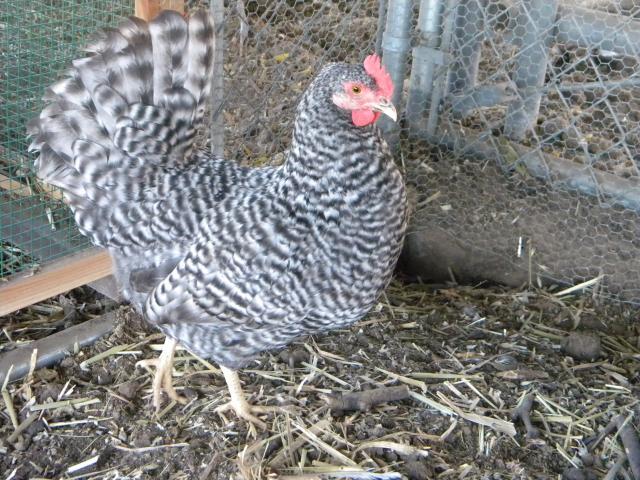
Barred Rock or Cuckoo Marans????

id say shes a maran or a poor quality barred rock. or a mix breed. i had a mix of a barred rock and who knows what that looked exactly like urs. or it could be a california grey. always hard to tell exact breed with barred birds. i had a california grey everyone told me was a barred rock. but she was to small for a barred rock and i bought her as a grey. hopfully someone else has more ideas. u should post more pics of feet, wings, face, and body

my California grey(lays white eggs)
103601_dscn9855.jpg
 
Last edited:
It's a hatchery quality Cuckoo Marans. They're bred for egg production, not for color (which is what breeders focus on).
 
Thanks everyone. I really wanted a BR, but I seriously think she is HQ marans... Her feet have no yellow at all, that was my main clue. Like I said, I noticed as she was growing that she didn't look like my previous BR, and she is much bigger.
 
I have a cuckoo marans from Meyer hatchery as well as 3 barred rocks from same last spring's hatch. My cuckoo has white legs and more dull barring, and her eggs are not much darker than the BR's.
 
cuckoo marans. They have whitish legs, sometimes with a grey/silver wash over them. Also, the eggs start out dark and get lighter as the hen gets older, not the other way around.
 
we have fbcm their eggs started out just as light and have gotten darker but since they arent laying as much anymore they have gotten lighter. next year when they turn 1 their eggs should get darker. (info from breeders of marans)
 
Quote:
This is what I have read and found to be my experience with dark egg layers with my marans. However, it seems like there are variations to everything. I'd love to get darker eggs with my older girls!
From the University of FL
As the brown egg-type bird ages, there is a corresponding decrease in eggshell pigment intensity. The exact reason for this is unknown. It is possibly due to the same quantity of pigment being dispersed over a larger surface area of shell as egg size increases with bird age or less pigment synthesis. As the hen ages it is normal for the tapered end of the egg to contain less pigment than the rounded end. Stress-related egg retention in the shell gland and subsequent amorphous calcium carbonate deposition on the shell surface have been identified as a major cause of pale eggs in older hens.
 

New posts New threads Active threads

Back
Top Bottom