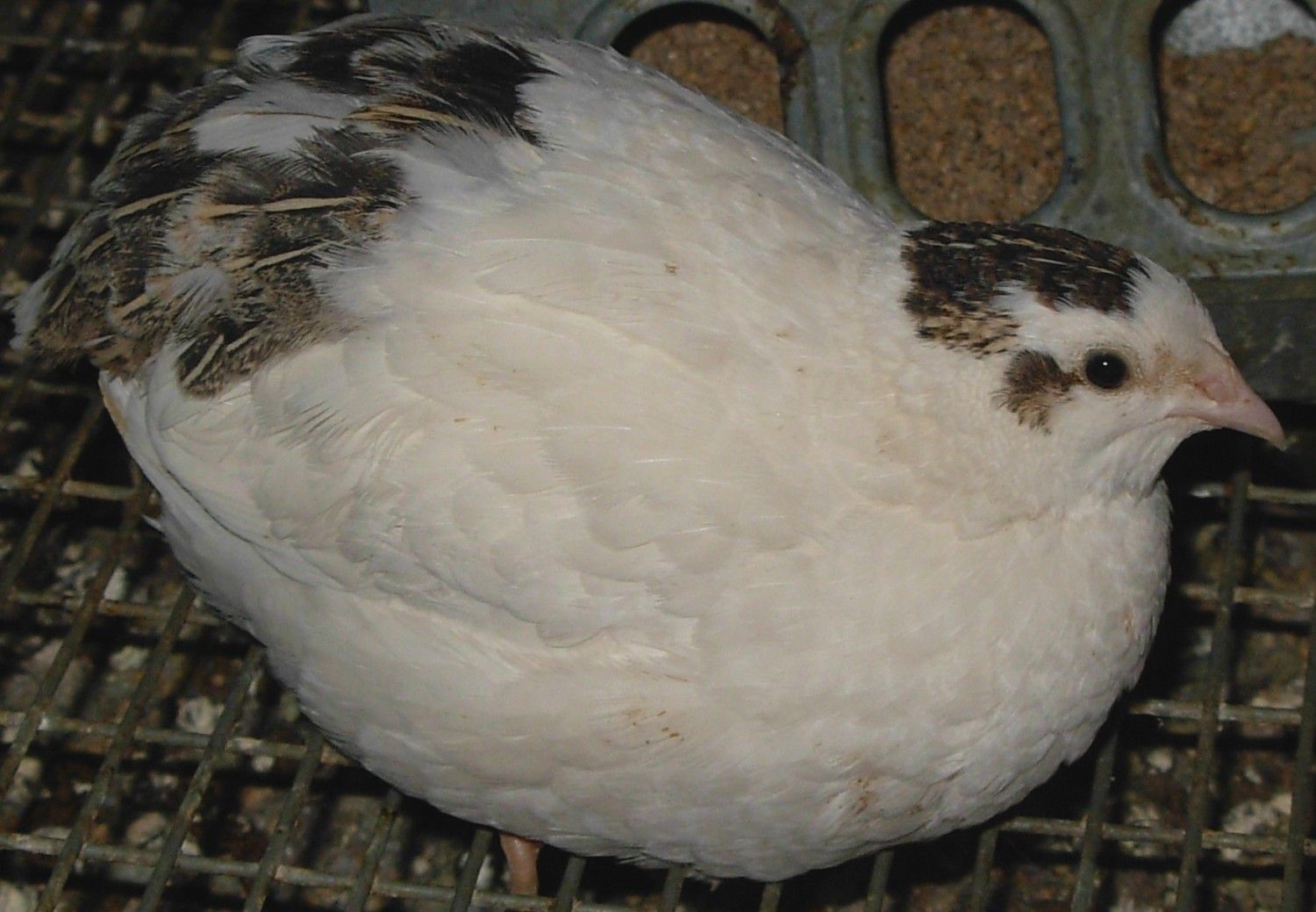
It also depends on what the bird carries as well. Coturnix carry many genes that the calculator is not accurate. That's why a white pops out of wilds after 5 generations. Epigenes too play a role. We would need the parents and their blue prints in order to figure out how to make the tuxedo pattern definitive.
LOL you guys are so far ahead of me... I was at an auction tonight and picked up 3 of these:
This is what we've always referred to as a bird with 2 copies of pied, vs the tuxedo which we say has 1 copy of pied. (Ignore that it has wild type plumage, its been Tibetan spots too lol).
Genetically speaking, none of my bachelors could have 2 copies of the pied gene as only one parent had it, all of the hens were solid. not mostly sold, but totally solid.
I believe i got 3 girls of this wild type panda (double pied). I can test breed them to solid jumbo browns, if i get 100% tuxes(in one form or another), i suppose it will be safe to say they are double pied and tuxes result from single pied...
So my question is this, how long does it take for any previous matings to clear out before any hatchlings will be true?
#1 imho, I think the reason whites pop up in brown pens is because the breeder is using splits in their pens... which can look brown but carry recessive white, when 2 of these splits meet up split roo x split hen, there is a 25% chance of white offspring, breeders should be testing their browns against white birds, if a brown bird crossed with a white bird produces whites then the original brown bird is a "split" bird carrying one copy of the recessive white gene (but is still visually brown). I know this because I crossed my browns with my whites and back to each other and I breed white split birds.
#2 "So my question is this, how long does it take for any previous matings to clear out before any hatchlings will be true?"- I learned a neat trick from someone, you take the amount of days in the incubation period of the species, 17 days for quail, that hen can be fertile with a roo after mating for ~17 days. Chickens ~21 days, ducks, turkeys, etc., also... split those times in in half, ~8 days for Quail, that is how long the egg is at peak hatchability, after that it decreases, same with chickens, etc. just a general rule of thumb...
Birds can contain the sperm for up to a month at times so I would give at least 2 weeks before incubating a new project to get maximum results.
The fun thing about coturnix is that they are so fast reproducing, we get so many neat color combos so we can test theories out. My lab is full of neat projects. I do have some split white to brown birds so I know which carry what in my pens but coturnix are so jumbled in genetics at times, Most colors do breed true over 5-6 generations. Can test cross to see what they carry as well. Breeders do this all the time, even to create new colors.
LOL you guys are so far ahead of me... I was at an auction tonight and picked up 3 of these:
This is what we've always referred to as a bird with 2 copies of pied, vs the tuxedo which we say has 1 copy of pied. (Ignore that it has wild type plumage, its been Tibetan spots too lol). I agree
Genetically speaking, none of my bachelors could have 2 copies of the pied gene as only one parent had it, all of the hens were solid. not mostly sold, but totally solid.- good to know and I agree with the math
I believe i got 3 girls of this wild type panda (double pied). I can test breed them to solid jumbo browns, if i get 100% tuxes(in one form or another), i suppose it will be safe to say they are double pied and tuxes result from single pied... wait a second... we need to do some math first down below.
solid jumbo browns, which we know are pure wildtype and not white splits right?
so, Wh+Wh+ Br+Br+yw+yw+e+e+pi+pi+
crossed with a recessive white (wildtype) double pied bird? leaving out the chance for any change at the yellow and red genes = wh wh Br+Br+yw+yw+e+e+PiPi
when we cross Wh+Wh+ with wh wh on the white gene, you end up with all Wh+wh which are going to be visually wildtype birds with a recessive white allele, ya follow?
move to the next Br+Br+ x Br+Br+ all birds are Br+Br+ right?
next color gene, what are the 2 alleles at the yellow loci? all will be yw+yw+ wildtype
red loci e+e+ x e+e+ all birds will be wildtype- remember we are dismissing the tibetan spots... but we could do that math too...
last gene associated with color and how it is displayed is the pied gene, and I think Syble and I both are saying the same thing, single pied gene Pi instead of pi+ at one of the alleles produces tuxes, 2 of them, produces double-pied birds "pandas", now what color displays in that double pied "layer" is another math formula altogether.
so, what will the offspring look like, of the cross double pied recessive white to solid brown, well if all the birds are Wh+wh they are going to look wildtype but they are going to carry 1 copy of the pied gene, with no other colors but "wildtype" to be displayed, but they can pass that recessive white and the pied gene to their offspring down the road a few generations until 2 birds meet up that both pass a recessive white and a pied gene to their offspring and bam, double pied white bird again.
I don't think the white gene plays in there.I could be wrong, but my understanding is that there is 2 ways to get white birds.
recessive white, where your splits come in, they need 2 copies to look white, 1 copy makes them look normal but they carry
the other way(at least mostly white) is pied. but again the way it was explained to me is that the pied gene needs nothing to do with the white gene to be able to express. and its that independence that allows a typical look to express (white under side/colored topside approximately).
So far in all my browns (or any other pens i have) there are no whites. So theoretically there is not a single recessive white bird in my flock. When i talked to the guy last night (genetics are even further over his head then they are mine lol) he told me of these panda type birds showing up when he bred them together, but nothing about white birds showing up from brown breedings etc. (he was hoping for a solid white bird, or mostly solid white), So I would be very skeptical about his flock containing recessive white either?
lol good, I don't want to have to worry about another gene to watch before i have this batch figured out lol.
So have i got it figured out generally then? tux is a specific visual expression of a single pied gene and panda is a specific visual expression of a double pied bird, solids by default have no pied. My generalized statement is not taking in to effect the countless little modifiers that are probably linked to them just the general rule of thumb here.