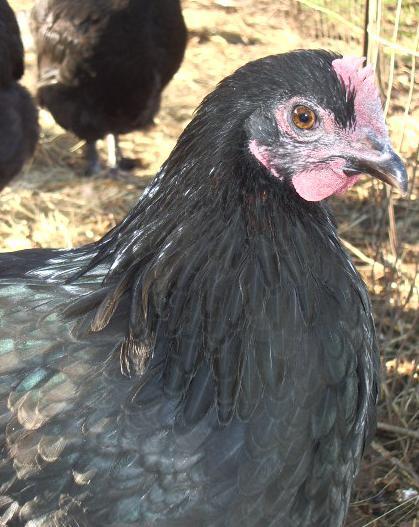
Marans Thread - breed discussion & pictures are welcome!

It's a little shriveled up quick, like what's inside those those funny lobster legs.
It should dry out in a couple of days, just watch it, as it could bleed.
 
Quote:
No my oil has been checked, I'm ok............
wink.png


O.K....I gotta ask...Where did they put their "dipstick"?
ep.gif


Lol, that you have to ask the wife, I may have said to much already..........
 
old.gif
About spur removal....

Take a pair of pliers, get a good grip on your own fingernail, and rip it completely off.
ep.gif
Why not? This is what you are talking about doing to your chickens!
barnie.gif
I find it hard to believe that anyone would actually entertain the thought of doing this to a bird that did not require it for medical reasons (i.e. caught in a fence and partially ripped a spur off).
 
Quote:
do you know if they will regrow the spurs if the spur is taken off- we have 1 boy that got his spur caught in the fence and we ended up having to take it off completely- didn't bleed much at all and we wrapped it with vet wrap to keep it clean.

They continue to grow, very much like our fingernails.

Walt

that's good to know as this boy is one that my DD(12) uses for showing at fair for 4-H. Guess we will just wait and see, we did keep his son as a back up, but the son gives my DD crap!
 
Quote:
They continue to grow, very much like our fingernails.

Walt

that's good to know as this boy is one that my DD(12) uses for showing at fair for 4-H. Guess we will just wait and see, we did keep his son as a back up, but the son gives my DD crap!
 
Quote:
Mel, It's not something I would do just for cosmetics' sake, or even for my sake. I think, especially if they are breeding hens and free ranging, there is more danger to the hens and the roos with the really long spurs. Those spurs could literally slice a hen open while breeding! I would also think that if they got hung up by a spur while out in the yard, it would make them more apt to get attacked by a predator that sees them in a vunerable position. Then the roo would have to yank it off himself, if he could, which is not in a controlled setting, and he could bleed to death. So far, none of mine are to that point yet, but I'd like to be prepared in case they get that way. JMO
 
No, they are similar to antlers...I have had them pop off on their own, it's just kinda nasty on the inside.
I prefer to cut the tips off, and file it smooth.
 
Quote:
Mel, It's not something I would do just for cosmetics' sake, or even for my sake. I think, especially if they are breeding hens and free ranging, there is more danger to the hens and the roos with the really long spurs. Those spurs could literally slice a hen open while breeding! I would also think that if they got hung up by a spur while out in the yard, it would make them more apt to get attacked by a predator that sees them in a vunerable position. Then the roo would have to yank it off himself, if he could, which is not in a controlled setting, and he could bleed to death. So far, none of mine are to that point yet, but I'd like to be prepared in case they get that way. JMO

Personally, I have never had a bird that sustained an injury from a spur although I have been seriously gouged by a RIR Roo more than once!
somad.gif
somad.gif

I have, however, lost several fingernails and toenails and I know how bad that hurted!
hit.gif

As a kid I took part in all the de-horning of cattle and I'm sure that lopping off those horns really must hurt.
hit.gif
I guess that in my advancing age I look at these things more from the animals point of view. I don't crop my dogs' ears but I will dock their tails within a day or 2 of birth. I just don't like the thought of hurting my animals.
hugs.gif
They depend on me for food, water, and care.

hugs.gif
 
Quote:
The copper leaking through is just that....copper leaking through. In a way you could say that he is over melanized. I think we spoke about him before and that fact that he has copper in his genetics so this copper can and most likely will sneak out on him and his offspring. The over melanization comes into play because the melanizers will try to cover the copper or mask it, but it really is still there. Sometimes the melanizers will just make it very dark and in the case of blue bird the hackle or where ever the bird is suppose to be copper will most likely be very very dark blue...on black birds it just looks black...other times the melanizers may not be enough and they allow the color to leak. On lighter colored blue birds the color usually comes through and just expresses as sort of a dirty look. Did any of that make sense or did I just confuse you?

This is a photo of a young Black Copper pullet that is WAY over melanized and very dark........look closely and you will see fine hints of very very dark copper sort of lacing the outer edge of her hackle feathers.
https://www.backyardchickens.com/forum/uploads/11170_gff_pullet_hackles.jpg

edited to add this photo...this is the same bird as above but just as the sun came around and lit up her hackles. I thought it would be cool to see both photos. She is still just as dark as she appears in the first photo and she is now 1.5 years old.
https://www.backyardchickens.com/forum/uploads/11170_imgp0040.jpg


This is a darker blue, Blue Copper hen that is over melanized.
https://www.backyardchickens.com/fo..._original_davis_hens_clean_legged_1252011.jpg

Yes this is the same bird..I only have this one cockerel so it is all I talk about.
lol.png

Alright...so if I used this bird for breeding and was not looking to hatch for solid blue necessarily I need a hen who has lots of copper right? Or should I not really use him? I am planning on an olive egger pen. Should he be the olive egger daddy? lol

I am super stoked that Stephanie from Chestnut Ridge farm is going to send me marans chicks!!! (Finally chicks instead of a dozen scrambled eggs in my incubator with me hoping and hoping for even one hatch.) So I might have other marans stud muffins to choose from in the future.
 
Quote:
I'll take your word for it....
hugs.gif

Antlers are the same as bone, once they no loger have blood flowing through them. Antlers are attached to the skull pedicule by a testosterone cement. After breeding has been completed and the bucks' hormone levels return to normal, the testosterone cement releases and the antlers drop off.
Antelope are weird, and I wish someone could explain them to me. They have an outer sleeve of horn, much like cattle, but they shed it every year, so I am told. Do people pick up these shed outer sleeves like they do shed deer & elk antlers?
idunno.gif
 

New posts New threads Active threads

Back
Top Bottom